


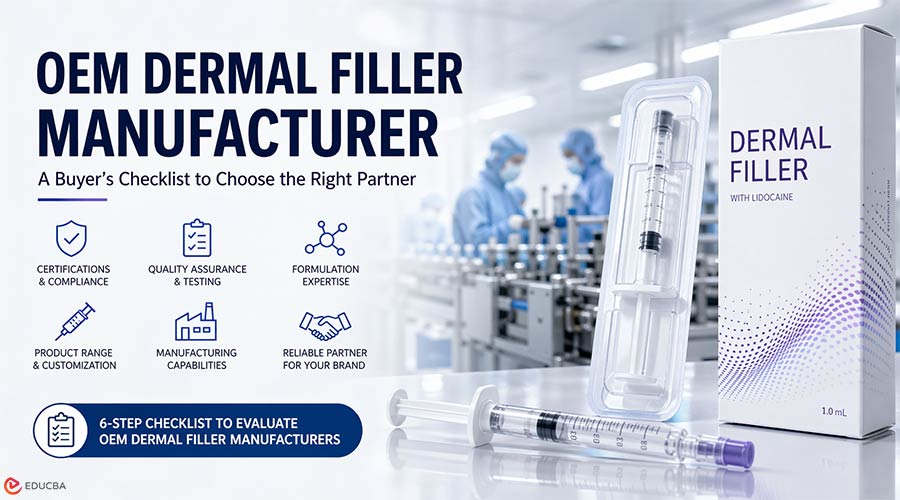
Search for an OEM filler manufacturer, and you get two completely different supplier categories on the same results page. One group builds industrial filling equipment, including piston fillers, auger systems, peristaltic machines, and rotary lines. The other group makes the filler product, prepares it, sterilizes it, and packs it under your brand name. Buyers often make sourcing mistakes before sending the first email by conflating the two categories and chasing the wrong quotes. This guide focuses exclusively on the product side of that equation: private-label injectable aesthetic OEM manufacturing and how to properly evaluate an OEM dermal filler manufacturer.
By the end, you will have a clear criteria framework and a six-step checklist to vet any supplier you are considering. We will also reference Aowita Biotech (Rveiling®) throughout as a concrete benchmark, a manufacturer with over 23 years in hyaluronic acid R&D and more than 580 branded clients across global markets, according to the company. That is what a credible, long-standing OEM partner looks like in practice.
Machine OEM vs. Private-Label Product OEM
Industrial filling machine OEMs build production equipment. This includes piston fillers for precise pharmaceutical dosing, auger fillers for powders with tight accuracy control, rotary systems for high-volume production, and volumetric machines that maintain consistent fill levels. These companies sell capital equipment to production engineers who are setting up manufacturing lines, not finished products. In contrast, an OEM filler manufacturer in medical aesthetics produces the finished injectable product. They make the product, fill it into pre-sterilized syringes, sterilize or process it safely, and package it under your brand. This includes choices like HA level, cross-linking method, lidocaine amount, syringe type, and needle details.
The key difference is simple:
- Machine OEMs provide equipment to make products
- OEMs provide the finished, branded product.
Confusing the two can lead to wrong pricing comparisons, compliance issues, and wasted sourcing efforts. If your goal is to launch an aesthetic brand, you should only evaluate certified OEM dermal filler manufacturers.
How to Vet an OEM Dermal Filler Manufacturer?
Evaluating an OEM dermal filler manufacturer requires more than comparing pricing or product portfolios. Because injectable aesthetics are highly regulated, your first filter should always be quality systems, regulatory approvals, and documentation readiness. A supplier that cannot meet these standards should not move to the next stage in your sourcing process.
1. Core Quality System Requirements (Non-Negotiable)
For any credible OEM dermal filler manufacturer, the following systems form the baseline:
GMP (Good Manufacturing Practice)
GMP ensures proper control over:
- Cleanroom and facility hygiene standards
- Batch-level production documentation
- Personnel training and qualification
- Process validation and consistency controls.
However, GMP requirements may differ slightly depending on regional regulatory frameworks.
ISO 13485 (Medical Device Quality Management System)
ISO 13485 goes beyond GMP and is essential for any legitimate OEM dermal filler manufacturer. It covers:
- Design and development controls
- Supplier qualification systems
- Product traceability across batches
- Corrective and preventive action (CAPA) processes.
A manufacturer without both GMP and ISO 13485 certification should be excluded from consideration immediately, regardless of pricing or MOQ advantages.
2. Market-Specific Regulatory Compliance
Regulatory approval depends on your target geography. A qualified OEM dermal filler manufacturer must clearly specify where its products are legally registered.
European Union (EU)
- CE Marking under Medical Device Regulation (MDR 2017/745)
- Regulatory authorities typically classify dermal fillers as Class III medical devices
- ISO 13485 is a prerequisite for CE certification via a notified body.
United States (US)
- FDA clearance via 510(k) or PMA (Premarket Approval)
- Compliance with 21 CFR Part 820 (Quality System Regulation)
- Note: CE marking is not valid for entry into the US market.
Always confirm whether the OEM dermal filler manufacturer holds approvals for your specific target region and request official documentation, not verbal confirmation.
3. Essential Technical and Safety Documentation
Beyond certifications, a serious OEM dermal filler manufacturer must provide complete product-level documentation. These are not optional; they are part of the qualification.
Request the following:
- Biocompatibility Reports (USP Class VI / ISO 10993): Confirms the product is safe for human use.
- Container Closure Integrity Testing (CCIT): Ensures syringes and packaging remain sterile and leak-proof.
- Sterility Test Reports: Verifies the product is free from microbial contamination (from accredited labs).
- Endotoxin Test Results: Confirms safety by checking for harmful bacterial toxins.
- Batch-Level Certificate of Analysis (COA): Provides full traceability and quality validation for each production batch.
A manufacturer that delays, avoids, or partially provides these documents is signaling weak quality governance.
4. Quality Culture vs. Paper Compliance
Certificates alone are not enough. A reliable OEM dermal filler manufacturer should demonstrate:
- Fast and transparent document sharing
- Full traceability systems across production batches
- Willingness to support audits or inspections.
- Consistency between documentation and actual production capability.
If documents are incomplete or hard to get, it often shows bigger problems in quality control.
5. Key Buyer Mindset
In injectable aesthetics, regulatory and quality checks are not just paperwork; they are risk filters.
A strong OEM dermal filler manufacturer should be able to:
- Prove compliance instantly
- Align with your target market regulations
- Provide complete technical transparency without resistance.
If any of these elements are missing, the supplier should not proceed to your shortlist.
Real Manufacturer vs. Repackager
A repackager buys a finished product and applies your brand label. They do not control the formulation, so they rebrand standard stock products instead of developing or customizing the formula.
A real OEM manufacturer is different. They control the full formulation process, including:
- Cross-linking chemistry
- HA molecular weight selection
- Gel cohesivity and texture
- Lidocaine concentration
- Syringe fill volume.
A key way to identify them is to ask directly whether they formulate the product in-house or source finished gel from another supplier. The answer quickly reveals whether they are a true manufacturer or just a rebrander. Aowita Biotech sets a strong example of deep OEM/ODM capability. With 23 years of hyaluronic acid R&D, a broad patent portfolio, and large-scale production capabilities, it covers a full range of injectable aesthetic products, including HA fillers (mono and biphasic), CaHA fillers, PLLA-PEG collagen stimulators, mesotherapy solutions, and hair regrowth serums. This kind of setup shows what a fully integrated manufacturer can offer in terms of R&D and product range.
The difference between stock private-label SKUs and custom formulations depends on business stage:
- Stock SKUs: lower minimum order quantities, faster turnaround (around 30–35 days), but limited customization
- Custom formulations: higher commitment and longer development time, but full control over product design, positioning, and differentiation.
The right choice depends on whether you prioritize speed to market or long-term product differentiation.
MOQ, Pricing, and Lead Times for OEM Dermal Filler Manufacturers
Injectable products typically have higher MOQs than cosmetics because sterile manufacturing must be performed in validated batch sizes to remain cost-effective. For most standard private-label programs with basic logo customization, reputable OEM manufacturers often set MOQs around 5,000+ units. If you need custom packaging, syringe design, or needle specifications, MOQs usually increase to 10,000–20,000 units or more. Some suppliers offer smaller “sample” runs, but these should be checked carefully for compliance and production quality, since true sterile manufacturing is not always viable at very low batch sizes.
Typical Lead Times
OEM dermal filler timelines usually follow a predictable structure:
- Artwork and packaging approval: 5–7 days
- Production cycle: 25–30 days (for custom batches)
- Shipping:
- Sea freight to U.S. West Coast: 18–22 days
- Sea freight to East Coast: 28–35 days
- Air freight: 10–14 days total after dispatch (higher cost).
Overall, most projects take about 35–50 days from concept to delivery. Planning is essential because custom production does not easily accommodate last-minute changes.
Pricing Overview
Per-unit pricing depends heavily on formulation, packaging, and order volume. As a general benchmark for mid-volume runs (10,000–50,000 units), prices typically range from US$9 to US$ 30 per unit. More complex formulations or premium packaging can push costs higher, while simpler stock SKUs sit at the lower end. Manufacturers usually charge one-time costs for tooling, logo setup, and syringe customization, and they amortize these expenses across production volume. A key warning sign is pricing that is significantly below market norms (e.g., 30–40% below that of established manufacturers). This often indicates compromises in raw material quality, sterility controls, or documentation, which ultimately affect regulatory safety and brand reputation.
Quality Control and Factory Vetting
GMP-grade injectable manufacturing requires strict standards. At a minimum, production should take place in ISO Class 7 (Class 10,000) cleanrooms for filling operations, supported by validated sterilization processes, real-time environmental monitoring, and full batch release documentation. These expectations align with ISO 14644 cleanroom standards and aseptic processing regulations. Never treat these requirements as marketing claims. Always verify them through official documentation or confirm them during a physical factory audit.
Key Documents to Request Before Engaging a Supplier
- Valid ISO 13485 and GMP certificates (with expiry dates clearly shown)
- Recent third-party audit reports
- Sample Certificates of Analysis (COA) with full batch traceability
- CE technical files or equivalent product registration dossiers
How quickly and transparently a supplier provides these documents is itself a strong indicator of quality culture. Established manufacturers usually respond clearly and confidently, while unclear or delayed responses often signal weak compliance systems.
Red Flags to Watch for
- Missing or unverifiable certifications
- No real client references or traceable case studies
- Pressure to proceed without an NDA or quality agreement
- Pricing far below established market norms
- Avoidance of technical questions about formulation or sterile processes.
A single warning sign deserves closer scrutiny. Multiple red flags usually indicate it is safer to move on to another supplier.
A 6-Step Checklist to Shortlist and Qualify OEM Manufacturers
This framework helps you systematically evaluate OEM filler manufacturers and avoid unreliable suppliers.
Step 1: Verify Certifications
Confirm that GMP and ISO 13485 certificates are valid, current, and issued by recognized bodies. Cross-check certificate numbers independently where possible. Also, confirm market coverage. EU certification does not automatically mean U.S. compliance.
Step 2: Evaluate Formulation Capability
Ask whether the formulation is done in-house. Request a detailed product catalog including:
- HA concentration ranges
- Cross-linking agents used
- Gel viscosity options
- Lidocaine availability.
Strong manufacturers answer these questions clearly and in detail.
Step 3: Check Regulatory Documentation
Request market-specific proof:
- EU: CE technical file and MDR declaration of conformity
- S.: FDA-related correspondence, 510(k) numbers (if applicable), or import compliance documentation.
Do not accept general statements like “fully certified”; ask for actual documents.
Step 4: Assess Commercial Fit
Confirm:
- MOQ requirements
- Pricing tiers
- Lead times
- Setup/tooling fees.
Also ask how pricing changes at higher volumes (e.g., 2× scale). This shows whether the supplier can support long-term growth.
Step 5: Order Paid Samples
A paid sample order is essential. Evaluate:
- Fill consistency
- Syringe and packaging quality
- Needle performance
- Batch documentation accuracy.
This reflects real production quality under normal conditions.
Step 6: Validate References or Audit the Factory
Request at least two verified client references and contact them directly. If order size justifies it, conduct a remote or on-site audit. Hesitation or refusal to provide references or audits is a major warning sign.
How to use this Checklist?
Run this process across 2–3 shortlisted manufacturers simultaneously, not one after another. This speeds up sourcing and gives you better bargaining power. A supplier that goes through all six steps smoothly and clearly is usually a good choice for a long-term partnership.
Choosing the Right OEM Partner is a Filtering Problem
Choosing the right OEM partner is mainly about filtering the right capabilities early. Many buyers make the mistake of confusing OEMs of filling machines with true product manufacturers. This often leads to wasted time and hidden risks. Others skip certification checks or focus solely on low pricing, which can later lead to regulatory and quality problems.
A reliable OEM filler manufacturer should be evaluated on three key factors:
- What they can actually formulate in-house
- What documentation and certifications can they provide
- Whether their pricing and terms match your production scale.
A good benchmark is Aowita Biotech. With over 23 years of hyaluronic acid R&D, 28+ patents, and a broad portfolio including HA fillers, CaHA, PLLA-PEG collagen stimulators, mesotherapy products, and hair regrowth serums, it represents a high level of manufacturing depth that many suppliers cannot match. Comparing other suppliers against this kind of capability helps you ask more precise questions. Use a simple six-step checklist during supplier talks and note where answers are unclear, late, or incomplete. Those gaps usually reveal the real limitations.
Recommended Articles
We hope this guide on OEM dermal filler manufacturers helps you understand how to effectively evaluate suppliers, verify compliance, and identify genuine manufacturing capability in the aesthetic industry. Explore the recommended articles below to learn more about medical aesthetics, regulatory standards, and global cosmetic manufacturing trends.

