
What is the Merton Model?
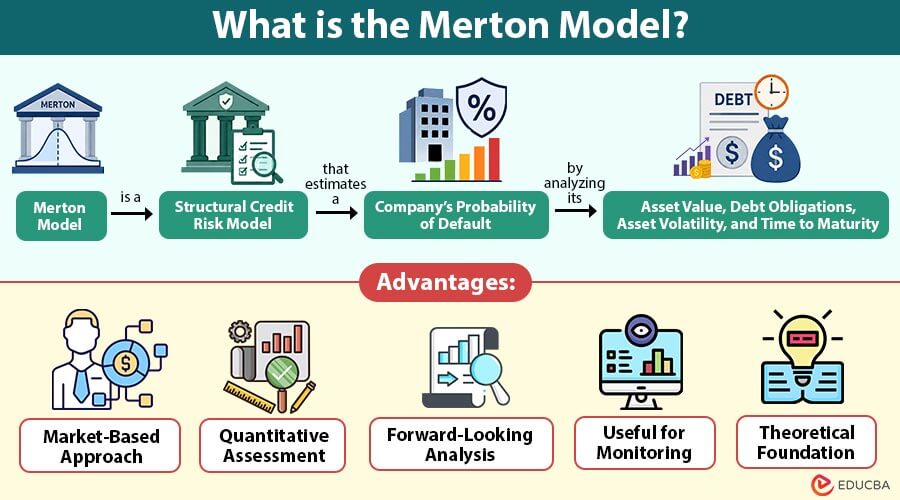
The Merton Model is a structural credit risk model that estimates a company’s probability of default by analyzing its asset value, debt obligations, asset volatility, and time to maturity.
Developed by Robert C. Merton in 1974, the model is based on the idea that a company’s equity can be viewed as a call option on its assets. If the company’s asset value exceeds its debt obligations at maturity, shareholders can repay the debt and retain the remaining value. However, if the asset value falls below the debt amount, the company may default.
Table of Contents:
Key Takeaways:
- The Merton Model estimates corporate default probability using asset value, debt, volatility, interest rates, and maturity.
- It treats company equity as a call option on assets, linking equity markets with credit risk.
- The model provides forward-looking insights that help lenders and investors monitor changing corporate credit risk.
- Its simplified assumptions mean institutions should combine Merton Model results with broader credit risk analysis.
Why is the Merton Model Important?
The Merton Model is important because it provides a market-oriented approach to credit risk assessment.
Traditional credit analysis may rely heavily on financial statements, credit ratings, and historical financial information. The Merton Model can incorporate information from the company’s stock price and market volatility, allowing credit risk to be assessed using market data.
It can help financial institutions and investors:
1. Estimate Probability of Default
The model estimates the likelihood that a company will fail to meet its debt obligations.
2. Monitor Changes in Credit Risk
It helps track changes in credit risk by analyzing movements in market-based financial indicators.
3. Analyze Corporate Borrowers
Financial institutions can use the model to evaluate the creditworthiness and financial stability of corporate borrowers.
4. Evaluate Debt Securities
Investors can assess the default risk associated with corporate bonds and other debt securities.
5. Support Credit Risk Management
The model provides market-based insights that help institutions identify, measure, and manage corporate credit risks.
6. Compare Relative Company Risk
It enables investors and lenders to compare the relative default risk of different companies.
7. Develop Early-Warning Indicators
Changes in estimated default risk can provide early signals of deteriorating corporate financial conditions.
How Does the Merton Model Work?
The Merton Model assumes that a company has two primary financial claims:
- Equity: Owned by shareholders.
- Debt: Represents obligations owed to lenders and creditors.
The model assumes that the company’s assets follow a stochastic process, meaning their value can change over time. At the maturity of the company’s debt, there are two possible outcomes.
If:
Asset Value > Debt Value
The company can repay its debt, and shareholders receive the remaining value.
If:
Asset Value < Debt Value
The company cannot fully meet its debt obligations and is considered to be in default under the model.
This relationship allows the model to estimate the probability that the company’s asset value will fall below its debt obligations.
Merton Model Formula
The Merton Model is based on the Black-Scholes option pricing framework.
The value of equity can be represented as:
Where:
- E = Market value of the company’s equity
- V = Market value of the company’s assets
- D = Face value of debt
- r = Risk-free interest rate
- T = Time until debt maturity
- N(d₁) = Cumulative normal distribution of d₁
- N(d₂) = Cumulative normal distribution of d₂
The variables d₁ and d₂ are calculated using:
d₁ = [ln(V/D) + (r + σ²/2)T] / (σ√T)
d₂ = d₁ − σ√T
Here, σ represents the volatility of the company’s assets.
The probability of default is commonly expressed as:
Probability of Default = N(−d₂)
The model therefore uses asset value, debt, volatility, interest rates, and maturity to estimate credit risk.
Key Components of the Merton Model
Below are the key components that form the foundation of the Merton Model and help assess a company’s default risk:
1. Asset Value
Asset value represents the company’s total economic worth and indicates its financial capacity to meet outstanding debt obligations.
2. Debt Value
Debt value represents the amount a company must repay at maturity, with higher debt generally increasing its default risk.
3. Equity Value
Equity value represents shareholders’ residual claim after debt obligations, functioning like a call option on company assets.
4. Asset Volatility
Asset volatility measures fluctuations in company asset values, with greater volatility generally indicating higher potential default risk.
5. Risk-Free Interest Rate
The risk-free interest rate represents a low-default-risk return used to calculate the present value of future debt obligations.
6. Debt Maturity
Debt maturity represents the remaining period before repayment becomes due, helping assess whether assets can cover obligations.
Example of the Merton Model
The following example shows how the Merton Model uses financial inputs to assess a company’s potential default risk:
Suppose a company has:
- Asset value: ₹100 crore
- Debt: ₹70 crore
- Debt maturity: 1 year
- Asset volatility: 25%
- Risk-free rate: 6%
The Merton Model uses these inputs to estimate the company’s equity value and probability of default. Because the company has ₹100 crore in assets against ₹70 crore of debt, it has a ₹30 crore difference between its assets and debt before considering market movements and other factors.
However, the company’s asset value can change because of business performance, market conditions, economic factors, and other risks. The model uses asset volatility to estimate the possibility that the asset value could fall below ₹70 crore at maturity. The resulting probability of default provides investors and lenders with a quantitative measure of the company’s credit risk.
Applications of the Merton Model
The following applications demonstrate practical importance of the Merton Model in finance:
1. Credit Risk Assessment
Banks and financial institutions can use the model to estimate the probability that a company will default on its obligations.
2. Corporate Bond Analysis
Investors can use Merton-based approaches to evaluate the credit risk associated with corporate bonds.
3. Default Probability Estimation
The model provides quantitative framework for estimating the likelihood of default based on market and financial variables.
4. Risk Management
Risk managers can monitor changes in equity prices and volatility to identify potential deterioration in a company’s credit quality.
5. Financial Research
The Merton Model is also widely used in academic and quantitative finance research to study the relationship between equity markets and credit risk.
Advantages of the Merton Model
The model offers several important advantages.
1. Market-Based Approach
It uses publicly traded equity prices and market volatility to incorporate current market information into credit risk assessment.
2. Quantitative Assessment
It provides numerical estimates of default probability, supporting objective credit risk analysis and reducing reliance on qualitative judgment.
3. Forward-Looking Analysis
Market prices reflect investor expectations, enabling the model to provide a forward-looking perspective on potential corporate credit risk.
4. Useful for Monitoring
Changes in stock prices and volatility can update estimated default risk, helping risk managers monitor companies continuously.
5. Theoretical Foundation
The model connects credit risk with option pricing theory, providing a structured mathematical framework for analyzing corporate liabilities.
Limitations of the Merton Model
Despite its usefulness, the Merton Model has several limitations.
1. Simplified Debt Structure
The basic model assumes a relatively simple debt structure with a single maturity. Real companies may have multiple types of debt with different maturities, interest rates, covenants, and seniority levels.
2. Difficult-to-Observe Asset Value
A company’s total asset value is not directly observable in the same way as its stock price. Therefore, the asset value often needs to be estimated using equity market information.
3. Constant Volatility Assumption
The traditional model assumes constant asset volatility. In reality, volatility changes over time and can increase significantly during periods of financial stress.
4. Default Timing
The basic Merton Model generally focuses on default at debt maturity. In reality, companies can experience financial distress or default before scheduled maturity.
5. Market Data Requirements
The model works best for companies with reliable market information. It may be less useful for private companies whose equity does not trade publicly.
6. Real-World Complexity
Actual corporate default depends on many factors, including liquidity, management decisions, refinancing ability, economic conditions, and legal considerations that the basic model does not fully capture.
Final Thoughts
The Merton Model is a structural credit risk model that estimates default probability using asset value, debt, volatility, interest rates, and maturity. It connects market data with credit risk but relies on simplified assumptions. Therefore, institutions typically combine it with other credit analysis and risk management techniques.
Frequently Asked Questions (FAQs)
Q1. Is the Merton Model suitable for private companies?
Answer: It is primarily designed for companies with publicly traded equity because market prices provide important inputs for estimating asset value and risk.
Q2. What does distance to default mean in the Merton Model?
Answer: Distance to default measures how far a company’s estimated asset value is from the level at which its debt obligations would create default risk.
Q3. How does stock price affect the Merton Model?
Answer: Changes in stock prices can influence the estimated value and volatility of company assets, which may subsequently change the model’s default-risk estimate.
Q4. Can the Merton Model predict the exact date of default?
Answer: No. The model estimates the likelihood of default over a specified horizon rather than identifying the precise date when a company will fail.
Recommended Articles
We hope that this EDUCBA information on “Merton Model” was beneficial to you. You can view EDUCBA’s recommended articles for more information.


