


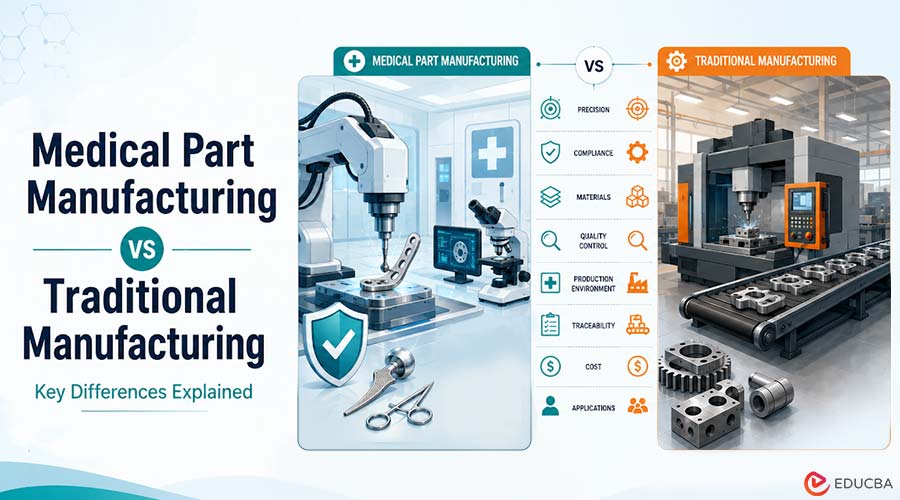
Manufacturing processes vary significantly depending on the industry they serve. While traditional manufacturing is designed to produce a wide range of industrial and consumer products efficiently, medical manufacturing operates under far stricter standards. Healthcare components require strict standards for precision, cleanliness, material quality, and compliance to ensure patient safety and device performance. Medical components used in surgical instruments, implantable devices, diagnostic equipment, and laboratory systems must meet rigorous standards for precision, cleanliness, material quality, and regulatory compliance. Even the smallest manufacturing defect can compromise device performance and patient outcomes. This guide explores medical part manufacturing vs traditional manufacturing by examining their standards, materials, quality control processes, production environments, and ideal applications.
Understanding Medical Part Manufacturing
Medical part manufacturing involves producing highly precise components for medical devices, healthcare equipment, laboratory instruments, and surgical tools. These components are manufactured using advanced technologies such as:
- CNC Machining
- Precision Injection Molding
- Laser Cutting
- Micro Machining
- 3D Printing
- Precision Assembly
Because these parts are often used in life-saving devices, manufacturers must adhere to strict quality management systems and regulatory requirements throughout the production process.
Understanding Traditional Manufacturing
Traditional manufacturing refers to the production of industrial, automotive, consumer, and commercial products using conventional manufacturing methods. Common production technologies include:
- CNC Machining
- Injection Molding
- Die Casting
- Metal Stamping
- Extrusion
- Fabrication
Traditional manufacturing focuses on producing reliable products efficiently while maintaining acceptable quality standards for commercial applications.
Key Differences: Medical Part Manufacturing vs Traditional Manufacturing
Understanding medical part manufacturing vs traditional manufacturing requires comparing several critical factors that influence product quality, safety, and overall manufacturing processes.
1. Precision Requirements
Precision is one of the biggest differences between these two manufacturing approaches.
Medical components often require micron-level tolerances because even minor dimensional variations can affect the safety and performance of medical devices. Working with an experienced medical part manufacturing partner ensures components are produced with exceptional accuracy, consistency, and repeatability to meet strict healthcare requirements.
Traditional manufacturing also emphasizes precision, but acceptable tolerances are generally less demanding for many industrial and consumer products.
2. Regulatory Compliance
Medical products must comply with strict international regulations before they can be sold or used in healthcare environments. Common standards include ISO 13485, FDA Quality System Regulations (QSR), Good Manufacturing Practices (GMP), and CE requirements for applicable markets.
While traditional manufacturing often follows ISO 9001 and other quality standards, it generally operates under less stringent regulatory requirements than medical manufacturing.
3. Material Selection
Medical manufacturers use specialized materials that offer:
- Biocompatibility
- Sterilization resistance
- Corrosion resistance
- Chemical stability
- High durability
Common materials include titanium, medical-grade stainless steel, PEEK, silicone, and engineering plastics.
Traditional manufacturing uses a broader range of commercial materials selected primarily for
- cost
- strength
- production efficiency.
3. Quality Control
Medical manufacturing incorporates extensive inspection throughout every production stage. Quality assurance often includes Coordinate Measuring Machine (CMM) inspections, optical measurement, material certification, surface finish analysis, functional testing, and process validation.
Traditional manufacturing also performs inspections, but the testing requirements are generally less extensive unless dictated by specific industries.
4. Production Environment
Many medical products require manufacturing in contamination-controlled environments. Depending on the application, manufacturers may use cleanrooms, controlled assembly areas, sterile packaging environments, and particle monitoring systems.
Manufacturers usually carry out traditional manufacturing in standard industrial production facilities without specialized contamination controls.
5. Traceability
Every medical component must often be traceable throughout its manufacturing lifecycle. Medical manufacturers maintain detailed records of raw materials, production batches, inspection reports, process parameters, and final testing. This traceability supports product recalls, audits, and regulatory compliance.
Traditional manufacturers may also use traceability systems, especially in industries such as aerospace and automotive, but documentation requirements vary depending on the application.
6. Production Costs
Medical manufacturing generally has higher production costs due to regulatory compliance, rigorous quality inspections, specialized materials, controlled production environments, and extensive documentation.
Traditional manufacturing is generally more cost-effective because it focuses on scalability, faster production cycles, and reduced compliance requirements.
7. Product Applications
Manufacturers design medical manufacturing processes specifically for healthcare products where patient safety is critical.
Traditional manufacturing serves a much broader range of industries, including automotive, construction, consumer goods, and industrial equipment.
Industries That Require Medical Manufacturing
- Medical Device Industry: Manufacturers produce components for patient monitoring systems, infusion pumps, imaging equipment, and diagnostic devices.
- Surgical Equipment: Precision manufacturing supports scalpels, forceps, orthopedic tools, robotic surgery systems, and minimally invasive surgical instruments.
- Pharmaceutical Industry: Medical manufacturing produces equipment and components used in drug production, packaging, and laboratory testing.
- Biotechnology: Companies in the field rely on precision components for research instruments and analytical equipment.
- Dental Industry: Dental implants, orthodontic equipment, imaging devices, and surgical tools require highly accurate manufacturing.
When Should You Choose Medical Manufacturing?
Medical manufacturing is the right choice when:
- Products Will Be Used in Healthcare: Medical devices and equipment require specialized production standards.
- Regulatory Compliance Is Mandatory: Products subject to FDA, ISO 13485, or similar regulations require qualified medical manufacturers.
- Precision Is Critical: Tight tolerances are essential for many surgical and diagnostic applications.
- Sterilization Compatibility Is Required: Medical components must withstand repeated sterilization without compromising performance.
- Patient Safety Is a Priority: Reliable manufacturing reduces the risk of equipment failure and supports better healthcare outcomes.
When Traditional Manufacturing Is the Better Choice?
Traditional manufacturing is often the preferred option when:
- High-Volume Production Is Required: Traditional manufacturing is ideal for large-scale production where efficiency and speed are important.
- Medical-Grade Certifications Are Not Required: Products that do not need ISO 13485, FDA compliance, or healthcare-specific standards can benefit from conventional manufacturing methods.
- Cost Efficiency Is a Major Factor: Traditional manufacturing generally offers lower production costs due to simpler processes, fewer regulatory requirements, and easier scalability.
- Shorter Production Timelines Are Needed: Standard manufacturing processes often enable manufacturers to produce commercial and industrial products more quickly.
- Products Are Designed for General Applications: Manufacturers commonly produce automotive components, consumer goods, industrial equipment, and commercial products using traditional manufacturing methods.
Final Thoughts
Understanding medical part manufacturing vs traditional manufacturing is essential for businesses developing products for healthcare and industrial markets. Although both aim to produce high-quality components, their objectives, standards, and production requirements differ significantly. Medical manufacturing places greater emphasis on precision, regulatory compliance, material quality, cleanliness, traceability, and patient safety. Traditional manufacturing prioritizes efficiency, large-scale production, and cost reduction across a wide range of industrial and consumer products.
Businesses developing healthcare products should partner with manufacturers that specialize in medical production to ensure compliance with industry regulations and deliver safe, reliable products. Choosing the right manufacturing approach not only improves product quality but also supports long-term success in the highly regulated healthcare industry.
Frequently Asked Questions (FAQs)
Q1. What is the main difference between medical manufacturing and traditional manufacturing?
Answer: Medical manufacturing follows strict regulatory standards, uses medical-grade materials, and requires higher precision and quality control than traditional manufacturing.
Q2. Why is precision so important in medical manufacturing?
Answer: Even minor dimensional inaccuracies can compromise the safety, performance, and reliability of medical devices, making precision a critical requirement.
Q3. What certifications should a medical manufacturer have?
Answer: Many reputable medical manufacturers hold certifications such as ISO 13485 and comply with the FDA Quality System Regulation (QSR) and Good Manufacturing Practices (GMP).
Q4. Which materials are commonly used in medical manufacturing?
Answer: Manufacturers widely use medical-grade stainless steel, titanium, PEEK, silicone, and engineering plastics because these materials offer strength, durability, and biocompatibility.
Q5. Is medical manufacturing more expensive than traditional manufacturing?
Answer: Yes. Medical manufacturing typically involves higher costs due to strict quality requirements, regulatory compliance, specialized materials, and advanced inspection processes.
Recommended Articles
We hope this guide on medical part manufacturing vs traditional manufacturing helps you understand the key differences. Explore our recommended articles for more insights into manufacturing processes and industry trends.

