


Updated September 22, 2026
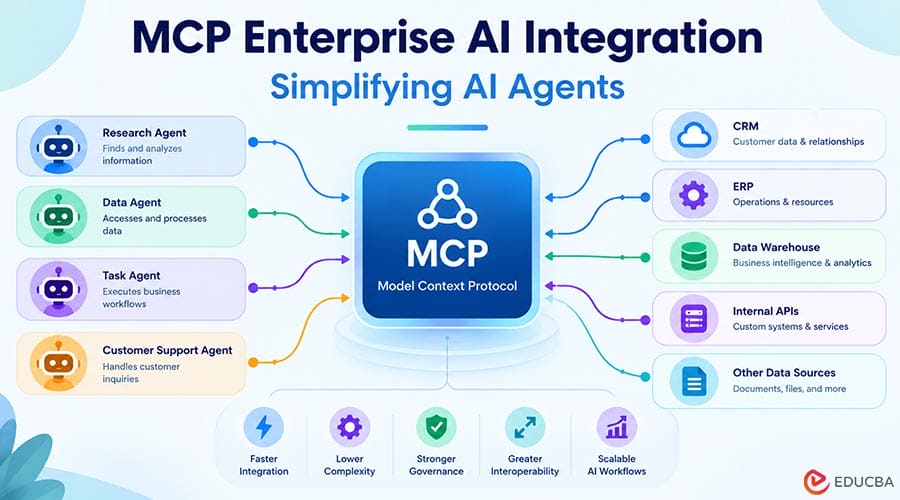
Remember when every device in your living room needed its own remote? Volume on one, input switching on another, and streaming on a third. It worked, technically. But no one would call it efficient.
Currently, enterprise AI integration looks a lot like that. Each agent, tool, and data source requires a unique connector, creating an integration tangle that slows scaling and drains engineering resources. MCP Enterprise AI Integration provides a standardized approach to connecting AI agents with enterprise tools, systems, and data sources, reducing the complexity of building and maintaining these connections.
Model Context Protocol is the universal remote that enterprise AI has been missing. One standard. One standard. Every agent. Any tool or data source. If AI complexity is eating into your ROI, keep reading. Read on as we break down how MCP simplifies AI integration and helps businesses scale AI with less complexity.
Why Is MCP Enterprise AI Integration Gaining Attention in 2026?
Scaling agentic AI solutions for enterprises requires more than capable AI models. CRMs, ERPs, data warehouses, internal APIs, and other systems that store critical business data must connect reliably with those models. MCP Enterprise AI Integration addresses one of the biggest challenges by providing a standardized way for AI agents to connect with enterprise systems, tools, and data sources.
For years, organizations have relied on custom code, unique adapters, and fragile integrations to establish these connections. These systems can become difficult to maintain when an upstream platform or API changes. MCP offers a standardized approach that can simplify integration. As enterprise AI adoption continues to grow in 2026, this approach is gaining increased attention.
The momentum behind MCP comes from several key factors:
- Support from major technology platforms: OpenAI, Google, and Microsoft have embraced MCP, giving enterprises greater confidence in adopting a common approach to connecting AI agents with existing technologies.
- Independent governance: MCP’s inclusion within the Linux Foundation provides enterprises with a vendor-neutral framework that can help address legal, procurement, compliance, and governance requirements.
- Reduced integration complexity: Instead of developing bespoke connectors for every AI use case, engineering teams can use standardized connections to reduce repetitive development and maintenance work.
- Better coordination between AI agents: Enterprise workflows increasingly involve multiple agents that need to transfer tasks, share context, and escalate issues. MCP provides a standardized connectivity layer that can support this type of collaboration.
How Does Model Context Protocol Make Enterprise AI Agents Work Together Seamlessly?
A single agent is generally not used in most enterprise deployments. They operate on networks of agents, each responsible for a particular task, who must exchange context, delegate tasks, and coordinate actions across systems. This change is substantial in scope.
Gartner predicts that 40% of enterprise applications will be integrated with task-specific AI agents by the end of 2026, up from less than 5% in 2025.
Getting all those agents to work together without building custom coordination logic every time has been the hard part. MCP solves this at the protocol level. This makes MCP Enterprise AI Integration particularly relevant for organizations building multi-agent environments, where multiple AI agents need consistent access to tools, data, and enterprise systems.
Here is what that looks like in practice:
1. A Common Language for Agent-to-Agent Communication
Thanks to MCP, every agent in a network can exchange context and invoke tools using the same interface. Agents do not translate between proprietary formats when they must work together on a task. Because they speak the same language from the start, coordination is faster and more reliable.
2. Modular Agent Design at Enterprise Scale
The shift to composable, modular agent systems is one of the most important agentic AI trends changing enterprise architecture. MCP makes this possible by ensuring that adding or removing an agent from a process doesn’t affect the surrounding integrations.
A modular approach also lets organizations expand AI capabilities without redesigning the entire integration architecture each time they introduce a new agent or tool.
3. Uniform Access to Data Throughout the Agent Network
In an MCP-enabled system, all agents use the same standardized resource layer to access data. The access pattern is consistent whether reading from a document repository, pulling from a data warehouse, or accessing an internal API, thereby reducing errors and streamlining governance.
This consistency is particularly valuable in enterprise environments where multiple agents may need access to the same business information while operating within defined access and security boundaries.
4. Vendor-Agnostic Interoperability
Developing agentic AI solutions for enterprises often requires using tools and models from multiple providers. Agents built on various platforms can work together within the same workflow thanks to MCP’s open standard, which gives businesses flexibility without compromising compatibility.
This interoperability can also reduce dependence on isolated technology stacks and make it easier for enterprises to introduce new AI models or tools into existing workflows.
5. Quicker Implementation of New Agent Features
Rebuilding surrounding integrations is unnecessary when adding a new agent to an established workflow because MCP standardizes the connection layer. This makes MCP Enterprise AI Integration more scalable as organizations expand their agent networks and introduce new AI capabilities.
Businesses can gradually expand their agent networks, significantly shortening deployment times and reducing repetitive integration work for engineering teams.
6. Accurate Error Transmission Through Agent Boundaries
Operational resilience in multi-agent systems is a key trend in agentic AI for 2026. MCP enables consistent error signaling throughout the agent network, allowing systematic application of escalation logic rather than a case-by-case approach to failures.
This can make troubleshooting and exception handling more consistent, particularly when several agents and enterprise systems are involved in the same workflow.
5 Ways MCP Is Shaping the Future of Agentic AI
Discussions about agentic AI have shifted from what agents can do on their own to what they can achieve when they collaborate across systems at scale, without constant human intervention. MCP is at the heart of that change.
Here is how it is shaping what comes next:
- One Protocol Is Replacing Hundreds of Custom Integrations: By consolidating the disparate connection landscape into a single open standard, MCP can reduce the technical overhead required to link agents to enterprise systems at scale.
- Agent Networks Are Becoming Genuinely Collaborative: Agents can cooperate across complex workflows without losing information or requiring human intervention at every transition point, thanks to shared context, standardized handoffs, and consistent tool access.
- Cross-Platform Freedom Is Becoming a Realistic Expectation: Because of MCP’s vendor-neutral design, businesses can deploy agents built on multiple models and platforms within the same workflow, giving architecture teams greater flexibility without compromising compatibility.
- Security and Compliance Are Built Into the Connectivity Layer: Protocol-level access control can keep governance consistent across the agent network, rather than patching it onto individual agents or integrations as an afterthought. This is especially important for enterprise data management, where auditable, controlled access boundaries are required for sensitive information.
- Time-to-Value for New Agent Use Cases Is Declining: Standardized connectivity lets businesses implement new agent capabilities without waiting for the development, testing, and upkeep of custom integrations before realizing commercial value.
Prepare Your AI Strategy for What Comes Next
The industry has increasingly focused on MCP as a common standard for connecting AI systems, tools, and data sources. Building outside that standard today can create additional integration work as enterprise AI architectures evolve.
Organizations that align their agent architecture with MCP can build a foundation that supports growing agent networks while maintaining flexibility and governance. A structured approach to MCP Enterprise AI Integration can help organizations reduce dependence on one-off connectors and custom integration work.
To make that shift feasible, Straive provides the agentic AI and data management knowledge required. With its AI solutions, data foundations, and enterprise implementation experience, Straive helps businesses create interconnected AI ecosystems built for long-term value, scalability, and flexibility.
The era of one-off AI integrations is evolving. As enterprise AI systems become more interconnected, standardized protocols such as MCP can provide a foundation for organizations building scalable, adaptable AI ecosystems.
Final Thoughts
Enterprise AI is moving toward interconnected ecosystems where multiple agents, models, tools, and data sources need to work together reliably. As these environments become more complex, relying on separate custom integrations for every connection can increase development effort, maintenance requirements, and operational complexity. MCP offers a standardized approach that can simplify how AI agents interact with enterprise systems while supporting greater interoperability.
For organizations exploring MCP Enterprise AI Integration, the value extends beyond connecting individual tools. A standardized integration layer can make it easier to introduce new agents, support multi-agent workflows, and maintain consistent access to enterprise data and services. As businesses continue expanding their use of agentic AI, an MCP can be an important part of an architecture designed for scalability, flexibility, and long-term integration needs.
Recommended Articles
We hope this guide helps you understand MCP Enterprise AI Integration, including how Model Context Protocol simplifies AI agent connectivity, supports interoperability, reduces integration complexity, and enables scalable enterprise AI workflows. Explore our recommended articles for more insights on agentic AI, AI agents, enterprise AI, AI integration, AI trends, and data management.


