


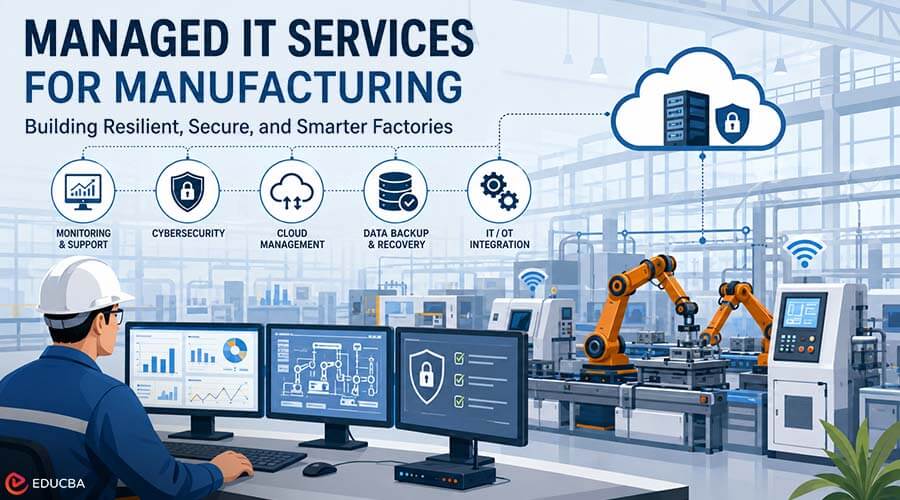
Managed IT services for manufacturing provide a dedicated approach to keeping the digital infrastructure behind production secure, available, and continuously optimized, covering everything from networks, endpoints, cloud platforms, and business applications to monitoring, cybersecurity, backup, and recovery. For manufacturers, this matters because IT performance is no longer separate from production performance: when enterprise systems, connectivity, or operational technology fail, the consequences can quickly reach the factory floor.
Manufacturing IT has become an unusually complex environment. A modern plant may depend simultaneously on ERP, MES, warehouse systems, industrial IoT devices, engineering applications, cloud services, remote access, and decades-old machinery. The challenge is not simply keeping each component operational. It is making the entire technology landscape work as a coherent, resilient system.
Why Manufacturing Needs a Different IT Operating Model?
Traditional IT support often revolves around employee devices, office networks, and business applications. Manufacturing adds another dimension: operational continuity. A production facility cannot always reboot a system, install a patch immediately, or tolerate an extended maintenance window. Some industrial environments contain equipment that was designed long before today’s cybersecurity practices existed. At the same time, factories are becoming increasingly connected, creating more pathways between corporate IT and operational technology (OT).
That convergence creates a difficult engineering problem. Security controls must be strong without interfering with production. Infrastructure must be modernized without destabilizing legacy equipment. And support teams need visibility across environments that were never originally designed to operate together. A managed service model addresses this complexity by establishing continuous ownership rather than waiting for individual failures to generate support tickets.
Proactive Monitoring Instead of Reactive Troubleshooting
The most valuable shift in managed IT is moving from reaction to prevention. Instead of discovering a problem when an employee or plant manager reports it, monitoring tools continuously inspect infrastructure health, network performance, system availability, storage, endpoints, cloud resources, and security signals. When abnormal behavior appears, technical teams can investigate before it becomes an operational incident.
For manufacturers, this distinction matters most. A degraded network connection might initially look insignificant, but if it affects production data, warehouse communications, or access to an MES platform, its business impact can multiply quickly. Managed services therefore turn infrastructure telemetry into an operational feedback loop: detect, investigate, remediate, document, and learn.
Connecting IT and OT Through Managed IT Services for Manufacturing
The IT/OT boundary is one of the most important considerations in manufacturing technology. IT environments typically prioritize confidentiality, data management, and business productivity. OT environments prioritize availability, safety, deterministic behavior, and physical process control. Their objectives overlap, but they are not interchangeable. A thoughtful managed-services strategy recognizes this difference.
Rather than forcing industrial systems into conventional corporate IT practices, specialists can segment networks, control privileged access, monitor traffic, establish secure remote-access mechanisms, and define carefully tested change procedures. Research into OT cybersecurity similarly emphasizes the risks created as industrial systems become increasingly connected to enterprise networks and the internet. The goal is not merely to make a factory more connected. It is to make connectivity manageable.
Cybersecurity Becomes an Operational Requirement
For manufacturers, cybersecurity is ultimately a production issue. A ransomware incident affecting an office file server is serious. An attack that interrupts production scheduling, disables engineering systems, compromises remote access, or spreads into industrial environments can become a business continuity crisis.
Managed IT services can create a layered defense built around identity management, endpoint protection, vulnerability management, network segmentation, security monitoring, backup, and incident response. The exact controls depend on the plant’s architecture and risk profile, but the core principle remains the same: operate security continuously instead of auditing it periodically. This matters because many manufacturing environments include legacy systems that cannot be treated like ordinary laptops or cloud workloads. Security therefore requires architectural thinking, not simply more security software.
Keeping Legacy Systems Relevant
Digital transformation does not mean replacing everything old. Manufacturers often depend on applications and machines that remain operationally valuable despite their age. Replacing them can be expensive, disruptive, or technically impractical. The smarter approach is frequently controlled modernization.
Managed IT teams can help inventory applications and infrastructure, identify unsupported components, set maintenance priorities, and introduce modern services around legacy systems. Cloud infrastructure, secure integration layers, monitoring platforms, and centralized identity can extend the useful life of existing technology while creating a path toward gradual modernization. This approach is especially valuable for manufacturers operating multiple plants, where every site may have accumulated a slightly different technology stack.
Cloud, Data, and the Road to Smarter Manufacturing
The cloud has become an important part of manufacturing infrastructure, but moving workloads to the cloud is not automatically a transformation strategy. The real opportunity comes from creating reliable data flows between production environments and business systems. Once organizations can consistently collect and contextualize machine, production, inventory, quality, and supply-chain information, they can begin building more sophisticated analytics.
That foundation supports applications such as predictive maintenance, production optimization, demand forecasting, and digital twins. Predictive-maintenance research, for example, focuses on analyzing equipment data to identify patterns associated with potential failures before they cause unexpected downtime. But analytics are only as reliable as the infrastructure underneath them. A factory cannot become genuinely data-driven when its systems remain fragmented, poorly monitored, or inconsistently maintained.
Backup and Recovery Are Part of Production Resilience
Backup is sometimes treated as an administrative IT task. In manufacturing, it is part of resilience engineering. A serious recovery strategy must answer practical questions: Which systems are critical? How quickly must each one be restored? Where are backups stored? Can they be recovered if the primary environment is compromised? Who has authority to initiate recovery?
Managed services can formalize these processes through scheduled backups, recovery testing, documented procedures, and continuous monitoring. Andersen, for example, describes managed backup and disaster recovery as part of its broader managed IT model, alongside infrastructure management, security, monitoring, and cloud operations. The objective is not simply having a backup copy. It is having confidence that the organization can actually return to operation.
Supporting People as Well as Technology
Technology alone does not keep a factory running. Engineers, operators, maintenance teams, warehouse staff, and corporate employees all interact with digital systems. A managed service desk provides a consistent channel for incidents, requests, access issues, and technical questions. More importantly, it can create structured escalation paths so routine issues don’t consume the attention of specialized internal teams.
This frees internal IT professionals to focus on architecture, modernization, automation, and business initiatives instead of spending their working day chasing recurring operational problems.
From IT Support to a Manufacturing Technology Strategy
The strongest managed-services relationships eventually move beyond tickets and uptime metrics. Once a provider understands the environment, it can identify recurring failures, obsolete infrastructure, security gaps, capacity constraints, and automation opportunities. That operational knowledge can feed into a technology roadmap.
For manufacturers, the value is therefore broader than outsourcing IT. It creates an operating model that manages infrastructure, security, cloud, applications, and support as interconnected parts of production resilience.
Final Thoughts
Manufacturing is becoming a software-defined business, but the physical factory remains unforgiving. Production cannot simply pause while technology teams troubleshoot an infrastructure problem. As IT and OT converge, manufacturers need continuous visibility, disciplined security, resilient infrastructure, and specialists who can manage complexity without disrupting operations.
The right managed-services strategy provides that foundation while giving internal teams room to focus on transformation rather than constant firefighting. Andersen managed IT services for manufacturing bring together infrastructure management, proactive monitoring, security, cloud operations, backup, and strategic IT expertise to help manufacturers build more resilient technology environments and support the next stage of industrial modernization.
Recommended Articles
We hope this comprehensive guide to managed IT services for manufacturing helps you build a more secure, resilient, and efficient manufacturing environment. Check out these recommended articles for more insights and strategies to strengthen your technology infrastructure and support digital transformation.

