

Updated March 28, 2023
Difference Between LXC vs LXD
In this article, we will learn about LXC vs LXD.
LXC and LXD are two prominent words that admin or developer frequently hears when they work on containers. They sound similar to the acronym, and they use the same platform, i.e. containers, for their purpose, but they are different.
LXC, which is ‘Linux Containers’, is a solution for creating a virtual environment for software at the operating system level within the scope of the kernel of Linux. LXC allows us to run a single application in virtual environments. The key factor with LXC is the ability to control the virtual environment utilizing the userspace tools from hosting the operating system itself, reducing the overhead and making it cost-efficient.
LXD is, in a way, has LXC as its subset, and we can say that it is its extension. LXD uses the REST API that connects one of the LXC software resource, i.e. libxlc. LXD is written in GO and has a daemon that can connect to applications from the UNIX socket over the network via HTTP protocols. This particular LXD daemon can handle all the networking and data storage-related issues.
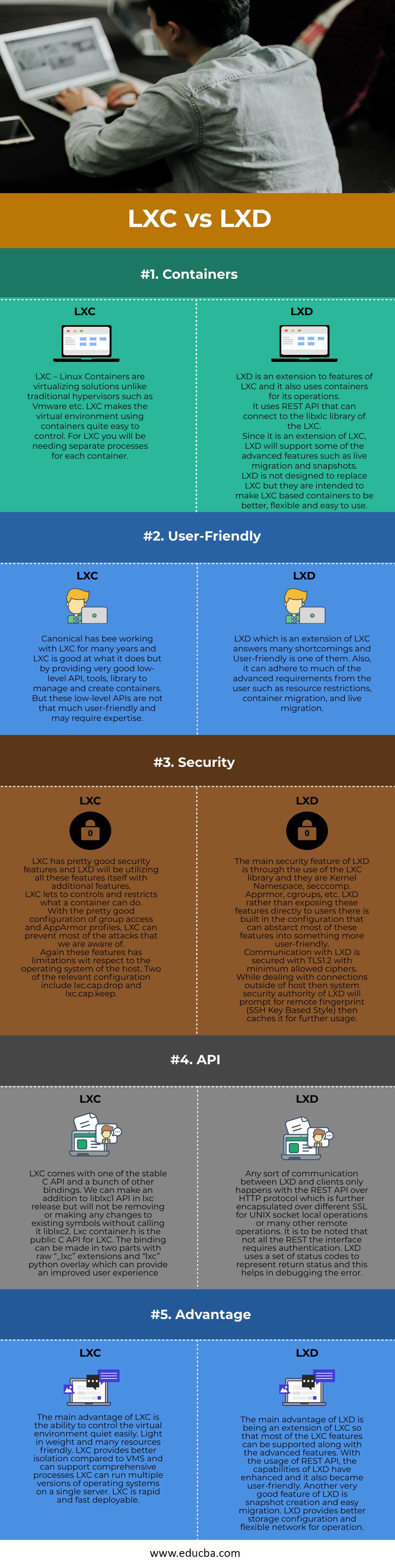
Head to Head Comparisons Between LXC vs LXD (Infographics)
Below are the top comparisons between LXC vs LXD:
Key Differences between LXC vs LXD
Let us discuss some of the major key differences between LXC vs LXD:
- LXD is an open-source container management system and is an extension of LXC; and hence LXD improved the existing LXC features and also provides multiple new features for managing and building Linux containers.
- A host can run multiple LXC containers using only a single system daemon, reducing the required overhead and simplifying the management. With pure LXC, we may require separate processes for each of container.
- The daemon of LXD the container will take advantage of the host-level security feature, so the containers are more secure. On pure LXC based containers obtaining this level of security is quite problematic.
- LXC doesn’t provide the feature of live container migration where the container-related complete configurations and directories are moved to separate machines, and this feature is quite desired. This advantage can be overcome by using LXD, which provides this additional feature.
- LXD can snapshot a running container, and this is also one of the advanced features that we don’t see in LXC. And since LXD is an extension of LXC, we see that LXD can handle all the LXC related tasks efficiently.
- LXD container has a wide range of features for security, and LXD can easily integrate with Canonical RBAC services. When it comes to security with LXC, it is good but not competitive enough when compared with LXD.
Comparison Table of LXC vs LXD
Let’s look at the top comparisons between LXC vs LXD.
|
Basis of Comparison |
LXC |
LXD |
| Containers | LXC – Linux Containers are virtualizing solutions, unlike traditional hypervisors such as Vmware etc. LXC makes the virtual environment using containers quite easy to control. For LXC, you will need separate processes for each container. | LXD is an extension of the features of LXC, and it also uses containers for its operations. It uses a REST API that can connect to the libxlc library of the LXC. Since it is an extension of LXC, LXD will support some of the advanced features such as live migration and snapshots. LXD is not designed to replace LXC, but it is intended to make LXC based containers better, flexible, and easy to use. |
| User-Friendly | Canonical has bee working with LXC for many years, and LXC is good at what it does but by providing very good low- level API, tools, library to manage and create containers. But these low-level APIs are not that much user-friendly and may require expertise. | LXD, which is an extension of LXC, answers many shortcomings, and User-friendly is one of them. It can also adhere to much of the user’s advanced requirements, such as resource restrictions, container migration, and live migration. |
| Security | LXC has pretty good security features, and LXD will utilise all these features with additional features. LXC lets to controls and restricts what a container can do. With the pretty good configuration of group access and AppArmor profiles, LXC can prevent most of the attacks. Again these features have limitations wit respect to the operating system of the host. Two of the relevant configuration include lxc.cap.drop and lxc.cap.keep. | The main security feature of LXD is through the use of the LXC library, and they are Kernel Namespace, secccomp. Apprmor, cgroups, etc. LXD, rather than exposing these features directly to users, there is a built-in configuration that can abstarct most of these features into something more user-friendly. Communication with LXD is secured with TLS1.2 with minimum allowed ciphers. While dealing with connections outside of the host, then the system security authority of LXD will prompt for remote fingerprint (SSH Key Based Style) then caches it for further usage. |
| API | LXC comes with one of the stable C API and a bunch of other bindings. We can make an addition to liblxc1 API in lxc release but will not be removing or making any changes to existing symbols without calling it liblxc2. Lxc container.h is the public C API for LXC. The binding can be made in two parts with raw “_lxc” extensions and “lxc” python overlay, which can provide an improved user experience. | Any sort of communication between LXD and clients only happens with the REST API over HTTP protocol which is further encapsulated over different SSL for UNIX socket local operations or many other remote operations. It is to be noted that not all the REST the interface requires authentication. LXD uses a set of status codes to represent return status, and this helps in debugging the error. |
| Advantage | The main advantage of LXC is the ability to control the virtual environment quiet easily. Light in weight and many resources friendly. LXC provides better isolation compared to VMS and can support comprehensive processes LXC can run multiple versions of operating systems on a single server. LXC is rapid and fast deployable. | The main advantage of LXD is being an extension of LXC so that most of the LXC features can be supported along with the advanced features. With REST API usage, the capabilities of LXD have enhanced, and it also became user-friendly. Another very good feature of LXD is snapshot creation and easy migration. LXD provides better storage configuration and flexible network for operation |
Conclusion
LXD and LXC are not completely different things; they have many dependencies, and the same organizations and developers are developing both and the choice of which is use not easy. Iso if your team is using LXD, then they are using LXC too. The choice purely dependent on our requirement and then analyzing which can be apt for our purpose. LXC, then we can use that but LXD is better for production environments gives you basic subset features and if you are satisfied with it.
Recommended Articles
This is a guide to LXC vs LXD. Here we discuss the key differences with infographics and comparison tables. You can also go through our other related articles to learn more –

