


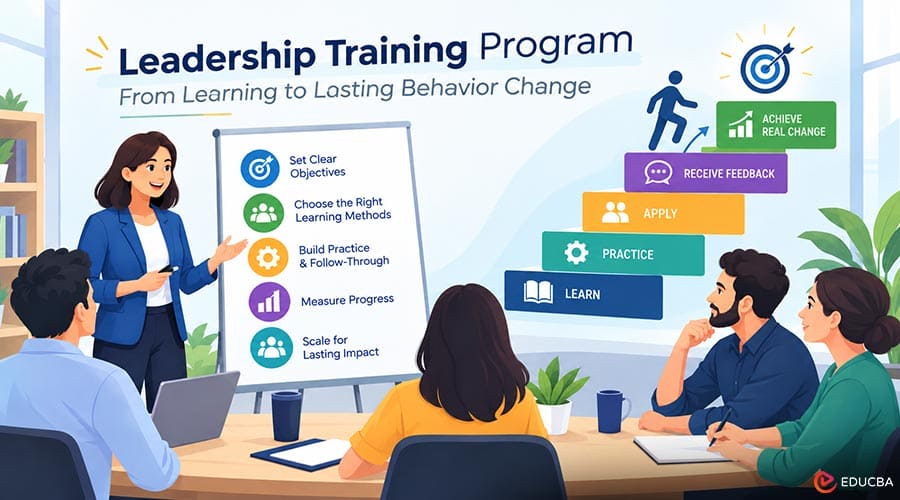
A leadership training program can earn excellent attendance and satisfaction scores while leaving managers to handle the same difficult conversations in the same way on Monday morning. For HR and training professionals, the design challenge is to connect business priorities to specific leadership behaviors, select learning methods that fit those behaviors, and make application part of the program. That sequence offers a stronger starting point than choosing a workshop, course, or coaching provider first.
Start With the Leadership Behaviors the Organization Needs
Begin with the work leaders must do differently. A company preparing managers to lead larger teams, for example, may need more effective delegation and clearer performance conversations. Those are more useful design targets than a broad objective such as “improve leadership.” Each target can be described in observable terms: a manager assigns decision authority, checks understanding, gives timely feedback, or addresses a missed commitment without postponing the conversation.
To identify priorities, compare organizational goals with evidence from the roles involved. Performance reviews, engagement feedback, employee interviews, and conversations with managers can reveal where expectations and day-to-day practice diverge. Ask which situations repeatedly cause difficulty, who experiences the consequences, and what successful behavior would look like. The answer may differ for first-time managers and experienced executives, even when both groups are described as needing better communication.
Turn the findings into a small set of objectives before selecting content. A meta-analysis of leadership training identifies needs analysis as a design factor associated with stronger outcomes. A focused diagnosis also gives the team a baseline: if the desired behavior is clear at the outset, it becomes possible to check later whether it appears at work.
Choose Learning Formats for the Leadership Training Program
Workshops, courses, and one-to-one coaching solve different learning problems. A facilitated workshop can bring peers together to rehearse a feedback conversation, compare approaches, and receive immediate observations. A course can give a geographically dispersed group shared language and consistent foundational knowledge, with participants learning material at an appropriate pace. Individual coaching gives a leader space to examine a specific challenge, set a personal goal, and reflect on decisions made in a live work context.
The choice depends on the objective, audience, and opportunity to practice. If many new managers need to understand a common performance-review process, a course may establish the basics efficiently. If they need to respond well when an employee disagrees with an assessment, a workshop can provide realistic practice. A manager facing a recurring difficulty with delegation may benefit from confidential, individualized coaching. CoachHub’s coaching-based leadership development program is one example of a format designed around individual goals and workplace application.
These options need not compete for the entire budget. A leadership training program might introduce a concept through a short course, test it in a facilitated session, and use coaching to help selected leaders apply it in their own teams. A research-informed framework for leadership development brings together educational, experiential, individual, and relational learning components. The practical question is what each component contributes to the behaviors the organization has chosen to develop.
Build Practice and Follow-Through Into the Program
Learning activities should create a route back to the job, not end when the session closes. For each objective, specify an application task that participants can complete in normal work. A leader learning to delegate might agree on a decision boundary with a team member, observe what happens during the next project milestone, and discuss the result afterward. Someone practicing feedback might prepare for an upcoming conversation, try a new approach, and record what the employee understood and what still needs attention.
Schedule opportunities to revisit those experiences. Peer discussions can expose different approaches to a shared problem; a coach or facilitator can help a participant examine assumptions and decide what to try next. The participant’s manager can support transfer by asking about a development goal, creating space to apply it, and giving specific feedback on observed behavior. That support matters particularly when workplace pressures reward familiar habits over newly learned ones.
Practice also needs an appropriate level of difficulty. A role-play provides a safer place to make an early attempt, but it should resemble a decision participants are likely to face. Follow-up assignments then move the skill into a real setting. Connecting rehearsal, application, feedback, and reflection gives HR teams a more useful design principle than simply adding more content to a leadership training program.
Measure Learning, Behavior, and Organizational Results
Measurement works best when it is planned alongside the learning objectives. The familiar Kirkpatrick evaluation model distinguishes reaction, learning, behavior, and results. Each level answers a different question. Participant feedback can show whether an activity felt relevant; a scenario or demonstration can show whether a leader understands or can practice a skill. Neither establishes that the leader uses it consistently at work.
For behavior measures, decide in advance what evidence can reasonably be gathered. A manager may observe whether a participant holds regular development conversations or delegates decisions with clearer boundaries. A participant may document attempts and obstacles, while team feedback can provide another perspective. Collect comparable information before the program begins and at a suitable follow-up point, using the same behavioral definitions where possible.
Organizational results require even more care. Improved retention, engagement, or performance may matter to the business, but many influences beyond leadership training affect those outcomes. Connect each selected result to the original business problem, then interpret changes alongside other available evidence rather than treating a single number as proof of causation. Early indicators can show whether participants are learning and trying new behaviors; later indicators help determine whether those behaviors are sustained and useful.
Make the Leadership Training Program Scalable Without Losing Relevance
A common framework can make delivery more consistent across teams while leaving room for different leadership challenges. Define a limited set of shared capabilities, then vary the examples and application tasks by role. First-time managers may practice setting expectations with former peers; senior leaders may work on decisions that affect several departments. The underlying skill can be related, but the situations in which it is used are not interchangeable.
For organizations operating across regions, consistency also means ensuring facilitators or coaches understand the intended objectives and that participants can engage in language suited to meaningful reflection. CoachHub offers coaching delivery across multiple countries and languages, illustrating one way an organization can support a distributed leadership population. Scale, however, should not replace local context: HR teams still need to learn which barriers participants encounter in their own workplaces.
A pilot with a defined leadership group can test the objectives, learning activities, application tasks, and measures before wider rollout. Feedback from that group can reveal unclear instructions or unrealistic practice opportunities. Refining those elements is often more valuable than expanding a program unchanged because its initial sessions were well attended.
Turn the Design Into a Practical Sequence
A workable design sequence starts with the business challenge, identifies the leadership behaviors that could address it, and checks the current gap. Only then does format selection become meaningful. Courses can establish shared knowledge, workshops can support collective practice, and coaching can help leaders work through individual situations. Each format needs a planned opportunity for application and follow-up.
Finally, decide how you will observe learning and behavior before delivery begins, and use the evidence to refine the program. This keeps leadership training connected to the work managers actually perform. The aim is not merely to complete a learning path, but to give leaders repeated opportunities to make better decisions when those decisions count.
Final Thoughts
A successful leadership training program starts with the behaviors an organization wants leaders to demonstrate, not with a course or workshop format. Clear objectives, realistic practice, workplace application, and ongoing feedback help turn learning into habits that managers can use in real situations. The right combination of courses, workshops, coaching, and experiential activities can also make the program relevant to different leadership levels and workplace challenges.
Measurement completes the process. Tracking learning, behavior, and relevant organizational outcomes helps HR teams understand what is working and where the program needs adjustment. By testing the approach with a focused group and refining it before wider implementation, organizations can build leadership development efforts that remain practical, measurable, and connected to the work leaders are expected to do.
Recommended Articles
We hope this guide helps you design a leadership training program that builds practical skills, encourages meaningful behavior change, and supports organizational goals. Explore our recommended articles for more insights on leadership skills, employee development, management strategies, workplace training, and effective learning programs.

