


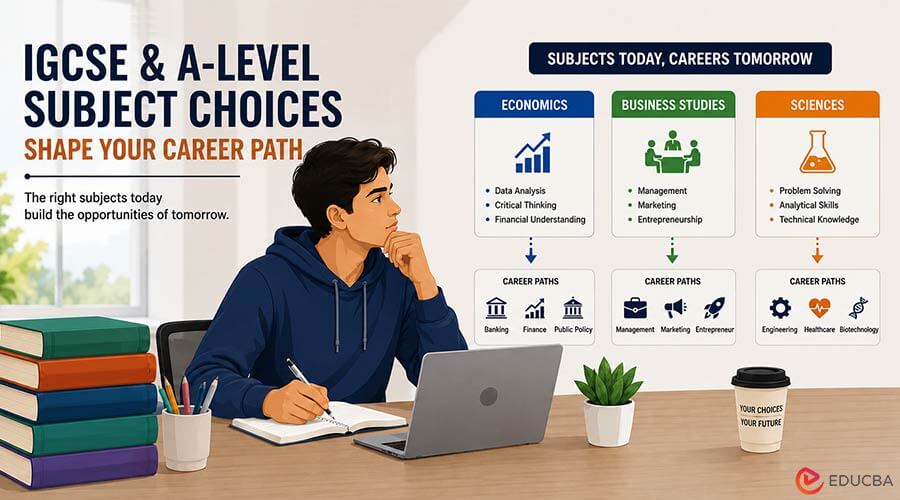
Most students approach IGCSE and A-Level subject choices the same way. They pick what they are good at, what their friends are taking, or what seems least difficult. Very few students are told clearly enough that these choices are not just about passing exams. They are the first real career decisions a person makes. Employers across finance, technology, healthcare, consulting, and countless other industries consistently trace the professional skills they value most back to the academic foundations candidates built at secondary school.
The student who chose Economics at A-Level walks into a banking interview with a different kind of preparation than one who did not. The student who built strong IGCSE Business Studies grades arrives at university commerce programs with groundwork already in place. Understanding this connection early changes how students approach their subject choices. Instead of picking what feels comfortable, they start picking what moves them toward where they actually want to go.
Why A-Level Subject Choices Matter for Career Entry?
At A-Level, subject choice signals something to universities and employers before a student has done a single day of professional work. It shows how a candidate thinks, what disciplines they have been trained in, and what analytical challenges they have already faced.
1. Economics
One of the most versatile A-Level subjects available. Students who study Economics develop the ability to analyze data, construct logical arguments, and understand the forces that drive financial systems. These skills translate directly into careers in banking, investment, financial consulting, and public policy. Many of the world’s leading financial institutions actively look for Economics at A-Level precisely because it signals a candidate who can think analytically under pressure.
2. Business Studies
Prepares students for the realities of commercial environments. It covers organizational behavior, marketing strategy, financial management, and entrepreneurship in a way that makes the transition from academic study to professional application genuinely smoother. Students who excel in Business Studies often find themselves well positioned for management training programs, graduate marketing roles, and entrepreneurial ventures where understanding how businesses actually operate is immediately useful.
3. Sciences at A-Level
Open doors across technology, data analytics, medicine, and engineering in ways that few other subject combinations do. Mathematics in particular has become an increasingly significant differentiator in hiring across data-driven industries. Physics and Chemistry carry strong signaling value for engineering and research roles. Biology sits at the intersection of healthcare, pharmaceuticals, and biotechnology. The sciences reward analytical rigor and problem-solving precision, and employers across technical industries know it.
None of these pathways are fixed or exclusive. But students who enter A-Level with a clear sense of direction make subject choices that create cumulative advantage. Every exam passed, every concept mastered, and every skill developed builds on the last. The student who chose strategically at 16 arrives at 18 with a portfolio of knowledge that looks nothing like the one assembled without a plan.
How Does IGCSE Build the Foundation?
The career relevance of IGCSE is something students and parents frequently underestimate. IGCSE is often treated as a stepping stone to A-Levels rather than as a qualification with independent value. In reality, the foundation it builds determines which A-Level options remain genuinely open, and employers and universities in over 145 countries recognize strong IGCSE results.
The connection between IGCSE grades and A-Level access is direct and often non-negotiable. Most sixth forms and international schools require specific minimum grades in relevant subjects before they will accept a student onto a particular A-Level course. A student who wants to study A-Level Economics but performed poorly in IGCSE Business Studies or Mathematics may find that door unexpectedly closed. This is not a distant hypothetical. It is a practical reality that shapes A-Level options every year for students who did not take IGCSE seriously enough as a career-relevant qualification in its own right.
The Importance of IGCSE Business Studies
Business Studies at IGCSE level deserves particular attention in this context. It introduces students to the commercial concepts, analytical frameworks, and case study evaluation skills that become essential at A-Level and beyond. Students who master this subject early develop a vocabulary and a way of thinking about business problems that gives them a genuine advantage as they progress. Those who struggle and do not address it early carry the gap into A-Level and the graduate recruitment process.
Getting structured support before the gap becomes entrenched makes a measurable difference. Working with an online Business Studies tutor who understands the IGCSE syllabus and assessment criteria means a student isn’t just reviewing content in general terms. They develop the exact skills the examination rewards, with targeted feedback on where marks are currently being lost. That kind of focused support at IGCSE level protects the grade that keeps future options open.
Matching Academic Choices to Career Goals
The most effective approach to IGCSE and A-Level planning is to work backward from a target career direction rather than forwards from a comfort zone. This does not require certainty about a specific job title. Very few 15-year-olds know exactly what they want to do professionally, and that is completely reasonable. It does require a broad awareness of which industries feel genuinely interesting and which academic disciplines tend to serve those industries well.
Students interested in finance can benefit from taking Economics, Mathematics, and Business Studies at A-Level. For technology careers, Mathematics combined with at least one science subject can provide a strong academic foundation. Students with entrepreneurial ambitions can also benefit from studying Business at both IGCSE and A-Level, as it helps develop commercial thinking and an understanding of how organisations operate.
How to Make Better IGCSE and A-Level Subject Choices?
The practical step is straightforward. Look at the entry requirements for the university courses most relevant to your target industry. Identify which A-Level subjects appear most frequently in those requirements. Then trace backward to the IGCSE subjects that best support those A-Level choices. This exercise takes an hour and produces a subject plan that is genuinely aligned to where the student is trying to go, rather than assembled by default.
Parents play a significant role in making this conversation happen early enough to act on it. Subject choices at 16 are not irreversible, but changing direction after they are made costs time, momentum, and options. The earlier a student has a clear picture of the relationship between what they study and where they want to go, the more confident and purposeful every subsequent academic decision becomes.
Academic Decisions Are Career Investments
The IGCSE and A-Level subject choices a student makes are not just about getting into the next stage of education. They are the first investments a person makes in their professional future, and like all investments, the returns depend heavily on how deliberately they choose. Students who approach these decisions with a clear sense of direction build a stronger academic foundation. Taking IGCSE grades seriously helps students prepare for future academic opportunities.
Choosing A-Level subjects that align with career goals can also strengthen their future professional profiles. At this stage, the difference between a good outcome and a great one is rarely raw ability. It almost always comes down to how early a student starts making intentional choices, and how much support they have in developing the skills those choices require.
Recommended Articles
We hope this guide to IGCSE and A-Level subject choices helps students make informed academic decisions. Check out these recommended articles for more insights and strategies to support academic and career success.


