


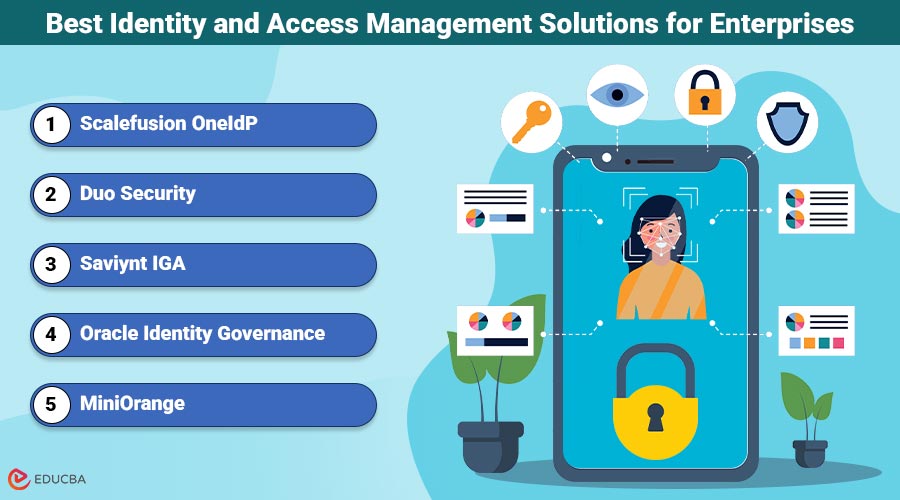
Identity and Access Management Solutions: Overview
Identity and access management has shifted from being a security checkbox to the backbone of enterprise defense. In 2025, with increasing cyber threats and stricter compliance requirements, choosing the right IAM solution is crucial. The best Identity and Access Management Solutions help control who gets access, protect sensitive data, and ensure smooth operations. Choosing the best IAM Solutions is not optional—it is crucial for business survival.
Before exploring the top 10 solutions, let us understand the main types of Identity and Access Management Solutions and their importance.
Understanding the Types of IAM Solutions
Choosing among these IAM products and identity access management solutions is not a checkbox exercise. It is about aligning security, scale, and operational efficiency. The best IAM solutions do more than authenticate; they become the backbone of safe, agile IT operations.
- Cloud IAM: Quick provisioning and monitoring at scale, no on-prem overhead.
- On-Prem IAM: Full control over sensitive identity data.
- Federated IAM: Secure single sign-on across organizations for seamless collaboration.
- RBAC: Role-based permissions that cut errors and streamline operations.
- PAM: Protects high-risk accounts and critical systems from misuse.
Best Identity and Access Management Solutions for Enterprises
Here is a breakdown of the best IAM Solutions in 2025 that help organizations secure access, streamline user management, and maintain compliance.
1. Scalefusion OneIdP
Scalefusion OneIdP is a contextual access management platform built on UEM for a secure zero-trust model. It enforces conditional access using UEM-driven zero trust principles, ensuring that only compliant, managed devices can access corporate emails and work apps.
With SSO, MFA, and Just-In-Time Admin Access across Android, Windows, macOS, and Linux, OneIdP combines security and usability, giving IT teams control without slowing users down. Its device-aware approach enables context as per geofencing, location-based access, and automated provisioning. Thus, protecting sensitive data while streamlining operations. For organizations seeking strong zero trust enforcement at scale, OneIdP delivers both power and precision.
Key Features:
- Real-Time Device Checks: Verifies posture, location, and security before granting access.
- Strong Device Authentication: Blocks unapproved devices, even with correct credentials.
- Identity Federation: Enables secure single sign-on across multiple organizations and systems.
- SAML, OAuth, OIDC App Support: Provides seamless access to a wide range of applications.
- Browser-Based SSO: Allows logins only via verified browsers on compliant devices.
- Just-In-Time Admin Access: Grants temporary elevated privileges when needed.
- User Portal: Offers one central access point for all work applications, removing the need for multiple logins.
- Shared Device & User-Based Profiles: Manages access efficiently across users and devices.
- Consistent Policy Enforcement: Applies unified rules across Windows, macOS, Android, and iOS.
- Detailed Access Logs: Tracks users, devices, and sessions for easier audits.
Pros
- Guarantees that access is granted only to verified users and approved devices.
- Simplifies profile management with out-of-the-box directory services.
- Strengthens security through conditional policies and device access controls.
- Improves frontline productivity with passwordless authentication.
- Connect with identity providers like Ping One, AWS, Okta, Microsoft Entra (formerly Azure AD), and Google Workspace.
Cons:
- Needs Admin Access to Scalefusion UEM
2. Duo Security
Duo Security, part of Cisco, secures access with multi-factor authentication and device health checks. Built for Zero Trust, it ensures only verified users on secure devices can access corporate systems. Supporting 200+ cloud and on-prem apps, Duo is easy to deploy, though full identity lifecycle management requires pairing with broader IAM solutions.
Key Features:
- Multi-Factor Authentication (MFA): Introduces an additional step of authentication to enhance security.
- Device Health and Trust Checks: Confirms devices meet security standards before allowing access.
- Adaptive Access Policies: Adjusts access based on risk, location, and user behavior.
- SSO Integrations: Provides seamless access across multiple apps without repeated logins.
- Reports and analytics: Tracks access events, user activity, and security posture for better visibility and audits.
Pros:
- Easy to set up and use
- Strong device-focused security
- Scales well across hybrid environments
Cons:
- Limited governance and lifecycle management
- May require integration with other IAM tools
3. miniOrange IAM Solution
Based in Pune, India, miniOrange is a globally recognized provider of identity and access management (IAM) and cybersecurity solutions. The miniOrange IAM Solution helps organizations across industries such as healthcare, banking and finance, education, e-commerce, and government secure digital identities, enforce strong access controls, and meet regulatory compliance requirements.
Designed for modern cloud, on-premises, and hybrid IT environments, miniOrange delivers a unified IAM platform that covers workforce, privileged, and customer identity use cases. With 6000+ pre-built integrations and support for custom/in-house applications, organizations can centralize identity security across their entire ecosystem.
Key Features:
- Enterprise Single Sign-On (SSO): One-click access to cloud, on-premise, and custom apps using SAML, OAuth, and OIDC.
- Multi-Factor Authentication (MFA): Secure access with 15+ authentication methods, including biometrics, FIDO2, and passkeys.
- Adaptive Authentication: Apply risk-based policies based on contextual signals such as device, location, and behavior.
- Automated User Provisioning: Streamline onboarding and offboarding with SCIM-based lifecycle management.
- Directory Integration: Sync identities with AD, LDAP, and other directories for centralized authentication.
- Access Gateway: Extend modern authentication to legacy applications without code changes.
- Centralized Access Control: Manage users, roles, and policies from a unified dashboard.
- Reports & Analytics: Monitor access activity with real-time insights and audit-ready logs.
Pros:
- Supports cloud, on-premise, and hybrid deployments
- 6000+ integrations plus custom/in-house app support
- Strong SSO capabilities across modern and legacy applications
- 15+ MFA methods, including passwordless authentication
- Integrated IAM, PAM, and CIAM within a unified platform
- Compliance-ready for HIPAA, GDPR, SOC 2, and other global standards
- Flexible pricing starting at $2 per user per month
Cons:
Intelligent authentication and deeper behavioral analytics can be further enhanced for faster, context-aware access decisions.
4. Saviynt IGA
Saviynt Identity Governance and Administration serves enterprises that require strict compliance and strong security controls. It provides detailed entitlement management, segregation-of-duties policies, and continuous risk monitoring. Integrating with cloud and on-prem systems, it offers unified identity controls and strong audit capabilities, though deployment can be complex and may need dedicated teams.
Key Features:
- Identity Governance & Administration: Centralizes identity and access control.
- Fine-Grained Role & Entitlement Management: Assigns precise permissions, reducing risk.
- Access Request Workflows: Streamlines requests and approvals securely.
- Risk-Based Analytics: Detects potential threats through user behavior.
- Compliance Reporting Tools: Simplifies audits with clear access reports.
Pros:
- Strong governance capabilities
- Excellent for compliance-heavy sectors
- Rich reporting and analytics
Cons:
- Complex implementation
- It may be overkill for smaller organizations
5. Oracle Identity Governance
Oracle Identity Governance helps large enterprises manage complex user lifecycles and enforce detailed access policies. It automates provisioning, enforces least-privilege access, and provides detailed compliance reporting across cloud and on-prem systems. Ideal for Oracle-centric environments, it addresses role sprawl and audit gaps, though implementation and maintenance require significant expertise.
Key Features:
- User Provisioning & Deprovisioning: Quickly adds or removes user access.
- Role-Based Access Control (RBAC): Assigns permissions based on roles.
- Policy Enforcement: Ensures consistent application of access rules.
- Workflow Automation: Streamlines approvals and routine tasks.
- Audit & Compliance Tools: Tracks access and simplifies regulatory reporting.
Pros:
- Highly customizable for large enterprises
- Deep integration with Oracle products
- Mature, proven solution
Cons:
- Complex to deploy and maintain
- Requires significant resources
6. MiniOrange
MiniOrange provides SSO, multi-factor authentication, and adaptive access controls, tailored for small to midsize businesses. With hundreds of pre-built integrations, it reduces password fatigue and inconsistent policies. Offering risk-based authentication and API protection, it delivers advanced security simply, though deeper governance and compliance may require additional tools.
Key Features:
- Single Sign-On (SSO): Access multiple apps with one login.
- Multi-Factor Authentication (MFA): Provides an additional safeguard to strengthen overall protection.
- Adaptive Authentication Policies: Adjusts access based on risk and context.
- User Provisioning: Quickly grants or revokes access.
- Pre-Built Integrations: Connects seamlessly with common apps and systems.
Pros:
- Budget-friendly pricing
- Quick deployment
- Good support for custom workflows
Cons:
- Limited advanced governance features
- Some UI elements feel dated
7. Omada Identity
Omada Identity brings strong identity governance to the table, with features like role-based access control, policy-driven access reviews, and automated provisioning tied to business workflows. It is not an access management solution like Pin, but complements it well by handling governance, audit readiness, and access certifications.
Key Features:
- Identity Governance & Administration (IGA): Centralizes identity and access management.
- Role-Based Access Control (RBAC): Assigns permissions based on roles.
- Access Request & Approval Workflows: Streamlines requests and approvals.
- Policy-Based Access Reviews & Certifications: Ensures access aligns with policies.
- Automated Provisioning & Deprovisioning: Quickly grants or removes access.
- Integration with HR Systems & Directories: Syncs identities across systems.
- Audit & Compliance Reporting: Tracks activity and simplifies audits.
Pros
- Strong governance and compliance focus
- Flexible role and policy management
- Automates user lifecycle with clear controls
- Good integration options for enterprise systems
Cons
- Setup and configuration can be complex
- UI feels dated compared to modern SaaS tools
- Longer deployment timelines for large organizations
8. OneLogin
OneLogin simplifies identity and access management with secure SSO, adaptive authentication, and automated user provisioning. It integrates with cloud apps and directories for centralized control. With SmartFactor Authentication and a clean admin interface, it reduces credential risk and scattered identities, though organizations with complex compliance needs may require additional tools.
Key Features:
- Single Sign-On & Directory Integration: Access multiple apps through one login, synced with directories.
- Multi-Factor Authentication (MFA): Adds extra verification for stronger security.
- Adaptive Access Policies: Adjusts access based on risk and context.
- User Provisioning Workflows: Streamlines granting and revoking access.
- Pre-Built App Integrations: Connects quickly with common applications.
Pros:
- Simple to set up and manage
- Great user experience
- Scales well with cloud adoption
Cons:
- Limited advanced governance capabilities
- Pricing can increase with enterprise features
9. Ping Identity
Ping Identity provides enterprise-grade SSO, adaptive authentication, and federation for hybrid and multicloud environments. Supporting standards like SAML, OAuth, and OpenID Connect, it connects modern and legacy apps seamlessly. Known for flexibility and robust policies, it handles complex access needs but can be challenging to deploy without experienced teams.
Key Features:
- SSO & Federation: Single login across apps and organizations.
- MFA & Adaptive Authentication: Adds verification and adjusts access by risk.
- Directory Integration: Syncs identities across systems.
- API Security: Protects data and services from unauthorized access.
- Risk-Based Access Controls: Grants access based on user behavior and context.
Pros:
- Strong support for hybrid IT
- Highly configurable
- Enterprise-grade security
Cons:
- Complex setup
- It can be expensive for smaller teams
10. ManageEngine ADManager Plus
ManageEngine ADManager Plus simplifies Active Directory and Exchange management. It streamlines user provisioning, access reviews, and compliance reporting, while automating tasks and safely delegating permissions. Ideal for AD-heavy environments, it provides detailed audit trails but has limited support for cloud-first IAM and SaaS integrations.
Key Features:
- AD User Lifecycle Management: Manage user accounts from creation to removal.
- Role-Based Access & Delegation: Assign permissions based on roles and responsibilities.
- Automated Provisioning: Quickly grant or revoke access.
- Compliance Reports & Audits: Track activity and simplify audits.
- Workflow Automation: Streamline approvals and routine identity tasks.
Pros:
- Excellent for Microsoft-centric environments
- Saves time with bulk operations
- Intuitive interface
Cons:
- Limited support for non-Microsoft apps
- Less suited for full cloud IAM
11. CyberArk
CyberArk focuses on privileged access management, protecting high-risk and admin accounts. It provides credential vaulting, session monitoring, and just-in-time access to secure sensitive systems. CyberArk helps reduce insider threats and supports compliance, but it works best alongside broader identity platforms instead of serving as a complete IAM solution.
Key Features:
- Privileged Account Security: Protects high-risk accounts from misuse.
- Credential Vaulting & Rotation: Secures and regularly updates passwords.
- Session Recording & Monitoring: Tracks privileged sessions for accountability.
- Threat Analytics: Detects suspicious activity and potential risks.
- Just-In-Time Access: Grants temporary elevated privileges only when needed.
Pros:
- Industry-leading protection for privileged accounts
- Strong auditing and compliance tools
- Deep visibility into high-risk access
Cons:
- Complex deployment
- Not designed for general IAM alone
Final Thoughts
Selecting a strong IAM solution, such as Oracle Identity or Duo Security, is just the first step in protecting your business. Even the most advanced platforms can still leave security gaps after login, since unsecured devices, outdated software, and inconsistent policies continue to create risks. Your IAM controls who signs in, but solutions like OneIdP verify every device, browser, and session against your standards before granting access, adding stronger control and consistency to protect users and data.
Recommended Articles
We hope this guide to identity and access management solutions helps you strengthen your enterprise security. Check out these recommended articles for more insights and strategies to protect your business.


