
What is Hyperautomation?
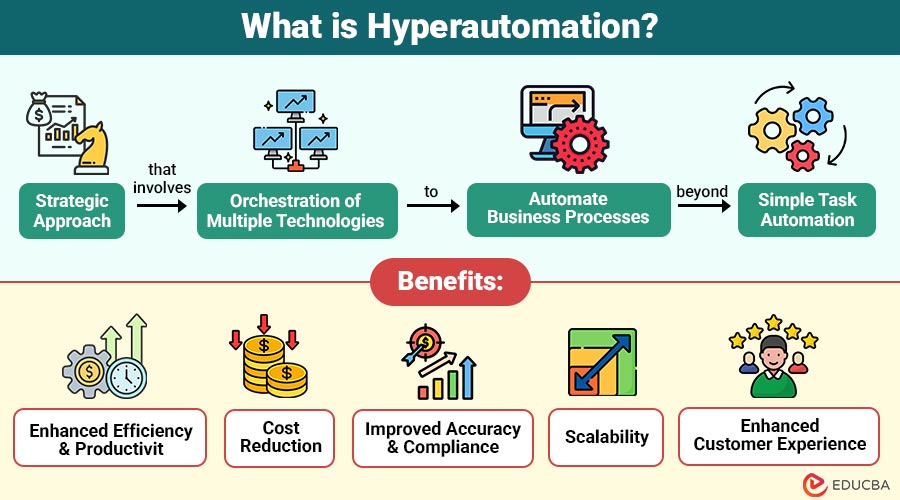
Hyperautomation is a strategic approach that involves the orchestration of multiple technologies to automate business processes beyond simple task automation.
Unlike traditional automation, which focuses on repetitive and rule-based tasks, hyperautomation leverages artificial intelligence (AI), machine learning (ML), robotic process automation (RPA), process mining, and other intelligent tools to create self-learning, adaptive, and fully integrated systems.
Table of Contents:
Key Takeaways:
- Hyperautomation integrates diverse technologies to achieve intelligent, scalable, and continuous business process improvement.
- Strategic adoption of hyperautomation boosts operational agility, enabling faster adaptation to evolving market demands.
- Combining AI, RPA, and analytics enhances decision-making and unlocks new growth opportunities for organizations.
- Effective hyperautomation demands robust governance, stakeholder collaboration, and continuous optimization for sustainable success.
How Hyperautomation Works?
Hyperautomation follows a structured approach:
1. Discovery and Analysis
Organizations use process and task mining tools to find repetitive or complex tasks that can be automated, boosting efficiency and delivering clear business results.
2. Design and Modeling
Teams map, analyze, and redesign processes for efficiency, configuring RPA bots and AI/ML models to execute tasks accurately and integrate seamlessly across systems.
3. Automation Execution
Set-up bots, AI tools, and machine learning programs work together to automate tasks, manage complex work, and make sure everything runs smoothly across different apps and parts of the business.
4. Monitoring and Optimization
Continuous monitoring tracks process performance. AI-driven analytics detect inefficiencies, provide actionable insights, and guide process refinement, ensuring hyperautomation evolves with changing business requirements.
5. Continuous Feedback Loop
Insights from monitoring feed back into process redesign and automation improvements, enabling agile, responsive operations that adapt to organizational needs and maximize automation ROI.
Benefits of Hyperautomation
Hyperautomation offers multiple advantages that extend beyond traditional automation:
1. Enhanced Efficiency and Productivity
Automating repetitive and complex tasks lets employees focus on strategic, creative, and customer-focused work, increasing productivity and reducing delays.
2. Cost Reduction
Automation reduces labor costs and operational errors by doing away with the need for manual intervention. Additionally, it expedites the execution of processes, saving resources and time.
3. Improved Accuracy and Compliance
Hyperautomation reduces human errors, ensuring high data accuracy. Additionally, it offers audit trails, assisting with regulatory compliance in sectors including insurance, banking, and healthcare.
4. Scalability
Hyperautomation helps organizations grow efficiently by automating complex or time-consuming tasks, allowing expansion without needing many extra resources.
5. Enhanced Customer Experience
Faster and error-free processes lead to improved service delivery. Customers benefit from quicker responses, personalized services, and consistent experiences across channels.
Challenges of Hyperautomation
Despite its advantages, hyperautomation comes with challenges:
1. Complex Implementation
Integrating multiple automation technologies requires careful planning and skilled resources. Without proper strategy, organizations risk failed or partial implementations.
2. Change Management
Employee resistance to implementing new automated procedures may stem from their inexperience with new tools or fear of losing their jobs. Training initiatives and change management must be done well.
3. Data Quality Issues
High-quality data is essential for automation systems. Inaccurate outputs and decreased efficacy of AI-driven automation can result from poor data quality.
4. Cybersecurity Risks
Automated systems can create new vulnerabilities if not properly secured. Ensuring robust security measures is critical to protect sensitive data.
Real World Applications of Hyperautomation
Hyperautomation is transforming businesses across various industries:
1. Banking and Financial Services
2. Healthcare
Hospitals and clinics automate patient records, billing, and insurance claims while using AI for medical imaging and predictive care, improving accuracy, efficiency, and overall patient outcomes.
3. Manufacturing
Hyperautomation helps manage the supply chain, track inventory, and predict maintenance needs, making production more efficient, reducing downtime, and allowing manufacturers to react quickly to changes in operations and market demands.
4. Retail and E-commerce
Retailers use automation to handle orders, update inventory, and run personalized marketing, which boosts efficiency, cuts mistakes, and improves customer satisfaction both online and in stores.
5. Telecommunications
Telecom companies use automation to improve customer service, manage support tickets, and monitor networks, leading to faster problem-solving, more reliable service, and better network performance for users.
Best Practices for Hyperautomation
To ensure a successful hyperautomation journey, organizations should follow these best practices:
1. Start Small and Scale Gradually
Start by automating simple tasks that bring big benefits. Then slowly move to more complex workflows, making sure the transition is smooth and risks are kept low for the whole organization.
2. Focus on Data Quality
Maintain accurate, consistent, and reliable data. High-quality data ensures AI, ML, and RPA systems perform effectively and deliver actionable, precise automation results.
3. Engage Stakeholders
Include employees, managers, and IT teams from the beginning. Involving stakeholders helps automation get accepted, reduces pushback, and ensures it meets business goals.
4. Continuously Monitor and Optimize
Use analytics to monitor automated processes, find slow spots, and keep improving workflows. This helps your work run faster, supports growth, and ensures operations meet changing business needs.
5. Invest in Training and Upskilling
Train employees to work with automation tools. Upskilling helps teams handle advanced systems, boost productivity, and use hyperautomation effectively.
6. Ensure Security and Compliance
Use strong security protections and follow the rules for your industry. Keep important data safe and meet legal requirements while setting up and growing automated systems.
Future Outlook of Hyperautomation
Here are some key trends shaping the future of hyperautomation:
1. Deeper AI Integration
Hyperautomation will utilize advanced AI to understand unstructured data, predict outcomes, and enable autonomous workflows with natural language understanding.
2. End-to-End Intelligent Automation
Businesses will use fully connected systems that combine process discovery, task execution, and optimization, enabling continuous automation across different functions with shared intelligence.
3. Low-Code/No-Code Hyperautomation Platforms
Accessible low-code and no-code tools will empower non-technical users to design, deploy, and manage automation without extensive IT resources.
4. Process Discovery and Optimization at Scale
Organizations will leverage process and task mining to identify inefficiencies, test improvements, and implement intelligent automation across enterprise operations.
5. Enhanced Decision-Making with Predictive Analytics
Final Thoughts
Hyperautomation combines RPA, AI, ML, process mining, and intelligent document processing to simplify complex processes, increase efficiency, and support better decision-making. This smart system lowers costs, improves accuracy, and enhances customer experiences. In today’s competitive digital world, using hyperautomation strategically is crucial for growth, agility, and scalability, making it a must-have for businesses.
Frequently Asked Questions (FAQs)
Q1. How is hyperautomation different from RPA?
Answer: RPA automates repetitive, rule-based tasks, while hyperautomation combines RPA with AI, ML, and process mining to automate end-to-end business processes intelligently.
Q2. Which industries benefit most from hyperautomation?
Answer: Banking, healthcare, manufacturing, retail, and telecommunications are some industries that gain significant advantages from hyperautomation.
Q3. Can hyperautomation replace human employees?
Answer: By automating monotonous and repetitive processes, hyperautomation enhances human labor by freeing up staff members to concentrate on higher-value tasks. It is not intended to replace people completely.
Q4. How can organizations start their hyperautomation journey?
Answer: Organizations should start with process discovery, identify high-impact automation opportunities, deploy RPA and AI solutions, and continuously monitor and optimize automated processes.
Recommended Articles
We hope that this EDUCBA information on “Hyperautomation” was beneficial to you. You can view EDUCBA’s recommended articles for more information.

