


Transforming Law Firms with Smart HR Practices
When we discuss HR for law firms, what comes to mind are its fundamental functions in a legal environment. These functions encompass improving candidate recruitment and selection, managing employment contracts and internships, ensuring employee safety, including updating job descriptions, and providing training commonly required by the department, whether hiring an in-house paralegal or virtual assistant for lawyers.
While these functions encompass a broad range of responsibilities, they primarily address challenges faced by teams and are not limited to legal matters. They include everything from providing feedback to managing conflicts, making HR for law firms an essential component of internal operations.
However, this is the minimum scope of HR’s reach, often present when the sector is in its implementation phase. Suppose the firm is determined to go deeper. In that case, it will want to build an increasingly strategic HR department that contributes to improving service delivery and participates in administrative management by offering more accurate data, often responsible for removing subjectivity and adding professionalism to matters involving people (practically everyone) within society.
Investing in HR involvement in the firm’s administrative strategy brings numerous advantages.
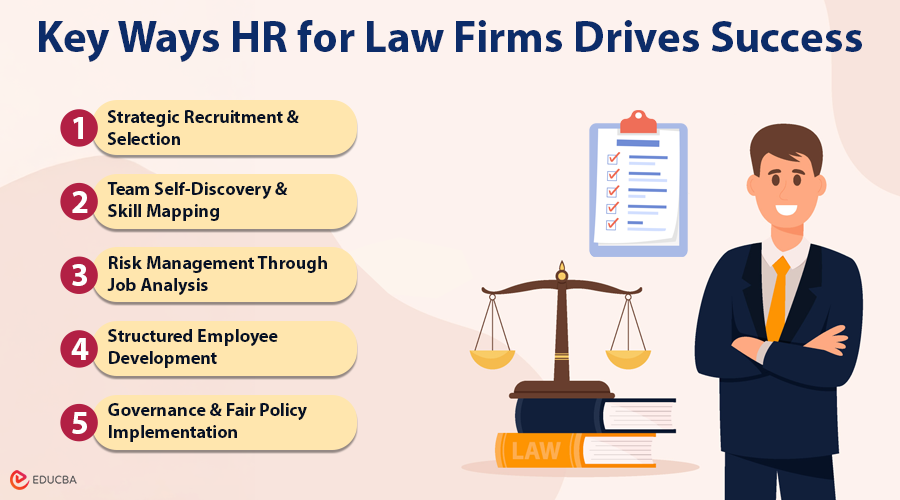
Key Ways HR for Law Firms Drives Success
Here are some ways HR for law firms drives success:
#1. Strategic Recruitment and Selection
The first advantage of HR for law firms lies in implementing an impartial recruitment and selection process that aligns with the firm’s mission and service delivery goals. Here, it is not enough to have a strong résumé or a connection with a partner. Candidates must demonstrate technical competence, as evidenced by a practical test designed by the hiring team, and align with the behavioral profile required for the position.
The most “qualified” candidate is not always the right choice. Often, the ideal candidate is the one who complements the internal team’s skill gaps, adding value in both technical and interpersonal areas. HR for law firms thus becomes critical to ensuring a high-performing team.
#2. Team Self-Discovery and Skill Mapping
The second advantage of a strategic HR department that directly engages with the search for candidates with skills that complement those of the internal team is the implementation of self-discovery sessions with the internal team.
These sessions enable team members to assess their skills and those of the group, thereby complementing recruitment and selection processes. Knowing the skills present and absent within the team makes it easier to identify suitable candidates in the market when a position opens up, and/or enables internal team changes to maximize each member’s skills.
#3. Risk Management Through Job Analysis
Another advantage is the management of employees’ PPRA and PCMSO, provided it takes on a more in-depth approach, with a critical analysis of job descriptions, aiming to prevent labor risks related to, for example, the same positions and different salaries, job accumulation and job misuse, as well as a lack of information to employees regarding their job responsibilities.
Otherwise, if HR merely describes positions and prepares PPRA and PCMSO documents with occupational medicine without such analysis and without prioritizing information to employees regarding their job duties, such documents may serve as evidence against the firm for unresolved labor risks.
#4. Structured Employee Development
Instead of relying on sporadic training sessions, HR for law firms should implement structured development programs that utilize proven methodologies, such as coaching. These can target leadership growth, productivity, and well-being, delivered through certified professionals.
It must be delivered by a professional certified by a reliable and renowned institution in the field. The firm assesses the results after each development program to measure the return on investment.
Still, regarding measuring results, people management indicators can and should be measured to monitor macro-level developments over time in events related to the firm’s people.
Examples of indicators include turnover, absenteeism among employees, the number and expenditure on sick leave, the predominance of gender and age in the office, the number of employees by employment type, the average length of stay in the office, the predominant profile in the office, and comparisons with the chosen business model.
#5. Governance and Fair Policy Implementation
Another important point is that HR always works closely with the partners to validate institutional rules on various topics. As anyone who has studied law will tell you, without rules, any company would collapse.
Thus, HR’s role is to raise issues that require rules because they have the potential to generate conflict within the team, request approval from the partners, and, finally, make these rules known to all employees, which facilitates the maintenance of well-being and clarity in the workplace.
It is also HR’s responsibility to develop fair profit distribution options based on objective criteria and, after approval from the partners, manage them optimally in conjunction with the finance department.
Final Thoughts
When a law firm employs strategic HR practices, HR for law firms transitions from a support role to a vital component in enhancing performance and workplace culture. By focusing on the people behind the legal services—through structure, support, and development—firms can unlock new levels of excellence and client satisfaction.
Recommended Articles
We hope this article on HR for law firms has helped you understand how strategic HR practices can elevate legal team performance and workplace culture. Explore these recommended articles for expert insights on legal team management, law firm growth strategies, and HR best practices in the legal industry.


