


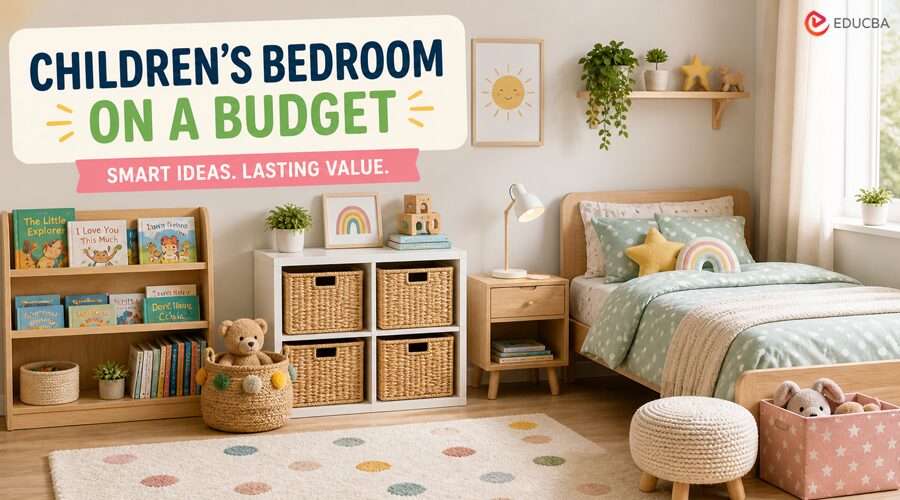
Furnishing a children’s bedroom on a budget that is real rather than theoretical requires a clear framework for deciding where to spend more and where to spend less. The common mistake is either spending uniformly across every category, ending up with a room full of medium-quality pieces that need replacing at medium intervals, or spending only on what is cheapest in every category, which produces a room where important pieces fail within a few years. The total cost of replacements exceeds what a more considered initial investment would have cost.
A considered children’s bedroom on a budget approach identifies which pieces warrant a higher investment for long-term performance and which can be addressed with more affordable options without significant compromise.
Key Takeaways
- A considered budget for a children’s bedroom allocates more to pieces used most intensively and daily, such as the bed, the kids bookshelf, and the primary storage unit, and less to pieces used less frequently or with lower safety criticality.
- The bookshelf is the children’s bedroom furniture piece with the highest return on quality investment because it is used every day from the earliest months and serves across the full span of childhood.
- Safety-critical pieces, including the sleep surface and any freestanding furniture in an unsupervised child’s room, should not be the primary cost-reduction targets in a budget.
- Second-hand furniture can be appropriate for non-safety-critical pieces in good structural condition. However, it should be checked carefully for lead paint and structural integrity before use in a child’s bedroom.
- Buying fewer, better pieces and adding over time is more effective than buying many affordable pieces at once. One excellent bookshelf serves the room better than three cheap ones purchased to address different problems.
Where to Invest More and Where to Spend Less?
| Piece | Investment Priority | Why | Budget Approach |
| Sleep surface
(cot or bed) |
High | Safety-critical, daily use | Buy quality, certify to Australian standards |
| Bookshelf | High | Daily use from 6 months, lasts 10+ years | Best long-term value in quality investment |
| Primary storage unit | High | Daily use, structural load | Quality construction pays off quickly |
| Wardrobe | Medium | Important but less daily stress | Mid-range quality is appropriate |
| Bedside table | Low | Low stress, easily replaced | Affordable option is appropriate |
| Decorative accessories | Low | Change as child grows | Budget, change with child’s preferences |
| Textiles
(bedding, rug) |
Low to medium | Change frequently, no safety criticality | Mid-range, choose for durability |
The Bookshelf is the Best Long-Term Budget Decision
In a considered budget for a children’s bedroom, the bookshelf deserves a higher investment relative to its purchase price than almost any other piece. The reasons are straightforward: it is used every day for around six months, it serves across the full span of childhood from the first board books through to the school-age reading collection, and its quality, specifically the panel thickness, join construction, and finish durability, determines how long it performs before needing replacement.
A quality children’s bookshelf purchased at six months and still performing at ten years old represents a very different cost-per-year than a budget bookshelf purchased at six months, replaced at three years, and again at seven. The total cost of three budget bookshelves often exceeds that of a single high-quality piece. The budget decision that is most financially sound over the full use period is the quality purchase at the outset.
Smart Ways to Save in a Children’s Bedroom on a Budget
Buy in Stages, Not All at Once
Spreading the purchase of a children’s bedroom over time, rather than buying everything before a baby arrives, is the most effective budgeting strategy for most families. Parents genuinely need nursery essentials like a cot and a change table before the birth. We have needed a bookshelf for about six months. Parents can add a wardrobe and dresser when the child reaches the toddler stage. The larger bookcase can come at the school stage. Spreading purchases over three to five years makes higher-quality purchases individually affordable within the family’s cash flow.
Choose Adaptable Pieces That Span Stages
A convertible cot that converts to a toddler bed eliminates the need for a separate purchase. A bookshelf with adjustable shelves that grow from picture-book display to chapter-book storage eliminates the need for an upgrade. A combined bookshelf and storage unit that accommodates both books and toys eliminates the need for a separate toy-storage piece. Each of these choices reduces the total number of purchases needed across the full span of the child’s bedroom years.
Use Second-Hand for the Right Categories
Second-hand furniture is appropriate for the low-to-medium investment categories identified in the table above: bedside tables, decorative accessories, and some textiles. For bookshelves and primary storage units in a child’s room, secondhand pieces should be carefully assessed for structural integrity, lead paint on surfaces that children regularly touch, and the quality of joins and panel stability before purchase. The total cost of replacing a structurally failing second-hand bookshelf often exceeds that of a high-quality new one.
Final Thoughts
A well-planned children’s bedroom on a budget is not about spending less everywhere; it is about spending wisely. Invest in high-use, long-term pieces, save on flexible or decorative elements, and avoid the cycle of repeated replacements. When done right, a children’s bedroom on a budget delivers both financial efficiency and a functional, long-lasting space that grows with your child.
Frequently Asked Questions (FAQs)
Q1. Is it possible to create a good children’s bedroom on a budget?
Answer: Yes, focus on priorities. Parents should not compromise on a safe, certified cot, as it is essential. Everything else can be flexible. One good, affordable bookshelf, a simple toy basket, and a secondhand rug are enough to create a functional space. Invest most in the bookshelf; add the rest over time.
Q2. What is the minimum viable children’s bedroom furniture set?
Answer: Sleep surface, one bookshelf, one storage solution for toys and everyday items, and appropriate bedding. A wardrobe or dresser for clothing can follow at the toddler stage. Schools can add a study area for school-age students. The absolute minimum for a functional, reading-friendly children’s bedroom is a safe place to sleep, a bookshelf with accessible books, and a place for toys that is not the floor.
Q3. Should I buy flat-pack or pre-assembled children’s furniture on a budget?
Answer: Flat-pack furniture from good brands can be just as strong as pre-assembled furniture but costs less because it saves on storage and shipping, not quality. The key difference is quality: well-made flat-pack uses solid materials and construction, while cheaper versions use thin panels and weaker joints, which don’t last as long.
Q4. How do I avoid buying children’s furniture that needs to be replaced too soon?
Answer: Ask three questions before purchasing: Is the panel thickness specified at 18mm or above? Do the descriptions include join methods other than cam locks alone? Is the finish explicitly certified for children’s products? A bookshelf that answers yes to all three is likely to serve the room for many years. One who cannot answer these questions confidently risks the budget approach not being worth taking.
Recommended Articles
We hope this guide on creating a children’s bedroom on a budget helps you make smarter furniture choices and build a functional, long-lasting space without overspending. Explore the recommended articles below to discover budget-friendly design ideas, space-saving solutions, and practical tips for growing with your child’s needs.

