


A Modern Approach to Organizational Management
In a traditional workplace, you usually have a hierarchy — CEO at the top, managers in the middle, and employees at the bottom. But what if there was a completely different way to run a company — one that removed job titles, empowered employees to make decisions, and encouraged flexibility? That is what holacracy aims to do. Let us explore what holacracy is, how it works, and why companies around the world are experimenting with this bold system of management.
Table of Contents
- Introduction
- What is Holacracy?
- How Does Holacracy Work?
- Key Principles
- Why Organizations Adopt Holacracy?
- Real-World Examples
- Challenges of Holacracy
- Is Holacracy Right for Your Business?
- Holacracy vs. Traditional Hierarchy
What is Holacracy?
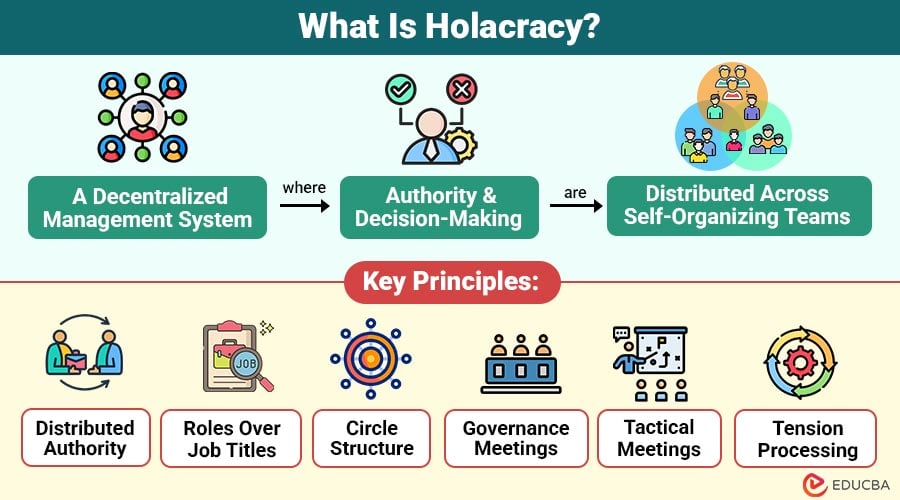
Holacracy is a decentralized management system where authority and decision-making are distributed across self-organizing teams rather than being held by a traditional management hierarchy. Each person holds one or more roles, each with specific domains of authority and accountability rather than a fixed manager–report line. Brian Robertson developed the framework at Ternary Software in the early 2000s, formalized it via the holacracy Constitution around 2010, and ratified it in 2013. It codifies how roles, governance, and operational decision-making should work.
How Does Holacracy Work in Practice?
Imagine a digital marketing company. In a traditional setup, you might have a CEO, department heads, and team members. In a Holacratic structure:
- The company organizes teams into circles such as “Content,” “Design,” and “SEO.”
- Each circle governs itself and defines specific roles like “Social Media Manager,” “Graphic Designer,” or “Analytics Coordinator.”
- A team member might hold multiple roles and be empowered to make decisions within those roles.
- The team holds governance meetings monthly to refine roles, address tensions, and adapt to change.
Team members make decisions at the level where information is most relevant, enabling faster adaptation without waiting for a manager’s approval.
Key Principles of Holacracy
Below are the core principles that guide how holacracy functions:
- Distributed Authority: Power and decision-making are spread across self-organizing teams (called circles), not concentrated at the top.
- Roles Over Job Titles: Employees do not have static job titles. Instead, they take on multiple dynamic roles, each with clear responsibilities and expectations.
- Circle Structure: The organization is divided into semi-autonomous teams known as circles, each handling a specific function. These circles can create sub-circles, forming a nested structure.
- Governance Meetings: Circles regularly hold structured meetings to evolve roles and policies. These meetings give everyone a voice in organizing the work.
- Tactical Meetings: These meetings focus on day-to-day operations—tracking progress, resolving tensions, and assigning tasks.
- Tension Processing: “Tension” refers to the gap between what is and what could be. Holacracy encourages employees to raise tensions and seek solutions proactively.
Why Organizations Adopt Holacracy?
Organizations adopt holacracy to increase agility, transparency, and employee empowerment. Here are the main reasons behind this shift:
- Greater Agility: Organizations can respond quickly to changes without bureaucratic slowdowns. Example: Zappos adopted holacracy to enhance adaptability in a fast-moving retail market.
- Employee Empowerment: Employees are empowered to take initiative and make decisions in their roles. A study by Deloitte found that 83% of millennials prefer a flat organizational structure that gives them more autonomy.
- Improved Clarity: Everyone knows who is accountable for what. Roles and responsibilities are documented and regularly updated.
- Faster Problem-Solving: Teams address tensions as soon as they arise, resolving issues quickly and driving continuous improvement.
- Increased Innovation: Decentralized decision-making allows for faster experimentation and creative problem-solving.
Real-World Examples
Here are real-world companies that have adopted holacracy, either fully or in part:
1. Zappos
Industry: E-commerce
Headquarters: Las Vegas, USA
Adoption Year: 2014
Zappos made headlines when its CEO, Tony Hsieh, announced the company would adopt holacracy to eliminate traditional management. The goal was to create a more agile and employee-empowered culture.
Key Outcomes:
- About 14% of employees left within a year, partly due to the system’s complexity.
- Zappos removed traditional job titles and encouraged role-based work.
- Over time, they adapted holacracy to their needs, blending it with other methods.
2. David Allen Company
Industry: Productivity Consulting
Headquarters: California, USA
Famous For: “Getting Things Done” methodology
The creator of the famous GTD system, David Allen, implemented holacracy to improve internal clarity and responsiveness.
Key Outcomes:
- Improved alignment with GTD’s principles of structured autonomy.
- Enabled team members to handle multiple roles with clear boundaries.
3. Springest
Industry: Education Technology
Headquarters: Amsterdam, Netherlands
Springest has operated under holacracy since 2012. The team values transparency, self-management, and continual growth—principles supported by holacracy.
Key Outcomes:
- Developed a culture of open governance.
- Employees maintain and update their roles publicly using GlassFrog.
- Encourages a high level of accountability and autonomy.
Challenges of Holacracy
Despite its benefits, holacracy is not for everyone. Here are common hurdles:
- Steep Learning Curve: The governance processes and language of holacracy can be complex for newcomers. Terms like “tensions,” “lead links,” and “accountabilities” require training.
- Resistance to Change: Employees accustomed to traditional hierarchies may find it difficult to adapt, especially those who associate leadership with control.
- Not Ideal for All Sizes or Cultures: Small startups may find holacracy too heavy, while large enterprises may struggle with alignment across thousands of roles.
- Slower in the Beginning: Initially, the system may feel slow because of frequent meetings and procedural rules, but over time, it self-optimizes to improve efficiency.
Is Holacracy Right for Your Business?
Holacracy is not a one-size-fits-all solution.
It works best for:
- Fast-growing startups
- Agile software companies
- Remote or distributed teams
- Organizations valuing transparency and flexibility
It might not be suitable for:
- Highly regulated industries (e.g., finance, healthcare)
- Companies with rigid cultural or management structures
- Workplaces requiring strict chain-of-command protocols
Holacracy vs. Traditional Hierarchy
| Feature | Traditional Hierarchy | Holacracy |
| Decision-making | Top-down | Distributed across roles |
| Structure | Fixed job descriptions | Dynamic, evolving roles |
| Leadership | Managers and supervisors | Role-based authority |
| Adaptability | Slower | Highly adaptable |
| Communication | Siloed | Transparent and open |
| Innovation potential | Depends on leadership | Encouraged at every level |
Final Thoughts
Holacracy offers a compelling alternative to the traditional hierarchy by decentralizing power, promoting self-management, and enhancing organizational responsiveness. While not suited for every organization, those that implement it thoughtfully can experience significant benefits—greater employee ownership, faster decision-making, and a culture of continuous improvement. As the future of work continues to evolve, especially in remote and hybrid setups, systems like holacracy may become increasingly relevant in shaping how organizations function, innovate, and grow.
Frequently Asked Questions (FAQs)
Q1: Can Holacracy work in a small company?
Answer: Yes, smaller teams can benefit from the flexibility and clarity Holacracy provides. However, the structure may feel heavy if the team is very small (under 5 people).
Q2: Is Holacracy the same as a flat organization?
Answer: Not exactly. While both avoid traditional hierarchies, holacracy still has structure, just distributed and role-based.
Q3: How long does it take to implement?
Answer: Typically, 6–12 months for medium-sized organizations. It depends on team readiness and training investment.
Recommended Articles
We hope this guide to holacracy gives you a clear understanding of the system. Explore these recommended articles for more insights into flexible management systems and workplace innovation.


