


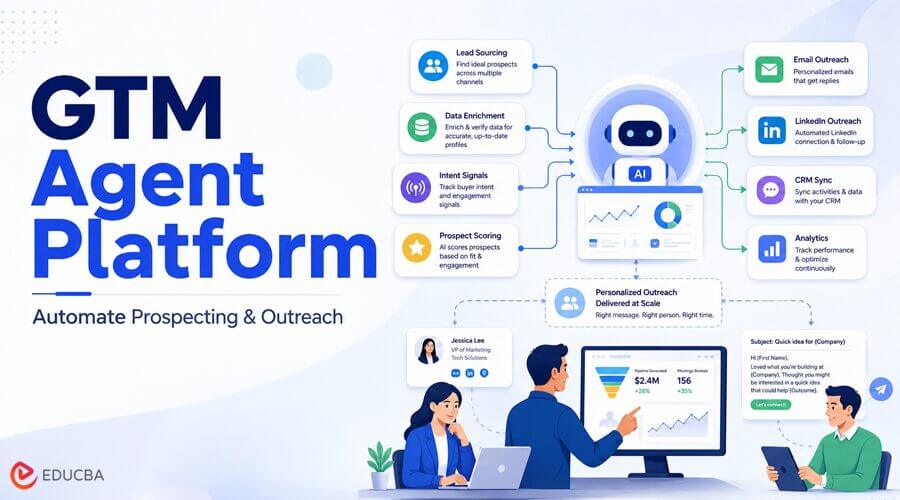
Go-to-market teams have spent the last decade stitching together point tools: a data provider here, a sequencing tool there, a CRM holding it all together with manual updates in between. That patchwork model is starting to break down under the weight of its own complexity. A newer category, the GTM agent platform, is emerging to replace fragmented workflows with autonomous systems that can research, prioritize, and engage prospects with far less manual input. This article breaks down what a GTM agent platform actually is, how it automates prospecting and outreach in practice, and what teams should weigh before adopting one.
What is a GTM Agent Platform?
A GTM agent platform is a system built around AI agents that can independently execute go-to-market tasks such as identifying target accounts, enriching prospect data, and generating outreach, rather than simply automating a single step in a workflow. This is a meaningful step beyond traditional sales engagement tools like Outreach or SalesLoft, which primarily manage sequencing and reminders for human reps to execute. It is also different from general-purpose automation tools like Zapier or Make, which move data between systems based on fixed rules but do not make independent decisions.
A GTM agent platform typically combines three elements: AI agents capable of reasoning over data and taking action, enrichment layers that pull in firmographic and behavioral signals, and orchestration logic that sequences these actions into a coherent workflow. The result is a system that behaves less like a tool a rep operates and more like a digital teammate handling defined portions of the pipeline.
Core Capabilities of GTM Agent Platforms
Most platforms in this category share a similar set of capabilities, even if the specific execution varies by vendor.
- Lead sourcing and enrichment: Agents pull contact and company data from multiple sources, then validate and enrich it, filling gaps in job titles, company size, tech stack, and contact details without a human manually cross-referencing tools.
- Intent signal detection: Rather than relying solely on static firmographic filters, agents monitor behavioral and technographic signals, such as hiring patterns, funding events, or website activity, to flag accounts that show buying intent.
- Autonomous prospecting: Once you define an ideal customer profile, agents can continuously build and refine target lists on their own instead of relying on a one-time export that becomes outdated within weeks.
- Personalized outreach generation: Agents draft messaging tailored to each prospect’s context, drawing on enriched data points rather than relying on generic, templated fields.
- Multi-channel execution: AI agents manage outreach across email, LinkedIn, and phone calls, changing the timing and channel based on how prospects respond instead of following one fixed plan.
Platforms such as Tapistro bring several of these capabilities together in a single system, pairing lead generation and signal monitoring with activation workflows so teams do not have to stitch together separate tools for each stage of the process.
How Does Prospecting Get Automated?
In a typical agent-driven workflow, the process starts with a defined ideal customer profile that covers firmographic criteria, buying signals, and disqualifying factors. From there, agents take over list-building: querying data sources, applying enrichment, and scoring accounts against the defined criteria.
The key difference from traditional prospecting is that this process continues even after building the first list. Agents continuously re-run enrichment and scoring as new data becomes available, meaning a list built this month should reflect current conditions rather than a one-time snapshot. This reduces the substantial manual research time SDRs traditionally spend cross-referencing LinkedIn, company websites, and internal notes before a single outbound message goes out.
How Does Outreach Get Automated?
Once qualified prospects are identified, GTM agent platforms extend automation into message creation and delivery. Rather than filling a template with a first name and company name, agents generate personalization based on the enriched data collected earlier: recent funding news, a specific pain point tied to company size, or relevant hiring activity. This creates clear, relevant messages without needing a person to write each one by hand.
Agents also manage follow-up logic, adjusting sequencing based on whether a prospect opened an email, clicked a link, or replied. Reply detection routes conversations appropriately, flagging interested responses for human handoff while automatically handling objections or scheduling requests where possible. Over time, agents can test subject lines, message styles, and send times, improving them based on results without needing a marketer to set up every test by hand.
Benefits for GTM Teams
The appeal of this category rests on a few concrete advantages.
- Speed: Time-to-first-touch shrinks significantly when list building, enrichment, and initial outreach happen without manual handoffs between tools.
- Scale:Teams can reach more good-fit accounts without hiring more people because AI agents handle much of the repeated research and writing.
- Consistency: Messaging quality becomes more uniform across the team, reducing variance caused by individual reps with different levels of research diligence or writing skill.
- Data quality:Because AI agents keep updating data instead of waiting for manual updates, CRM records stay current between outreach campaigns.
Limitations and Considerations
These platforms are not without tradeoffs, and teams evaluating them should approach the category with some caution. Data privacy and compliance remain a real concern. Automated enrichment and outreach at scale still need to operate within frameworks like GDPR and CAN-SPAM, and responsibility for compliance does not disappear simply because an agent is executing the workflow. There is also a risk that too much automation can make interactions feel less genuine.
Personalized messages based only on data can feel generic, and people are getting better at noticing AI-written messages that lack real value. Human oversight remains important. Agent output, particularly outbound messaging, benefits from periodic review to catch tone issues, factual errors, or messaging that drifts from brand voice. Finally, integration complexity should not be underestimated. These platforms typically need to connect deeply with existing CRM and data infrastructure, and the quality of that integration often determines whether the promised automation actually delivers on its potential.
How to Evaluate a GTM Agent Platform?
When comparing platforms, a few criteria matter more than flashy feature lists. Look closely at the quality and freshness of underlying data sources, since enrichment is only as good as what it pulls from. Assess integration depth with your existing CRM and tech stack rather than assuming compatibility. Check how much control you have over the agent’s actions and messages, because full automation without clear limits can put your brand at risk. Moreover, ask vendors directly about compliance features, data-handling policies, and how they handle opt-outs and regulatory requirements across the regions where you operate.
Final Thoughts
GTM agent platforms represent a genuine shift in how prospecting and outreach get executed, moving from tools that support human reps to systems that can independently handle significant portions of the pipeline. The field is still growing, and there are real challenges with monitoring, authenticity, and following the rules. Teams considering adoption should weigh these factors carefully against the speed and scale benefits before committing to a platform.
Recommended Articles
We hope this guide helps you understand how a GTM Agent Platform can automate prospecting and outreach to improve sales efficiency and accelerate business growth. Explore these recommended articles for more insights into AI sales automation, lead generation, CRM strategies, and go-to-market optimization.

