


Updated August 21, 2026
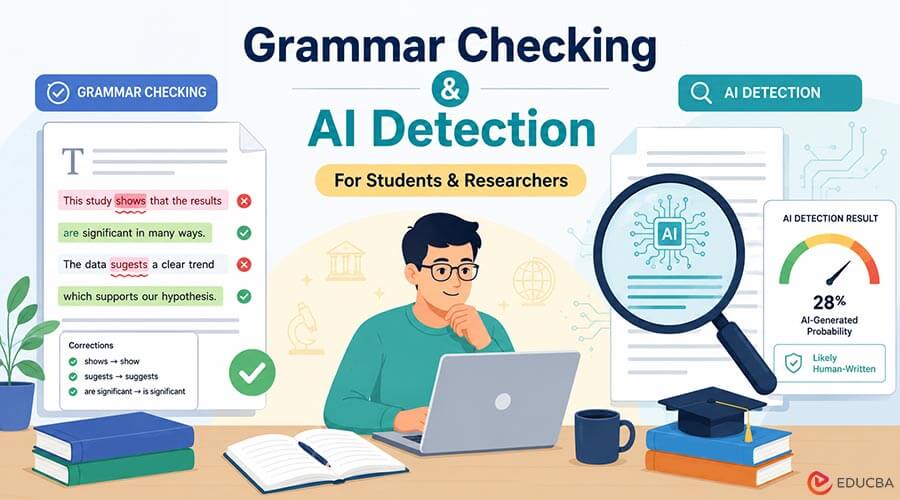
Students and researchers deal with two different writing problems. One is improving the language quality of a paper, thesis, dissertation, or assignment. The other is assessing whether a piece of text shows characteristics associated with AI-generated writing. These tasks require different tools. A Grammar Checker can help identify language problems, while an AI Detector can analyze text for signals associated with AI-generated writing. Understanding the difference between grammar checking and AI detection can help students, researchers, and educators use these tools more appropriately.
Trinka AI offers tools for both use cases, including a Grammar Checker designed for academic and technical writing and an AI Detector for analyzing written text.
What Are AI Writing Tools?
AI writing tools use computational language analysis to work with written text. Their capabilities vary by product. Some identify grammar, spelling, punctuation, sentence structure, and word choice issues. Others analyze text for patterns associated with AI-generated writing. For students and researchers, the useful question is not whether an AI writing tool is good in general. It is whether the tool fits the task.
A doctoral student preparing a thesis chapter has different requirements from a professor reviewing student submissions. A researcher preparing a journal manuscript may need language correction without changing technical terminology. An instructor may have a separate need to examine whether submitted work shows signs associated with AI generation. That distinction should guide how these tools are used.
How a Grammar Checker Helps Students and Researchers?
Academic writing has little room for ambiguity. A misplaced word, unclear sentence, or punctuation error can make an argument harder to understand. A Grammar Checker can scan written material and identify potential problems in areas such as:
- Grammar
- Spelling
- Punctuation
- Sentence structure
- Word choice
- Clarity
- Readability
For students, this can be useful when reviewing essays, assignments, research projects, and dissertations. For researchers, it can help during the language review of manuscripts, research papers, theses, and technical documents.
The author’s judgment remains important. Academic and scientific writing contains terminology, abbreviations, technical expressions, and discipline-specific language. A suggested correction should therefore be reviewed in context rather than accepted automatically.
Why Grammar Checking is Not the Same as Editing a Research Paper?
A language error and a research problem are not the same thing. Consider a sentence describing an experimental result. A grammar checker may identify a construction issue, but it cannot determine whether the experiment was designed correctly or whether the data support the conclusion.
The same applies to citations. A tool may help identify language problems around a citation, but the researcher still needs to verify that the cited source supports the claim. For that reason, language review should sit alongside substantive research review.
A practical sequence is:
Write → Review the research → Check the language → Verify the final manuscript
This keeps responsibility for the research with the author.
What Does an AI Detector Do?
An AI Detector addresses a different question. It analyzes written text and produces an assessment based on characteristics associated with AI-generated writing. This can be relevant in educational and research settings where people need to examine text more closely. An AI detector does not have access to a document’s complete history. It cannot see every draft, note, revision, or writing decision made by the author. That limitation matters.
An AI detection result should therefore be treated as an assessment that may warrant further review, not as conclusive proof of authorship or misconduct. OpenAI, for example, has stated that its research found AI detectors were not reliable enough to make consequential judgments about students.
Grammar Checking and AI Detection: What is the Difference?
The distinction can be stated simply:
| Tool | What it Examines | Main Purpose |
| Grammar Checker | Language and sentence construction | Find potential writing problems |
| AI Detector | Characteristics associated with AI-generated text | Assess whether text may show AI generation signals |
A Grammar Checker asks:
What could be improved in the language?
An AI Detector asks:
Does this text contain characteristics associated with AI-generated writing?
These are different questions. Using a grammar checker does not determine whether a person wrote the text, and an AI detector does not determine whether the research itself is correct.
How Students Can Use a Grammar Checker?
A grammar checker is most useful when it is part of the student’s own editing process.
- Start with the student’s own work: Develop the argument, evidence, analysis, and conclusions first.
- Review the substance: Check whether facts are accurate, sources are appropriate, citations are complete, and conclusions follow from the evidence.
- Run a language check: Use a Grammar Checker to identify possible problems with grammar, spelling, punctuation, sentence structure, and clarity.
- Review the suggestions: Read each correction before applying it. A change that improves general readability may not fit a particular academic context.
- Read the complete paper again: After making changes, read the document from beginning to end. Individual corrections can sometimes affect the meaning or flow of a larger argument.
Students should also check their institution’s rules before using AI-assisted writing tools. UNESCO recommends a human-centered approach to generative AI in education and research, with responsible implementation and careful consideration of its risks and opportunities.
How Researchers Can Use a Grammar Checker?
Researchers often work through several rounds of manuscript revision. Language checking can be useful during the later stages, when the research itself has already been reviewed.
A researcher might use a Grammar Checker to review:
- Abstracts: Check whether the abstract clearly communicates the research question, methods, results, and conclusion.
- Introduction: Look for unclear sentences, unnecessary repetition, and language problems that make the research context difficult to follow.
- Methods: Review sentence construction while preserving technical terminology and the exact meaning of methodological descriptions.
- Results: Check the language used to describe findings without changing numerical values or scientific meaning.
- Discussion: Improve clarity when explaining the significance, limitations, and implications of the findings.
- Final manuscript: Perform a final language review before submitting the paper to the target journal.
The researcher remains responsible for verifying every change.
How AI Detection Fits Into Academic Work?
AI detection is a separate part of the writing and review process. For example, an institution may want to examine a submission when there is a question about how the text was produced. An instructor may use an AI detection result as one part of a broader review. A researcher may also want to understand how a document is classified by a particular detection system. The result should be handled carefully.
Research and institutional guidance have raised concerns about false positives and the limitations of using AI detection scores as standalone evidence. Academic writing can be particularly challenging for detection systems because formal structure, consistent terminology, and polished language are common in research papers. Therefore, AI Detection should complement human review rather than replace it.
Why AI Detection Requires Context?
Suppose a student submits a well-edited research paper and an AI detector produces an elevated score. The score alone does not explain why the text received that result. The appropriate response is to examine additional evidence, such as:
- Earlier drafts
- Notes and research records
- Citation history
- Writing samples
- The student’s explanation of the work
- Applicable institutional policies
The same principle applies to researchers and professional writers. A detector can provide information about the text, but it cannot reconstruct the author’s complete writing process.
A Practical Workflow for Grammar Checking and AI Detection
The two tools can fit into different parts of a broader review process.
Step 1: Develop the work
Write the assignment or manuscript and develop the research argument.
Step 2: Check the substance
Verify the evidence, references, calculations, methodology, and conclusions.
Step 3: Review the language
Use a Grammar Checker to identify potential language problems.
Step 4: Make informed corrections
Review each suggestion and preserve the intended technical or academic meaning.
Step 5: Check the finished document
Read the entire document after editing and verify formatting, citations, figures, tables, and journal requirements where applicable.
Step 6: Use AI detection only when relevant
If AI detection is required or useful in the particular academic context, an AI Detector can provide an additional assessment of the text.
Step 7: Interpret the result carefully
Do not treat an AI detection score as a standalone determination of authorship.
What AI Writing Tools Cannot Tell You?
Several questions require human judgment.
A Grammar Checker cannot determine:
- Whether a research question is worthwhile
- Whether an experimental design is valid
- Whether a statistical conclusion is justified
- Whether a source actually supports a claim
- Whether a scientific interpretation is correct
An AI Detector cannot determine with certainty:
- Who wrote a document
- Why a particular sentence was written
- Whether AI was used at every stage of drafting
- Whether a person acted dishonestly
- Whether the underlying research is valid
These limitations do not make the tools useless. They define what the tools can reasonably be used for.
How to Choose Between a Grammar Checker and an AI Detector?
The choice depends on the question.
- Improve the language of a paper: Use a Grammar Checker.
- Assess Text for AI-Related Characteristics: Use an AI Detector.
- Want to verify the quality of the research: Review the research, evidence, methodology, calculations, references, and conclusions manually.
- Want to confirm whether a manuscript follows journal requirements: Review the target journal’s official author guidelines rather than relying on a general writing tool.
No single writing tool addresses all of these requirements.
Final Thoughts
AI writing tools are most useful when their role is clearly defined. For students and researchers, a Grammar Checker can reduce the time spent finding routine language problems in academic and technical writing. An AI Detector can provide a separate assessment of text for characteristics associated with AI-generated writing. Neither tool should replace academic judgment.
The author remains responsible for the research, evidence, citations, accuracy, and final text. Used within those boundaries, grammar checking and AI detection can serve as two distinct parts of a careful writing and review process.
Frequently Asked Questions (FAQs)
Q1. Can an AI Detector prove that a student used AI?
Answer: No. A detection result by itself does not establish authorship or prove that a student used AI. AI detection systems can misclassify work, so results require context and human review.
Q2. Should students use a Grammar Checker before submitting an assignment?
Answer: A Grammar Checker can help identify potential language problems before submission. Students should still review the suggestions themselves and follow their institution’s rules on AI-assisted tools.
Q3. Can researchers use a Grammar Checker on a journal manuscript?
Answer: Yes. Grammar checking can be part of manuscript preparation, particularly when researchers want to identify language issues that may affect readability. Researchers should verify all suggested changes and ensure technical meaning remains unchanged.
Q4. Are Grammar Checkers and AI Detectors interchangeable?
Answer: No. A Grammar Checker focuses on language quality. An AI Detector assesses characteristics associated with AI-generated text. They address different questions.
Recommended Articles
We hope this comprehensive guide to grammar checking and AI detection helps students and researchers make more informed decisions about academic writing tools. Check out these recommended articles for more insights and strategies to improve writing quality and research practices.


