


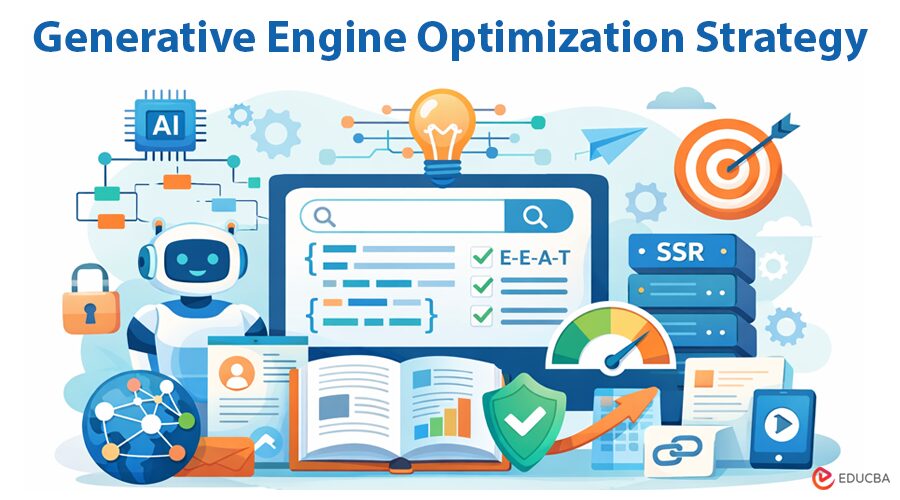
The Rise of Generative Engine Optimization Strategy in 2026
In the past few decades, the aim of search engine optimization was simple: get to the first page of Google to receive a click. However, in 2026, the digital landscape will change. We are not only maximizing human search through a list of 10 blue links anymore; we are also maximizing AI agents, such as Gemini, ChatGPT, and Perplexity, that read the web to construct direct responses. This shift has created a generative engine optimization strategy that makes your content easy for AI agents to read and cite as a trusted source.
The development of Generative Engine Optimization (GEO). Although conventional SEO services in New York can remain crucial for generating organic traffic, GEO will remain keen to ensure that your content is machine-readable so that AI models can respect it, learn from it, and reference your brand as the main authority.
To make sure your business does not disappear in this AI-driven world, you must adjust your technical foundation. Below are five technical improvements your website needs to implement to implement a strong Generative Engine Optimization Strategy fully.
Generative Engine Optimization Strategy
1. Intelligent Entity Disambiguation using JSON-LD
AI agents do not guess information on your page; they look for explicit signals. In 2026, basic schema markup is no longer enough. A proper Generative Engine Optimization Strategy requires strong JSON-LD (JavaScript Object Notation for Linked Data) to define entities on your site clearly.
Advantages of the Organization and Person Schemas
AI models place a lot of emphasis on Expertise (the E in E-E-A-T). Connect your brand to your official social profiles with the Organization schema, and connect your content to trusted human professionals with the Person schema. When you give an explicit knowledge graph in the form of your code, you instruct AI agents on who is actually talking and why they are to be trusted.
Schema of Extraction- Product and FAQ
If you want an AI shopping assistant to suggest your product, structure your data to show pricing, availability, and specifications clearly. Equally, having an FAQ Page schema would provide bite-sized question-and-answer pairs that AI engines could extract and deliver unedited in a conversational summary.
2. Adhering to the Standard of llms.txt
Just as robots.txt guides traditional search crawlers, the emerging llms.txt standard is becoming critical in any modern Generative Engine Optimization Strategy.
Establishing A.I. Policies
An appropriately formatted llms.txt file (usually located in the root of your domain) is a tab-separated list of the most important information about your site, specifically for AI training and retrieval. It can also prioritize AI agents to your most authoritative pillar content so that when an agent summarizes your SEO services or products, it draws on your best data rather than your old archives.
3. DOM Optimization Structural Optimization of fact density
AI agents do not visit a webpage like a human would; they seek so-called extractable data points. Bulky JavaScript or unsemantic tags severely reduce your site’s machine-readability.
Using Semantic HTML5
Use semantic HTML5 elements, such as article, section, header, and aside, in place of generic components. This hierarchy provides AI crawlers with a roadmap of which elements of the page harbor the central fact density and which ones are navigation or advertisements.
The “Inverted Pyramid” of Data
Place your most important definitions, statistics, and answers within the first 100 words of your content. AI agents often retrieve information when they find it within context windows. Making the most citable information at the top, in a clear, structured block, gives you the highest chance of being the source the AI will want to use.
4. Improving Server-Side Rendering (SSR)
Although current web development is obsessed with client-side JavaScript frameworks, they risk becoming an invisibility cloak for AI agents. When an AI crawler requires running fancy JavaScript in order to read your content, it can ignore it and go to a site that provides plain text immediately.
Why SSR Beats CSR in 2026?
Your content must be in the first HTML response and machine-readable. Server-side rendering (SSR) or Static site generation (SSG) will also mean that AI bots can search your entire expertise without the delay of client-side rendering. The machine sees first, it cites first, according to the world of GEO.
5. Minimization of Inference Window Latency
AI agents increasingly handle real-time requests, such as ‘Find the best international SEO services in New York offering a free audit. In case of a slow site, when latency is high, the AI agent timed out or switched to a competitor.
Core Web Vitals and Bot Speed
Although the human user cares about Core Web Vitals, such as Largest Contentful Paint (LCP), which are crucial, they are also indicators of AI efficiency. More crawled and processed by agentic workflows are fast-loading, mobile-optimized sites. Having a high-performing technical infrastructure, i.e., CDNs, optimized database queries, etc., is now a requirement to achieve AI visibility.
Final Thoughts
Generative Engine Optimization Strategy does not replace traditional SEO; it enhances it. Traditional SEO focuses on earning the click. The Generative Engine Optimization Strategy focuses on earning citations.
In 2026 and beyond, visibility will not be defined solely by rankings. It will be defined by whether AI agents recognize, trust, and reference your brand in their generated responses. That is the new frontier of search.
Recommended Articles
We hope this guide on Generative Engine Optimization Strategy helps you prepare your website for AI-driven search and increase your brand’s authority. Explore these recommended articles for practical tips, technical frameworks, and expert strategies to enhance AI visibility and citation potential.


