


Updated June 2, 2026
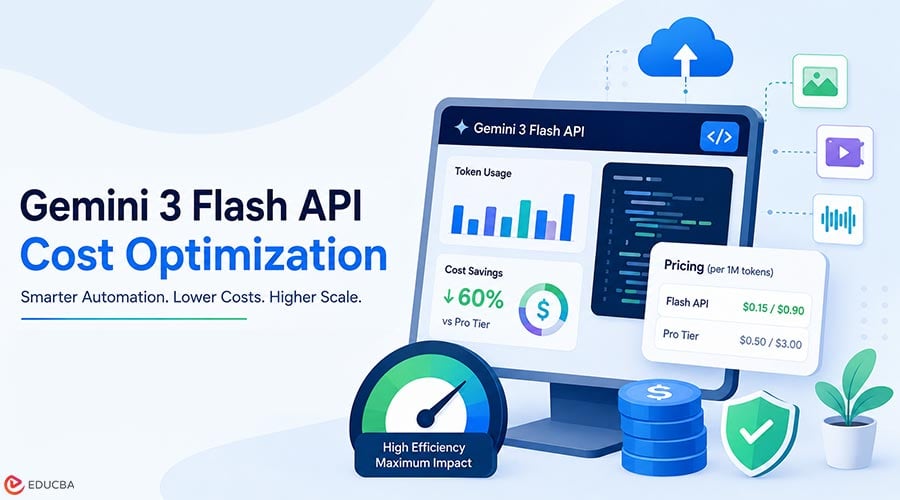
Enterprise development teams face a severe bottleneck when scaling automated pipelines: as data volume grows, backend infrastructure bills grow linearly. Relying exclusively on premium, heavy models results in unsustainable latency and token budget overruns in continuous processing workflows. This is where Gemini 3 Flash API cost optimization becomes essential. By strategically deploying a lightweight yet capable model architecture, organizations can maintain high-performance automation while significantly reducing operational expenses. The Gemini 3 Flash API enables a hybrid approach, combining reasoning capability with low-latency execution—making it a powerful solution for scalable enterprise systems.
Advanced Capabilities of the Gemini 3 Flash API: Elevating Production Efficiency
1. Balancing Pro-Tier Logic with Low-Latency Execution
Building high-throughput automated toolchains needs a system that provides strong reasoning without slowing user interfaces. The Gemini 3 Flash API helps by adding multi-step analysis within a fast and simple architecture. Using this interface, development teams can keep accuracy while still achieving very fast response times in high-traffic systems. This balance allows live production systems to handle complex automation tasks quickly. It becomes useful for modern enterprise workflows that need fast, logic-based feedback loops.
2. Handling Complex Analytical and Cognitive Tasks
Autonomous software systems often handle unstructured data that needs more than simple keyword matching. Turning on Gemini 3 Flash Thinking settings helps the model plan clear reasoning steps before giving a structured response. This deeper reasoning helps backend systems make complex decisions, compare multiple system details, and fix difficult software issues automatically. By using stronger built-in reasoning, the model can handle advanced engineering tasks smoothly and keep automated processes accurate in complex data situations.
3. Multimodal Comprehension and Vision-Driven Data Extraction
Modern application architectures must process diverse information formats beyond traditional flat text files to maintain comprehensive operational awareness. The Gemini 3 Flash API’s native multimodal architecture enables the simultaneous ingestion of images, video feeds, and complex schematics alongside standard textual documentation. This visual acuity enables systems to perform precise visual question answering, evaluate real-time server video telemetry, and extract structured metrics from dense infographics or architectural blueprints. Handling diverse media inputs smoothly makes this lightweight engine highly versatile, allowing developers to construct comprehensive AI applications that interpret the full spectrum of corporate assets.
4. Maximizing Token Throughput While Minimizing Operational Overhead
Scaling a digital system to thousands of tasks needs an infrastructure that stays stable over millions of tokens. Moving heavy data pipelines to this flexible interface lowers computing needs and reduces long-term Gemini 3 Flash API costs across the enterprise network. The model uses tokens efficiently without overloading servers, helping teams expand pipelines and manage larger datasets. This cost efficiency keeps automation systems financially stable and supports continuous background processing without big budget risks.
Strategic Price Comparison: Benchmarking Gemini 3 Flash API Cost Metrics
1. Comparative Financial Analysis: Pro Tier vs. Flash Tier
Evaluating token costs across continuous enterprise data pipelines requires checking long-term system budgets. Standard production tasks that process millions of background tokens each day can quickly use up resources when using only premium flagship models. For example, processing large text or visual logs with heavy frameworks can cause major budget overruns without adding value for routine tasks. Using a lightweight, purpose-built model helps engineering teams keep backend costs aligned with real business needs. This prevents infrastructure expenses from using up a startup’s operating budget.
2. Maximizing ROI with Kie Base Tariffs
Deploying infrastructure through Kie’s billing system changes the cost of large-scale automation tools. The standard base rate for the main engine is $0.50 per 1M text, image, or video input tokens. It increases to $1.00 per 1M audio input tokens, with an output cost of $3.00 per 1M tokens. Using the Gemini 3 Flash API optimized through Kie, teams get a lower rate of $0.15 per 1M input tokens and $0.90 per 1M output tokens. Moving high-frequency tasks to this setup reduces Gemini 3 Flash API costs. It provides strong cost savings while maintaining enterprise-level performance. This works across main backend workflows.
Engineering Strategies for Gemini 3 Flash API Cost Optimization
1. Leveraging the Efficiency of Gemini 3 Flash Thinking Parameters
Carefully setting model behavior helps avoid wasting system resources on simple automation tasks. Engineers should adjust Gemini 3 Flash Thinking budgets during setup. This helps match the needs of each task. Simple data parsing or JSON checks need very little reasoning. Developers can lower processing levels for routine tasks. Complex multi-step logic should be used only for hard debugging or deep understanding tasks. This approach ensures better use of processing power. It also prevents unnecessary compute use across backend systems.
2. Utilizing Contextual Storage and Prompt Caching Strategies
Repeatedly transmitting large blocks of sreuse static instruction sets across consecutive API calls rather than resending themtemplates, rapidly accumulates massive input token overhead. Development teams can implement strict prompt architecture guidelines and leverage native caching mechanisms to store persistent context on the server side. Restructuring application payloads allows reuse of static instruction sets across API calls. This avoids resending instructions with every query. Input token accumulation is significantly reduced. This optimization protects the monthly budget. High-frequency pipelines are charged only for unique variable data strings.
3. Controlling Media Resolution to Lower the Gemini 3 Flash API Cost
Multimodal features make enterprise pipelines more flexible. Handling raw images, diagrams, and videos can raise infrastructure costs. Developers should add automatic preprocessing to reduce system load. This step reduces file size before data reaches the model. Reducing image resolution, lowering video frame rates, and using compression cuts token usage while keeping clarity. This helps maintain accurate visual question answering. Good resource management lowers Gemini 3 Flash API costs. It keeps heavy media workflows stable for long-term use.
How to Integrate the Gemini 3 Flash API into Production Toolchains?
1. Acquiring API Credentials via the Kie Platform
Before initializing connection requests, development teams must establish an active account infrastructure to secure access tokens. System architects can navigate to the Gemini 3 Flash API landing page to complete registration and authentication. Once logged in to the centralized developer dashboard, engineers can generate unique API keys for their specific production environments. This credential authorizes backend communication with processing clusters and manages billing and usage monitoring.
2. Initializing the Interface and Endpoints
With credentials secured, integrating this engine starts with setting up your backend network routing. The gateway uses an OpenAI-compatible REST system to send requests through a single HTTP POST endpoint. Authentication is handled by adding the generated bearer token in the Authorization header of each request. This stateless setup allows backend microservices to send data smoothly without maintaining heavy, persistent connections.
3. Configuring Generation Parameters for Streaming
Production toolchains require predictable configurations to efficiently handle real-time user interfaces. Engineers can structure JSON request bodies with explicit instructions. They use developer or system roles to enforce strict behavioral parameters. Developers can also control processing depth by adjusting the reasoning effort parameter between high and low tiers to balance latency.
4. Implementing Unified Media Ingestion and Tool Frameworks
Handling different enterprise files like PDFs, videos, audio clips, and images can make backend checks more complex. To fix this, the gateway uses a simple, unified media structure where all files follow the same format in the message content array. Each media item uses a fixed type field called image_url, and the file path is given through an image_url key pointing to the file location. For interactive apps, developers can also add function calls in the array to trigger external automated systems.
5. Building Runtime Error Handling and Usage Monitoring Layers
Production-level deployment needs a strong error-handling layer to protect system uptime from network issues, authentication problems, and rate limits. Engineering teams should add clear catch blocks that handle standard HTTP status codes, such as client errors or server overloads. Also, every successful response returns a structured usage block with counts of prompt, completion, and total tokens. This simple operational record helps billing systems track usage in real time and avoid unexpected cost increases.
Engineering a Sustainable Architecture for Scaled Automation
Achieving long-term cost stability in high-volume enterprise pipelines requires shifting from unoptimized compute use to strict token budget control. Relying only on heavy, high-end models for routine extraction and data sorting increases unnecessary infrastructure costs and reduces scalability. By using a high-throughput and flexible toolchain, data infrastructure teams can keep multi-step reasoning while lowering overall computing costs.
Final Thoughts
Integrating a highly optimized Gemini 3 Flash API into production architectures enables developer teams to achieve the speed, multimodal capacity, and cognitive flexibility needed to sustainably handle complex workflows. Moreover, when combined with structured caching, controlled reasoning depth, and optimized streaming, the Gemini 3 Flash API cost optimization strategy effectively eliminates financial barriers, thereby enabling large-scale automation. This ensures enterprise systems remain fast, reliable, and economically viable across massive deployment cycles.
Recommended Articles
We hope this guide to Gemini 3 Flash API cost optimization helps you streamline enterprise automation and reduce infrastructure expenses. Check out these articles for more insights and strategies.


