
Updated August 10, 2026
What is Function Calling?
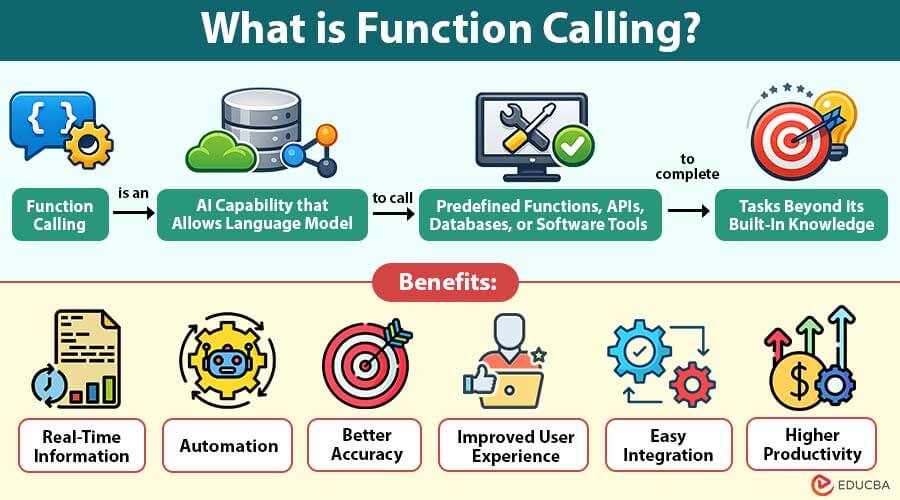
Function calling is an AI capability that allows a language model to call predefined functions, APIs, databases, or software tools to complete tasks beyond its built-in knowledge.
Instead of guessing answers, the AI identifies when external information or actions are required, gathers the necessary parameters from the conversation, calls the appropriate function, and uses the returned results to generate an accurate response.
In simple terms, function calling lets AI use external tools to perform real-world tasks rather than just generating text.
Table of Contents:
Key Takeaways:
- Function calling enables AI systems to use external tools, APIs, and databases effectively.
- It improves AI accuracy by accessing real-time information from trusted external sources.
- Function calling automates tasks, reducing manual effort and increasing operational efficiency.
- It helps businesses build smarter AI applications through seamless system integrations.
Why is Function Calling Important?
Below are the key reasons why function calling is important for making AI systems more powerful, accurate, and efficient:
1. Provides Real-Time Information
Accesses updated data from external sources, helping AI deliver accurate and current responses.
2. Performs Automated Actions
Allows AI systems to execute tasks automatically without requiring continuous human involvement or manual effort.
3. Connects Business Systems
Integrates AI with software, APIs, databases, and enterprise platforms for seamless operations.
4. Reduces Manual Work
Automates repetitive processes, saving time and improving productivity across various business activities.
5. Improves Response Accuracy
Uses trusted external data sources to generate reliable and contextually relevant AI responses.
6. Enables Workflow Automation
Helps AI manage complex workflows by connecting multiple tools and performing tasks efficiently.
How Does Function Calling Work?
Function calling follows a simple sequence of steps.
1. User Sends a Request
The user asks the AI to perform a task.
Example:
“Book a meeting with John tomorrow at 3 PM.”
2. AI Understands the Request
The language model analyzes the request and determines that booking a meeting requires an external calendar service.
3. AI Selects the Appropriate Function
The model chooses a predefined function such as:
- Create Calendar Event
- Send Email
- Search Database
- Get Weather
- Check Inventory
4. AI Extracts Parameters
The model identifies all required information.
Example:
- Name: John
- Date: Tomorrow
- Time: 3 PM
5. External Function Executes
The application or API performs the requested action.
Example:
- Creates the calendar event
- Returns confirmation
6. AI Generates the Final Response
The AI combines the function result with natural language.
Example:
“Your meeting with John has been scheduled for tomorrow at 3 PM.”
Key Components of Function Calling
The following are the key components that enable AI systems to understand requests, execute functions, and deliver accurate responses.
1. Language Model
Understands user requests and identifies when external functions are required to complete specific tasks accurately.
2. Function Definitions
Describe available functions, their purposes, required inputs, and instructions for AI systems to execute tasks correctly.
3. Parameters
Define necessary information required by functions, including dates, times, locations, product IDs, and customer details.
4. External APIs
Connect AI systems with external services such as weather platforms, payments, maps, CRM, and email providers.
5. Backend Application
Receives function requests, processes operations, executes tasks, and returns results to the AI system efficiently.
6. AI Response Generator
Converts function results into clear, natural, and user-friendly responses to improve communication and user experience.
Benefits of Function Calling
The following are the key benefits of function calling that help AI systems improve accuracy, automation, integration, and overall user experience.
1. Real-Time Information
AI retrieves up-to-date data from external sources rather than relying solely on prior training data.
2. Automation
Automatically completes routine tasks, reducing manual work and improving operational efficiency across business processes.
3. Better Accuracy
Uses reliable external systems and trusted data sources to provide precise and dependable information.
4. Improved User Experience
Provides complete answers and performs actions in a single conversation for seamless user interactions.
5. Easy Integration
Connects smoothly with existing APIs, software platforms, and business applications without major changes.
6. Higher Productivity
Reduces repetitive administrative tasks, allowing employees to focus on more valuable activities.
Common Use Cases of Function Calling
The following are common use cases in which function calling helps AI systems automate tasks, access real-time data, and improve business operations across industries.
1. Customer Support
Automates customer service by checking orders, resetting passwords, tracking deliveries, and creating support tickets.
2. Healthcare
Helps manage healthcare tasks like appointments, patient records, reminders, and laboratory result retrieval.
3. Banking and Finance
Enables financial operations including balance checks, fund transfers, fraud detection, and report generation.
4. Commerce
Supports online shopping activities through product searches, inventory updates, payments, and shipment tracking.
5. Travel
Assists travelers with flight bookings, hotel reservations, weather checks, and attraction recommendations.
6. Human Resources
Automates HR processes, including leave approvals, employee updates, interviews, and employee question responses.
Popular Function Calling Tools
The following are the popular function-calling tools that help AI systems connect with external services, execute functions, and build intelligent applications.
| Tool | Purpose |
| OpenAI API | Function Calling for AI applications |
| Anthropic Claude | Tool use and external function integration |
| Google Gemini | Function Calling and API interaction |
| LangChain | Builds AI workflows using external tools |
| LlamaIndex | Connects AI with enterprise data |
| Semantic Kernel | AI orchestration and function execution |
| AutoGen | Multi-agent function collaboration |
| CrewAI | AI agent workflow automation |
| Haystack | Search and retrieval pipelines |
| Model Context Protocol (MCP) | Standardized connection between AI and external tools |
Challenges of Function Calling
Although powerful, function calling has some challenges.
1. API Failures
External services may become unavailable, causing disruptions and preventing successful completion of function execution processes.
2. Incorrect Parameters
Missing, invalid, or incorrect inputs can create errors and affect proper function execution and results.
3. Security Risks
Weak permission controls may expose sensitive systems, confidential data, and business operations to security threats.
4. Higher Latency
External API communication can increase response times and reduce overall application speed and performance.
5. Integration Complexity
Connecting multiple enterprise systems requires careful planning, development efforts, and technical expertise for implementation.
6. Cost
Frequent API usage and external service dependencies may increase operational costs and resource expenses.
Final Thoughts
Function Calling enables AI systems to perform real-world actions by connecting with APIs, databases, and applications. It improves automation, provides access to live information, and supports smarter solutions across industries. As AI adoption grows, function calling will drive reliable, intelligent, and efficient business workflows.
Frequently Asked Questions (FAQs)
Q1. Can Function Calling work with custom business applications?
Answer: Yes, function calling can be connected with custom applications, internal software, and enterprise platforms to automate specific business processes and workflows.
Q2. Does function calling require programming knowledge to implement?
Answer: Implementation typically requires technical expertise to build functions, APIs, and integrations, but users can interact with the final AI system through simple conversations.
Q3. How does function calling help AI agents become more useful?
Answer: Function Calling enables AI agents to move beyond answering questions by allowing them to complete tasks, access information, and interact with digital systems.
Q4. Is function calling only available for large organizations?
Answer: No, businesses of all sizes can use function calling, from small applications to large enterprise AI solutions, depending on their requirements and available resources.
Recommended Articles
We hope that this EDUCBA information on “Function Calling” was beneficial to you. You can view EDUCBA’s recommended articles for more information.


