
What is Financial Benchmarking?
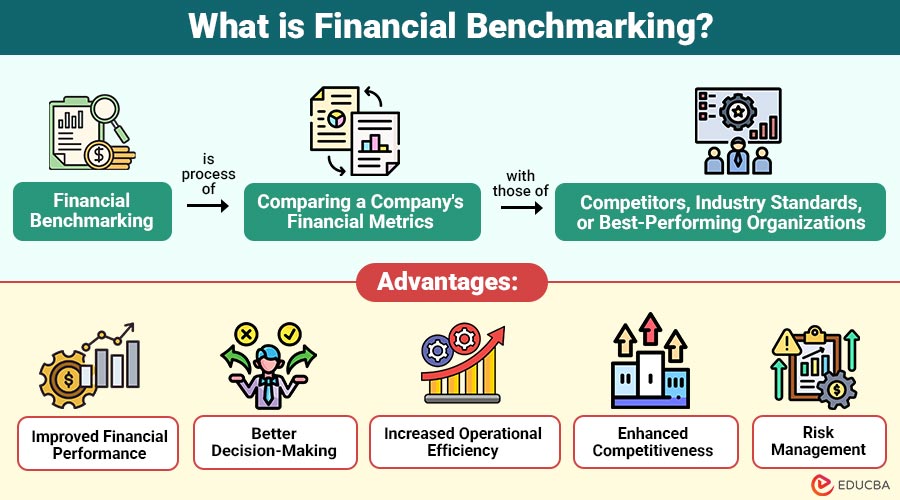
Financial benchmarking is process of comparing a company’s financial metrics with those of competitors, industry standards, or best-performing organizations. The objective is to evaluate financial performance and identify areas that require improvement.
Companies use financial benchmarking to measure key indicators such as revenue growth, profit margins, operating expenses, return on investment, and liquidity ratios. By comparing these metrics with benchmarks, businesses can determine whether they are performing above or below industry expectations.
In simple terms, financial benchmarking helps organizations answer questions like:
- Are our expenses higher than industry averages?
- Is our profitability competitive?
- Are we using resources efficiently?
The insights gained from benchmarking enable companies to refine strategies, reduce inefficiencies, and enhance financial performance.
Table of Contents:
- Meaning
- Importance
- Types
- Metrics
- Process
- Advantages
- Disadvantages
- Real-World Examples
- Best Practices
Key Takeaways:
- Financial benchmarking compares company performance against competitors and industry standards to identify gaps.
- It helps businesses improve profitability, efficiency, and decision-making through data-driven insights.
- Regular benchmarking enables organizations to monitor progress, control costs, and maintain a competitive advantage.
- Effective benchmarking requires reliable data, relevant metrics, and analysis for accurate performance evaluation.
Importance of Financial Benchmarking
Financial benchmarking plays an important role in improving business performance and guiding strategic decisions.
1. Performance Evaluation
Enables businesses to assess performance by comparing results against industry standards and identifying strengths and weaknesses.
2. Identifying Improvement Areas
Benchmarking helps organizations identify performance gaps against industry best practices, guiding focused improvements and enhancing financial efficiency.
3. Better Strategic Planning
Supports strategic planning by providing insight into competitor performance, enabling informed decisions and long-term growth.
4. Cost Control
Benchmarking helps control costs by identifying inefficiencies, comparing expense structures with industry averages, and promoting resource utilization.
5. Competitive Advantage
Regular financial benchmarking allows organizations to stay competitive, respond to market changes, and maintain a strategic position.
Types of Financial Benchmarking
Depending on how it is compared, it can be divided into several types.
1. Internal Benchmarking
Internal benchmarking compares performance across departments, divisions, or branches within the same organization to identify efficiency gaps.
2. Competitive Benchmarking
Competitive benchmarking compares financial metrics with direct competitors to evaluate performance, identify gaps, and improve overall position.
3. Industry Benchmarking
Industry benchmarking compares a company’s financial performance against industry averages or standards to assess competitiveness and identify opportunities for improvement.
4. Strategic Benchmarking
Strategic benchmarking compares financial strategies with leading organizations across industries to adopt best practices for long-term performance.
Key Financial Metrics Used in Benchmarking
Financial benchmarking relies on several important financial metrics.
1. Profitability Ratios
Profitability ratios evaluate a company’s ability to generate earnings relative to revenue, assets, equity, and overall financial performance efficiency.
2. Liquidity Ratios
Liquidity ratios measure a company’s capacity to meet short-term obligations using current assets without facing financial distress or cash shortages.
3. Efficiency Ratios
Efficiency ratios evaluate how well a business makes use of its resources and assets to increase operational productivity and produce income.
4. Leverage Ratios
Leverage ratios determine the extent of a company’s debt usage and evaluate financial risk related to borrowing and repayment capacity.
5. Growth Metrics
Growth metrics assess a company’s ability to consistently increase revenue, profits, and market presence over time through business expansion strategies.
Process of Financial Benchmarking
Financial benchmarking follows a systematic process to ensure accurate and meaningful comparisons.
Step 1: Define Benchmarking Objectives
The first step is identifying the purpose of benchmarking, such as improving profitability, reducing costs, or increasing efficiency.
Step 2: Select Relevant Metrics
Organizations must choose financial metrics that accurately reflect their performance and align with business goals.
Step 3: Identify Benchmark Sources
Benchmark data may come from competitors, industry reports, financial databases, or publicly available financial statements.
Step 4: Collect and Analyze Data
Companies gather financial data and compare it with benchmark values to identify performance gaps.
Step 5: Identify Performance Gaps
After comparison, organizations analyze areas where their performance falls below industry standards.
Step 6: Implement Improvements
Businesses implement strategies to address weaknesses and improve financial performance.
Step 7: Monitor and Review
Should be performed regularly to track progress and ensure continuous improvement.
Advantages of Financial Benchmarking
Financial benchmarking offers several advantages for organizations.
1. Improved Financial Performance
Benchmarking helps organizations identify inefficiencies, adopt best practices, and enhance profitability by improving overall financial performance consistently over time.
2. Better Decision-Making
Access to benchmarking data enables managers to make informed, data-driven decisions that align with business goals and improve financial outcomes.
3. Increased Operational Efficiency
Organizations improve efficiency by identifying process gaps, eliminating waste, optimizing resource utilization, and reducing unnecessary operational and administrative costs.
4. Enhanced Competitiveness
Enables companies to compare performance with competitors, align strategies with industry standards, and maintain strong competitive market positioning.
5. Risk Management
Benchmarking helps identify potential financial risks early, allowing businesses to implement corrective actions and maintain stability during uncertain market conditions.
Disadvantages of Financial Benchmarking
Despite its advantages, it also has disadvantages.
1. Data Availability Issues
Limited access to accurate benchmark data, particularly for private companies, can complicate comparisons and occasionally render them unreliable.
2. Differences in Business Models
Comparing companies with different business models, structures, or strategies can lead to misleading conclusions and inaccurate performance evaluations.
3. Time-Consuming Process
Requires extensive data collection, analysis, and interpretation, consuming significant time, effort, and organizational resources on a regular basis.
4. Over-Reliance on Benchmarks
Organizations may rely too much on benchmarks, limiting innovation and discouraging unique strategies tailored to specific business needs.
Real-World Examples
Here are some real-world examples of financial benchmarking across different industries.
1. Retail Industry
A retail company compares its gross profit margin with industry averages to determine whether its pricing strategy and cost structure are competitive. If the company’s margin falls below the benchmark, it may adjust pricing or reduce operational costs.
2. Manufacturing Industry
A manufacturing company benchmarks its inventory turnover ratio against industry leaders to improve supply chain efficiency and reduce holding costs.
3. Banking Sector
Banks often compare their return on assets (ROA) with industry benchmarks to measure profitability and operational efficiency.
Best Practices for Effective Financial Benchmarking
Here are the key best practices to ensure accurate, meaningful, and effective results.
1. Use Reliable Data Sources
Use credible financial reports, industry studies, and trusted databases to ensure accurate, consistent, and reliable benchmarking results.
2. Choose Relevant Metrics
Pick financial metrics that align with your business goals, industry norms, and operational aims to get useful, practical benchmarking insights.
3. Benchmark Regularly
Perform financial benchmarking regularly to track performance trends, measure improvements, and identify emerging issues over time effectively.
4. Consider Industry Context
Evaluate economic conditions, market trends, and industry dynamics to interpret benchmarking data and avoid misleading conclusions correctly.
5. Combine Quantitative and Qualitative Analysis
Integrate financial data with qualitative insights, such as management practices, strategies, and processes, to enable comprehensive benchmarking and better decision-making.
Final Thoughts
Financial benchmarking helps organizations compare performance with competitors and industry standards using key financial metrics. It identifies gaps, improves decision-making, reduces costs, and enhances efficiency. When supported by reliable data and proper analysis, benchmarking enables continuous improvement, strengthens competitiveness, and supports long-term financial success in a dynamic business environment.
Frequently Asked Questions (FAQs)
Q1. What metrics are used in financial benchmarking?
Answer: Common metrics include profit margins, liquidity ratios, efficiency ratios, leverage ratios, and growth indicators.
Q2. How often should financial benchmarking be conducted?
Answer: Businesses typically perform financial benchmarking annually or quarterly to monitor financial performance and maintain competitiveness.
Q3. What are the sources of benchmarking data?
Answer: Benchmarking data can be obtained from financial statements, industry reports, government publications, market research firms, and competitor disclosures.
Q4. Can small businesses use financial benchmarking?
Answer: Yes, small businesses can use financial benchmarking by comparing their performance with industry averages or similar-sized companies to improve efficiency and growth.
Recommended Articles
We hope that this EDUCBA information on “Financial Benchmarking” was beneficial to you. You can view EDUCBA’s recommended articles for more information.

