
What is Edge AI?
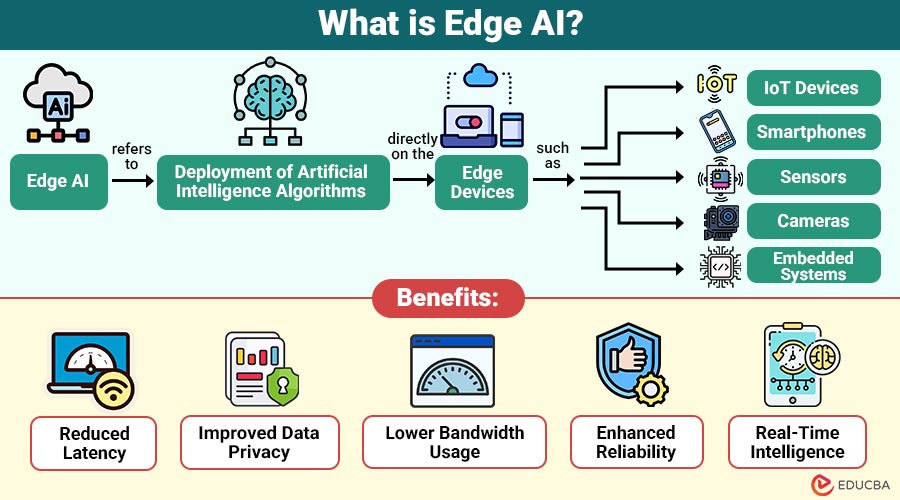
Edge AI refers to deployment of artificial intelligence algorithms directly on the edge devices such as IoT devices, smartphones, sensors, cameras, and embedded systems. Instead of sending data to a remote cloud server, these devices process and analyze information locally.
This local processing enables devices to make decisions instantly without waiting for data to travel back and forth from the cloud.
For example, Smart security camera with Edge AI can detect suspicious activity and send alerts immediately without sending all video data to the cloud.
Table of Contents:
Key Takeaways:
- Edge AI enables real-time decision-making by processing data locally on devices instead of relying on remote cloud servers.
- It improves privacy, reduces latency, and lowers bandwidth usage by keeping most data processing close to the source.
- Systems combine edge devices, AI models, sensors, and connectivity to deliver intelligent automation in real-time environments.
- Optimizing AI models for edge devices is crucial to balance performance, accuracy, and resource constraints in real-time applications.
Key Components of Edge AI
Edge AI systems rely on several technologies that work together to enable intelligent local processing.
1. Edge Devices
Edge devices are the physical devices that generate and process data. Examples include:
- Smartphones
- Smart cameras
- Industrial sensors
- Autonomous vehicles
- Smart home devices
These devices use processors that can run AI models.
2. AI Models
AI models are algorithms trained using machine learning or deep learning techniques. These models are optimized to run efficiently on edge devices with limited computational resources.
3. Edge Computing Infrastructure
Edge computing infrastructure provides the environment in which data processing occurs near the data source. This infrastructure may include gateways, local servers, or embedded computing units.
4. Sensors and Data Sources
AI models on edge devices analyze real-time data collected by sensors, including images, temperature, sound, motion, and location information.
5. Connectivity
Although it processes data locally, systems often use cloud connectivity for model updates, long-term storage, and system monitoring.
How Edge AI Works?
Systems follow a structured workflow to process data and generate insights.
Step 1: Data Collection
Sensors or devices collect real-time data from the environment. This may include images, audio signals, sensor readings, or video streams.
Step 2: Data Processing at the Edge
The collected data is processed locally using AI models embedded in the device. This step reduces the need to send large datasets to the cloud.
Step 3: Real-Time Decision Making
The AI system analyzes the processed data and makes immediate decisions or predictions.
Step 4: Action Execution
Based on the AI decision, the device acts, such as triggering an alert, adjusting a system parameter, or controlling machinery.
Step 5: Cloud Synchronization (Optional)
Some information may still be sent to the cloud for storage, analytics, or model improvement.
Types of Edge AI
It can be implemented in various types depending on the system architecture and available computing resources.
1. Device Edge AI
In this type, AI models run directly on devices such as smartphones, drones, or cameras. These devices independently process and analyze data.
2. Gateway Edge AI
An edge gateway or local server processes data from multiple devices before transmitting it to the cloud.
3. On-Premise Edge AI
Organizations deploy local computing infrastructure within their facilities to process data generated by connected devices.
4. Hybrid Edge AI
Hybrid systems combine edge computing with cloud computing. Time-sensitive tasks are processed locally, while complex analytics are handled in the cloud.
Benefits of Edge AI
The following are the major benefits that make it useful for real-time and intelligent applications.
1. Reduced Latency
Processes data locally on devices, reducing delay and enabling faster response times for real-time decision-making in critical applications.
2. Improved Data Privacy
Sensitive data remains on local devices rather than being sent to cloud servers, significantly reducing privacy risks and improving data security.
3. Lower Bandwidth Usage
Reduces the need to send large amounts of data to cloud, effectively minimizing network congestion and lowering bandwidth costs.
4. Enhanced Reliability
Edge devices can continue working without constant internet connectivity, ensuring uninterrupted operations even in remote locations or unstable network environments.
5. Real-Time Intelligence
Provides instant data processing and analysis, enabling immediate actions for time-sensitive applications such as automation, robotics, and smart vehicles.
Real-World Applications of Edge AI
The following are some common real-world applications that use it to enable fast, intelligent, and real-time decision-making.
1. Autonomous Vehicles
Self-driving cars rely on Edge AI to analyze sensor data, detect obstacles, recognize traffic signs, and make driving decisions in real time.
2. Smart Cities
Powers smart traffic management systems, surveillance cameras, and environmental monitoring solutions in modern cities.
3. Industrial Automation
Manufacturing systems use Edge AI to detect machine faults, predict maintenance needs, and optimize production processes.
4. Retail
Retail stores use Edge AI-enabled cameras and sensors for inventory tracking, customer behavior analysis, and automated checkout systems.
5. Smart Homes
Devices like smart speakers, thermostats, and security systems use Edge AI to respond instantly to user commands and environmental changes.
Challenges of Edge AI
Despite its advantages, it also has several challenges.
1. Limited Hardware Resources
Complex artificial intelligence models are challenging to execute effectively on edge devices due to their limited processing power, memory, and storage capacity.
2. Security Risk
It is more challenging for enterprises since edge devices function independently across networks, shielding them from cyberattacks, unwanted access, and data breaches.
3. Model Optimization
Artificial intelligence models must be carefully optimized to run efficiently on edge hardware without compromising accuracy, performance, or reliability in real-time environments.
4. Device Management
Organizations may struggle to monitor, control, update, and maintain thousands of distributed edge devices operating in different locations and network conditions.
5. Integration Complexity
Connecting systems with existing cloud platforms, enterprise software, and data pipelines often requires complex configuration, testing, and infrastructure adjustments.
Real-World Example
A smart healthcare monitoring system uses Edge AI to track patient vital signs through wearable devices such as smartwatches and medical sensors. The device processes heart rate, oxygen level, and body temperature locally using built-in AI models. If the system detects abnormal readings, it immediately sends an alert to doctors or caregivers without waiting for cloud processing. This enables faster medical response, improves patient safety, and reduces the need to send sensitive health data to remote servers continuously.
Frequently Asked Questions (FAQs)
Q1. How is the Edge AI different from cloud AI?
Answer: Cloud AI processes data on remote servers, while Edge AI processes data locally on devices or nearby infrastructure.
Q2. Is Edge AI suitable for real-time applications?
Answer: Yes, it is highly suitable for real-time applications because it processes data locally on devices, reducing latency and enabling immediate decision-making without relying on cloud servers.
Q3. Why is Edge AI important?
Answer: Edge AI improves speed, reduces latency, enhances privacy, and enables real-time decision-making for connected systems.
Q4. What industries benefit from Edge AI?
Answer: Industries such as healthcare, manufacturing, automotive, retail, and smart cities benefit significantly from Edge AI.
Recommended Articles
We hope that this EDUCBA information on “Edge AI” was beneficial to you. You can view EDUCBA’s recommended articles for more information.


