


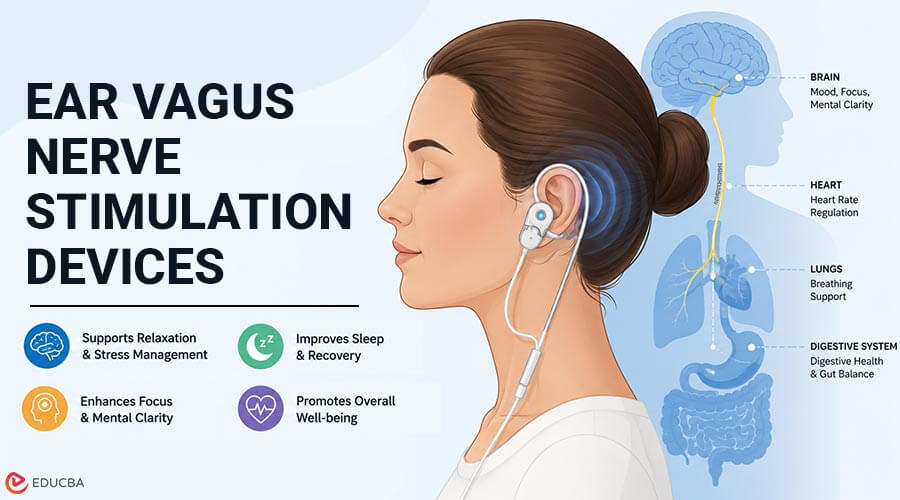
Ear-based vagus nerve stimulation is moving from research laboratories into the wider wellness-technology market. Small clips, earpieces, and wearable electrodes are now being promoted for relaxation, sleep routines, stress management, focus, and recovery. The technology is commonly called transcutaneous auricular vagus nerve stimulation, or taVNS. “Transcutaneous” means that stimulation passes through the skin, while “auricular” refers to the outer ear. This guide explains how ear vagus nerve stimulation devices work, how taVNS differs from implanted and neck-based vagus nerve stimulation (VNS), the most common electrode placement locations, what beginners can expect during their first session, and important safety considerations before using a device.
What is the Vagus Nerve?
The body’s vagus nerve, the tenth cranial nerve, is one of the longest neural communication pathways. It begins in the brainstem and travels through the neck into the chest and abdomen. Along the way, it communicates with structures associated with the heart, lungs, digestive system, throat, and other internal organs.
The vagus nerve carries signals in both directions:
- Efferent signals travel from the brain toward the body.
- Afferent signals carry sensory information from the body toward the brain.
A large proportion of vagal fibers are afferent, meaning much of the communication travels from the body to the brain. This is why the vagus nerve is frequently associated with the phrase “rest and digest.” However, it should not be viewed as a simple relaxation switch. The specific fibers reached and the method of delivering electrical stimulation determine its complex functions and effects.
How Are Ear Vagus Nerve Stimulation Devices Different from Implanted VNS?
The term “vagus nerve stimulation” describes several different technologies.
1. Implanted VNS
Implanted VNS involves a pulse generator surgically placed under the skin of the chest. A lead runs from the generator to an electrode wrapped around the cervical vagus nerve in the neck. The system is programmed by a medical team and is used for specific clinical indications. It should not be confused with a consumer wellness wearable.
2. Cervical Non-Invasive VNS
Cervical VNS is applied externally to the side of the neck. Some cervical products are prescription devices with condition-specific regulatory clearance. For example, gammaCore delivers stimulation through the skin of the neck and has defined indications and dosing instructions for selected headache conditions. Its regulatory status does not apply to unrelated consumer products.
3. Auricular Non-Invasive VNS
Auricular VNS uses an electrode on the external ear. It is generally compact and may allow hands-free use during a session. Some devices use a clip on the tragus, while others use an earpiece designed to contact the concha.
The differences can be summarized as follows:
| Type | Stimulation location | Requires surgery? | Common use context |
| Implanted VNS | Cervical vagus nerve inside the neck | Yes | Prescribed medical treatment |
| Cervical non-invasive VNS | Skin on the side of the neck | No | Prescription or consumer use, depending on device |
| Auricular VNS or taVNS | Selected area of the outer ear | No | Research, prescription systems, or consumer wellness |
A user should never assume that evidence for one category automatically proves that another category or a particular commercial product has the same effect.
Where is the Vagus Nerve Located in the Ear?
The outer ear receives sensory innervation from several nerves, not only the vagus nerve. Depending on the location, sensation may involve branches of:
- Vagus nerve
- Trigeminal nerve
- Facial nerve
- Cervical plexus
- Other sensory nerves
An anatomical review of taVNS explains that auricular nerve distribution is complex and that common stimulation targets include areas within the concha and the tragus. This complexity is one reason why electrode location matters.
Common Ear Placement Areas
1. Cymba Concha: The cymba concha is the upper portion of the bowl-shaped area leading toward the ear canal. It is frequently used in taVNS research because anatomical studies suggest it has vagal innervation. However, reaching it comfortably may require a specially shaped earpiece rather than a basic clip.
2. Cavum Concha: The cavum concha is the lower part of the ear bowl, closer to the opening of the ear canal. Some manufacturers design earpiece-style devices to make contact with both the cymba and cavum regions.
3. Tragus: The tragus is the small cartilage projection in front of the ear canal. It is easier to access with a clip and is used by several research and commercial systems. However, scientific discussion continues regarding the precise nerve distribution and whether every tragus placement targets the ABVN equally well.
4. Earlobe: The earlobe is commonly used as a sham or control location in research because it is not generally considered a primary vagal target. Therefore, a tingling sensation on the earlobe does not demonstrate that the stimulation activates the vagus nerve.
Why Placement Matters More Than Maximum Intensity?
A common beginner mistake is to increase stimulation intensity when the electrode is positioned poorly. This can lead to a sharp or uncomfortable sensation without solving the contact problem.
Electrical stimulation depends on several practical factors:
- Whether both electrode surfaces touch the skin;
- Whether the skin is clean;
- Whether the contact area is sufficiently moist;
The correct working intensity is not necessarily the highest level the user can tolerate. You can generally maintain a noticeable but comfortable level throughout the intended session. Do not interpret pain, burning, strong pinching, or an intense muscle contraction as evidence that stimulation is more effective.
When comparing ear vagus nerve stimulation devices, beginners should examine the earpiece design and placement guidance as carefully as the number of modes or intensity levels. A device that produces consistent contact at a moderate setting may be more practical than one that requires frequent repositioning.
Does Ear Vagus Nerve Stimulation Always Use the Left Ear?
Many consumer and research systems use the left ear. The historical preference for stimulating the left cervical vagus nerve in implanted VNS partly influences this convention. The right vagus nerve has stronger associations with cardiac structures involved in heart-rate regulation, which has led to caution around right-sided stimulation.
However, auricular stimulation is not identical to implanted cervical VNS, and research has not established a universal rule that every taVNS protocol must use only the left ear. Studies have investigated left, right, and bilateral placement. For consumers, the correct side is the side specified by the manufacturer.
How to Use an Ear Vagus Nerve Stimulator for the First Time?
The instructions for the specific product should always take priority. Ear clips and concha earpieces are not positioned in the same way. A general first-session process may include the following steps.
Step 1: Read the Entire Manual
Do not begin with assumptions based on another device or an online video.
Confirm:
- The intended ear;
- The correct electrode location;
- Whether gel or water is required;
- The minimum and maximum session duration;
- The recommended starting intensity;
- All warnings and contraindications.
Step 2: Charge and Inspect the Device
Check the battery, cable, electrode surfaces, and earpiece. Do not use damaged cables, cracked electrodes, or components with exposed metal unless that is part of the intended contact design.
Step 3: Clean and Dry the Ear
Remove skincare products, oils, sweat, and residue from the contact area. Clean the skin, but do not irritate or break it. Avoid placing electrodes over cuts, rashes, infection, or inflamed piercings.
Step 4: Prepare the Electrode Contact
Some devices require conductive gel, saline, or a small amount of water. Manufacturers design others for dry contact. Use only the method recommended by the manufacturer. Do not place conductive gel deep inside the ear canal. Use it only on the intended external electrode contact point.
Common Beginner Mistakes
1. Placing the Electrode Anywhere on the Ear: Not every ear region is a vagal target. Follow the device’s placement instructions.
2. Increasing Intensity to Fix Poor Contact: Sharp stimulation may indicate dry or uneven contact, not that the level is too low.
3. Copying a Research Protocol: A study may use a different electrode, waveform, participant population, and objective.
4. Using an Unapproved Accessory: An ear clip that physically fits a stimulator may not be electrically appropriate for that device.
5. Treating a Wellness Device as Medical Care: Do not use a consumer wearable to diagnose or self-treat epilepsy, depression, heart disease, anxiety disorders, IBS, insomnia, or any other health condition.
How to Compare Ear Vagus Nerve Stimulation Devices?
Before choosing a device, review more than its marketing promises.
1. Stimulation Location: Does it use a tragus clip, concha earpiece, or another design?
2. Contact Stability: Will the electrodes remain in place during the intended session?
3. Intensity Control: Can the level be increased gradually and reduced quickly?
4. Session Guidance: Does the product provide clear timing, placement, and troubleshooting instructions?
5. Ongoing Requirements: Check for replacement electrodes, conductive gel, subscriptions, or app requirements.
Final Thoughts
Ear vagus nerve stimulation devices represent an exciting and rapidly evolving area of neuromodulation and consumer wellness technology. Their non-invasive design offers a convenient way to stimulate areas of the outer ear associated with the auricular branch of the vagus nerve. However, not all devices work in the same way. Electrode placement, stimulation parameters, device quality, session duration, and intended purpose all influence the overall experience. People should not consider a research instrument, a prescription medical device, a consumer wellness wearable, and a TENS unit fitted with an ear clip to be equivalent.
For beginners, the safest approach is to:
- Read the manufacturer’s instructions carefully.
- Confirm the correct ear and electrode placement.
- Ensure clean, stable skin contact.
- Start with a low intensity.
- Prioritize comfort over maximum sensation.
- Follow the recommended session duration.
- Monitor your skin and overall response.
- Review all contraindications before use.
- Consult a healthcare professional if you have underlying medical conditions.
As research continues to evolve, ear vagus nerve stimulation devices may become an increasingly valuable addition to relaxation, focus, recovery, and wellness routines. Using them responsibly and with realistic expectations is the best way to maximize both safety and potential benefits.
Frequently Asked Questions (FAQs)
Q1. What part of the ear stimulates the vagus nerve?
Answer: Research commonly targets selected regions of the concha and tragus associated with the auricular branch of the vagus nerve. The exact location depends on the device and protocol.
Q2. Can you stimulate the vagus nerve through the earlobe?
Answer: The earlobe is not generally considered a primary vagal target and is often used as a control location in taVNS studies.
Q3. Should taVNS be used on the left or right ear?
Answer: Many devices specify the left ear, but research has examined left, right, and bilateral approaches. Follow the instructions for the exact product rather than choosing the side independently.
Q4. Should ear stimulation hurt?
Answer: No. The sensation is generally expected to be noticeable but comfortable. Sharp pain, burning, faintness, or chest discomfort is a reason to stop.
Q5. Does stronger stimulation work better?
Answer: Not necessarily. Stimulation depends on location, pulse parameters, contact, and individual sensitivity. Maximum tolerable intensity is not a universal goal.
Recommended Articles
We hope this guide on ear vagus nerve stimulation devices has helped you understand how taVNS works and how to use these devices safely. Check out these recommended articles for more insights into wellness technology.

