
What is Divesting?
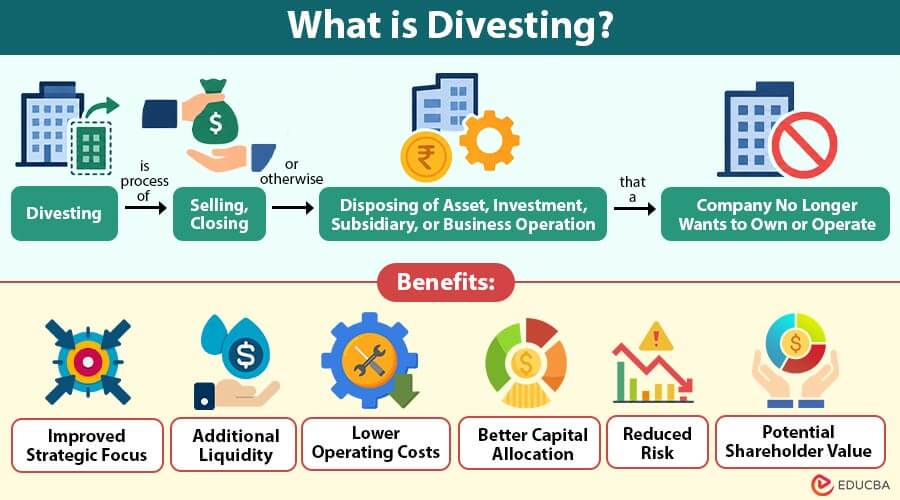
Divesting is the process of selling, closing, or otherwise disposing of an asset, investment, subsidiary, or business operation that a company no longer wants to own or operate.
For example, suppose a manufacturing company owns a small packaging unit that has become costly to operate and no longer supports its main business. The company may sell the packaging unit to another company. It can then use the money received from the sale to invest in its core manufacturing operations or reduce debt.
Divesting is generally considered the opposite of acquiring. While an acquisition involves buying a business or asset, divesting involves selling one.
Table of Contents:
- Meaning
- Why do Companies Divest?
- Working
- Types
- Example
- Difference
- Benefits
- Challenges
- How to Make Divesting Successful?
Key Takeaways:
- Divesting helps companies focus on core businesses while releasing capital from non-core or underperforming assets.
- Companies can divest through sales, spin-offs, carve-outs, liquidation, or partial ownership reductions.
- Successful divestitures require accurate valuation, careful planning, due diligence, negotiation, and effective stakeholder communication.
- Divesting can improve liquidity, reduce risk, lower costs, and support better long-term capital allocation.
Why Do Companies Divest?
Companies choose to divest for several strategic and financial reasons.
1. Focus on Core Businesses
A company may operate across multiple industries but find that some businesses don’t support its main strategy. Divesting non-core operations lets management focus on areas where the company has stronger capabilities.
For example, a technology company may sell a traditional hardware division to focus on cloud computing and artificial intelligence.
2. Raise Capital
Selling a business or asset can provide immediate cash. Companies may use the proceeds to fund expansion, invest in new technology, repay debt, or strengthen their balance sheets.
This can be especially useful when a company needs capital but wants to avoid additional borrowing.
3. Reduce Debt
Companies with significant debt may sell assets to generate funds for debt repayment. Lower debt can reduce interest expenses and improve financial stability.
For example, a manufacturing company could sell a non-core property portfolio and use the proceeds to reduce outstanding loans.
4. Improve Financial Performance
An underperforming business may reduce a company’s overall profitability. Divesting that business can remove ongoing losses and allow management to allocate resources to more profitable operations.
However, management must consider whether the business can be improved before deciding to sell it.
5. Respond to Regulatory Requirements
Regulators may require companies to sell certain assets or businesses to address competition concerns.
This can occur after mergers or acquisitions when regulators believe that retaining particular businesses could reduce competition in a market.
6. Manage Risk
A company may divest operations that expose it to excessive financial, operational, regulatory, or geopolitical risk.
Selling such assets can simplify the company’s risk profile and reduce exposure to uncertain markets.
How Does Divesting Work?
The divestiture process typically involves several stages.
1. Identify the Asset
The company first identifies the business, subsidiary, investment, property, or other asset that it may want to divest. Management evaluates its financial performance, strategic importance, growth prospects, risks, and contribution to the organization.
2. Develop a Divestiture Strategy
The company determines its preferred divestment method and sets transaction objectives. It may decide to sell the asset to another company, spin it off as an independent business, or dispose of selected assets.
3. Value the Asset
A valuation estimates how much the asset or business may be worth. Financial performance, cash flows, market conditions, comparable transactions, intellectual property, customer relationships, and future growth prospects can influence the valuation.
4. Find Potential Buyers
The company may approach strategic buyers, private equity firms, financial investors, or other interested parties. Strategic buyers may pay more when the asset provides synergies with their existing operations.
5. Conduct Due Diligence
Potential buyers examine the business before completing the transaction. They may review financial statements, contracts, employees, intellectual property, tax obligations, legal matters, customers, suppliers, and operational risks.
6. Negotiate the Transaction
Buyer and seller negotiate purchase price and other transaction terms. These may include payment structure, employee arrangements, liabilities, warranties, transition services, and closing conditions.
7. Complete the Divestiture
After obtaining necessary approvals and satisfying transaction conditions, the seller transfers ownership to the buyer or the new independent entity. The seller then focuses on integrating the remaining operations and using the proceeds according to its strategic objectives.
Types of Divesting
Divesting can take several types.
1. Sale
A company sells a business unit, subsidiary, property, investment, or other asset to another organization, completely transferring ownership.
2. Spin-Off
A company separates a business into an independent company and distributes shares of the new company among existing shareholders.
3. Carve-Out
A company sells part of a business to external investors while potentially retaining partial ownership in the separated business.
4. Liquidation
A company sells its assets and uses the proceeds to meet financial obligations when closing a business or operation.
5. Equity Reduction
A company reduces its ownership stake in a subsidiary or investment by selling part of its existing equity position.
Example of Divesting
Suppose Company A operates three divisions: software, consumer electronics, and logistics.
The software division generates ₹80 crore in annual profit, while the electronics division generates ₹25 crore and the logistics division generates ₹5 crore. Management believes that the logistics business requires significant investment but offers limited strategic value.
Company A decides to sell the logistics division for ₹40 crore.
The company can use the proceeds to reduce debt or invest in its software operations. At the same time, management can devote more resources to the company’s strongest business.
This illustrates how divesting can help a company simplify its operations and improve capital allocation.
Difference Between Divesting and Acquiring
The table below highlights the key differences between the two:
| Factor | Divesting | Acquiring |
| Meaning | Disposing of an asset or business | Purchasing an asset or business |
| Main objective | Release capital or improve strategic focus. | Expand operations or capabilities. |
| Cash flow | Usually generates cash | Usually requires capital |
| Ownership | Decreases | Increases |
| Strategic effect | Simplifies the organization | Expands the organization |
| Common reason | Non-core or underperforming assets | Growth and expansion |
Benefits of Divesting
Divesting can provide several benefits when properly planned.
1. Improved Strategic Focus
Companies can concentrate on core businesses, strengthen capabilities, improve decision-making, and allocate management attention toward activities that support long-term growth and competitive advantage.
2. Additional Liquidity
Selling non-core assets can generate cash that companies can use for investments, debt repayment, acquisitions, or other important corporate financial needs and priorities.
3. Lower Operating Costs
Divesting non-core operations can reduce administrative, staffing, maintenance, and operational expenses, helping companies improve efficiency and strengthen overall financial performance over time.
4. Better Capital Allocation
Divesting allows management to redirect capital toward businesses, projects, and opportunities offering stronger growth potential and better expected returns for shareholders and stakeholders.
5. Reduced Risk
Divesting assets can reduce exposure to volatile markets, declining industries, regulatory challenges, and other risks that may significantly and negatively affect performance over time.
6. Potential Shareholder Value
Effective divesting can potentially increase shareholder value when companies achieve attractive asset valuations and reinvest proceeds in productive opportunities with strong growth potential.
Challenges of Divesting
Although divesting can create value, the process also involves challenges.
1. Loss of Future Growth
A company may sell an asset that later becomes highly profitable, potentially losing future growth opportunities because of inaccurate forecasts or strategic decisions.
2. Transaction Costs
Legal, advisory, tax, restructuring, and other transaction expenses can increase divestiture costs and reduce the financial benefits generated from selling assets.
3. Operational Disruption
Separating employees, technology systems, contracts, suppliers, and shared services can disrupt operations, create inefficiencies, and affect business performance during the transition period.
4. Employee Uncertainty
Employees may worry about job security, compensation, reporting structures, responsibilities, or future employers, potentially reducing morale, productivity, and engagement during divestiture processes.
5. Tax Implications
Selling assets or businesses can create tax obligations, requiring companies to carefully evaluate potential tax liabilities and consequences before completing transactions.
6. Valuation Risk
Selling assets during unfavorable market conditions may result in lower proceeds, preventing companies from realizing the asset’s full potential value.
How to Make Divesting Successful?
Successful divestiture requires careful planning and execution.
Companies should first establish a clear reason for the transaction. They should then conduct an objective valuation and assess potential buyers. Management should also identify operational dependencies between the business being sold and the remaining organization. Shared technology, employees, facilities, supply chains, and financial systems can complicate separation.
Clear communication is equally important. Employees, customers, suppliers, investors, and other stakeholders should understand how the transaction may affect them. Finally, the company should have a clear plan for using the proceeds. Selling an asset alone does not automatically create value. Ideally, the capital should be directed toward debt reduction, profitable investments, strategic acquisitions, or other initiatives that support long-term objectives.
Final Thoughts
Divesting can help companies strengthen strategic focus, improve financial flexibility, reduce risk, and allocate resources more effectively. However, successful divestiture requires careful planning, accurate valuation, stakeholder communication, and effective execution. Companies should evaluate both immediate benefits and long-term consequences before deciding whether to sell, separate, or reduce ownership.
Frequently Asked Questions (FAQs)
Q1. Is divesting the same as closing a business?
Answer: No. Divesting usually involves transferring ownership of a business or asset, while closing a business means ending its operations without necessarily selling it.
Q2. Who typically buys divested businesses?
Answer: Divested businesses may be purchased by strategic companies, private equity firms, financial investors, competitors, or other organizations seeking new markets, customers, assets, or capabilities.
Q3. Can a company divest only part of a business?
Answer: Yes. A company can sell a specific division, product line, geographic operation, or ownership stake without disposing of the entire organization.
Q4. How long does a divestiture usually take?
Answer: The timeline varies depending on transaction complexity, regulatory approvals, due diligence requirements, negotiations, and the operational separation required.
Recommended Articles
We hope that this EDUCBA information on “Divesting” was beneficial to you. You can view EDUCBA’s recommended articles for more information.


