


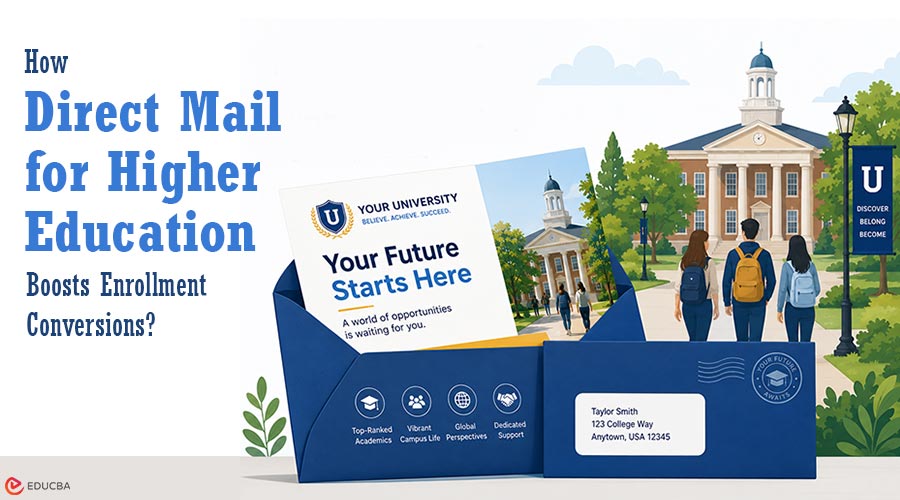
Higher education marketing teams are competing for attention across inboxes, social feeds, search results, campus fairs, and parent conversations. Students are comparing schools based on cost, outcomes, flexibility, academic fit, and career value before they ever speak with admissions. That is where custom direct mail for higher education can play a stronger role. A well-built mail campaign gives students and families something physical to review, keep, revisit, and act on during an important decision cycle. The strongest campaigns are not oversized brochures. They are structured around audience intent, enrollment timing, practical next steps, and measurable response.
Strategic Use of Direct Mail for Higher Education to Drive Enrollment Conversions
Explore key strategies to improve engagement, targeting, messaging, and overall enrollment outcomes.
1. Start With the Enrollment Decision, Not the Mail Piece
Direct mail works best when it is built around a specific decision the student needs to make. A high school junior may need a reason to explore the school. A senior may need help comparing programs and affordability. An accepted student may need reassurance before submitting a deposit. A transfer student may need clarity around credits, timelines, and advising. Each audience is in a different moment. The campaign should respect that.
Awareness Mailers Should Create Relevance Quickly
Early-stage prospects do not need every institutional detail. They need a clear reason to care. A strong awareness mailer might introduce a program cluster, a career pathway, a campus experience, or a scholarship opportunity. The goal is to make the school feel relevant enough for the student to take the next step.
Inquiry Mailers Should Help Students Compare
Once a student has shown interest, the mailer needs to become more practical. Inquiry-stage campaigns can help students compare majors, explore visit options, learn about student support, understand financial aid steps, and prepare for careers. The copy should answer the questions a real student or parent would ask before investing more time. The National Student Clearinghouse Research Center reported that spring 2025 postsecondary enrollment reached 18.4 million students, up 3.2% from spring 2024. Even with that growth, undergraduate enrollment remained below pre-pandemic levels.
2. Segment Audiences by What They Actually Care About
A single message rarely works across the full higher education audience. First-year undergraduate prospects may care about student life, academic fit, campus culture, and future opportunity. Transfer students often care about accepted credits, completion time, advising, and cost. Graduate applicants may focus on career advancement, program reputation, faculty expertise, and schedule flexibility. Parents bring another layer of scrutiny. They often look at affordability, safety, outcomes, student support, and return on investment.
Student Type Should Shape the Core Message
Segmentation should influence more than the mailing list. It should shape the headline, proof points, offer, landing page, and call to action. A transfer campaign should speak directly to credit transfer and time to completion. A graduate campaign should speak to career progression and flexible study options. A parent-facing campaign should address value, support, safety, and financial clarity.
Program Interest Can Make the Campaign More Useful
Program-specific campaigns often outperform broad institutional messaging because they feel immediately relevant. A nursing prospect may need details on clinical placements, licensure preparation, and simulation labs. A business prospect may respond to internships, alumni networks, and employer connections. A design student may care about portfolio development, studio access, and graduate outcomes. Specificity gives the mailer more value. It also gives the student a clearer reason to scan, visit, register, or apply.
3. Choose the Format Based on the Value of the Moment
The format should match the campaign goal. A postcard can work well for deadline reminders, campus visit prompts, scholarship notices, and application nudges. A folded mailer gives more room for program comparisons, financial aid guidance, transfer pathways, or parent-facing information. Dimensional mailers, video mailers, and premium packages should be reserved for higher-value moments. Accepted-student campaigns, donor outreach, honors programs, competitive graduate recruitment, and VIP campus visit invitations can justify a more memorable format.
Simple Formats Work Best for Clear Actions
A postcard can be powerful when the action is simple. A deadline reminder does not need a large brochure. An invitation to a campus visit does not need ten panels of copy. A scholarship reminder does not need institutional history. The message should be short, specific, and easy to act on.
Premium Formats Should Be Used Selectively
Premium mail formats should not be treated as decoration. They work best when the recipient is valuable, the decision is important, and the campaign needs a stronger emotional impact. A dimensional accepted-student package can help a student feel wanted. A video mailer can bring a campus story to life when an in-person visit is not practical. Higher-impact formats should earn their place in the budget.
4. Make the Message Useful for Students and Parents
College decisions rarely happen in isolation. A mailer may be opened by a student, read by a parent, discussed at the kitchen table, and revisited before a deadline. That shared household role is one reason direct mail still matters in higher education. The USPS Household Mail Survey studies how mail moves through U.S. households, using a representative sample of approximately 5,200 households each year. For colleges, household visibility can be valuable because decisions often involve more than one person.
Students Need Fit, Belonging, and Direction
Student-facing copy should help the prospect imagine a future at the institution. That does not mean filling the piece with vague inspiration. It means showing the academic path, campus experience, student support, and career direction in concrete terms.
Parents Need Proof, Cost Clarity, and Confidence
Parent-facing copy should reduce uncertainty. Parents often want to understand cost, aid, safety, academic support, graduation outcomes, and career preparation. Clear information matters more than polished slogans. The U.S. Department of Education’s College Scorecard provides families with data on college costs, graduation rates, student debt, and post-college earnings. That makes unsupported claims easier to question.
5. Use Outcomes Instead of Institutional Bragging
Higher education marketing often leans too heavily on what the institution wants to say. Students and families care more about what the institution helps them do. A mailer should translate school strengths into practical outcomes. Faculty expertise should connect to mentorship and learning quality. Facilities should connect to labs, studios, research, clinical practice, or hands-on training. Alumni networks should connect to internships, job search support, and career pathways.
Replace Generic Claims With Concrete Proof
Broad claims such as “academic excellence” or “innovative learning” do not carry much weight on their own. A stronger message explains what students experience. Name the advising model, internship access, licensure preparation, research opportunity, portfolio support, or career service that makes the claim credible.
Let Student Stories Do Strategic Work
Student stories can make a campaign feel more human, but they need detail. A useful story shows what the student studied, what support they received, and what changed as a result of the program. Program-specific stories are especially valuable because they help prospects see a path that feels relevant to their own goals.
6. Keep the Call to Action Focused
Every direct mail piece should drive one primary action. When a mailer includes too many options, such as applying, visiting, calling, scanning, following, downloading, or requesting information all at once, it creates unnecessary friction and weakens the response. The most effective campaigns keep the CTA simple and aligned with the student’s stage in the decision journey so that the next step feels natural and easy to take.
Match the CTA to the Enrollment Stage
In direct mail for higher education, the call to action should always reflect the student’s enrollment stage. Early-stage prospects should be encouraged to explore a program guide or discover academic pathways, while inquiry-stage students are better suited to actions such as booking a campus visit or attending an information session. Applicants should be prompted to complete any remaining steps in their applications, and accepted students should be guided to deposits, housing, or orientation activities. This ensures the CTA matches the level of commitment expected at each stage.
Align the CTA With Campaign Intent
Strong direct mail for a higher education campaign ensures the call to action feels like a natural continuation of the message rather than a separate request. A financial aid-focused mailer should guide students through the aid steps or connect them with a counselor, while a campus visit mailer should direct them to available visit dates. Similarly, a program-focused mailer should encourage students to explore the curriculum, outcomes, and application requirements. When the CTA aligns closely with intent, it reduces hesitation and significantly improves conversion outcomes.
7. Test the Campaign Before Expanding the Budget
Direct mail should improve with every cycle. Admissions teams can test headlines, formats, offers, image placement, QR codes, audience segments, and timing. A postcard may work well for deadline reminders, while a premium mailer may be more effective for accepted students in a competitive program. The goal is not to guess what works. The goal is to build a repeatable campaign system based on response data.
Track More Than QR Scans
QR scans are useful, but they do not tell the whole story. Better performance tracking looks at landing page visits, campus visit registrations, application starts, completed applications, deposits, event attendance, and enrolled students. Campaign reporting should connect activity to enrollment movement.
Use Results to Improve the Next Campaign
Every mailing should teach the team something. If transfer students respond positively to credit evaluation messaging, that approach should be expanded further. If parents engage more with clear financial aid information, that messaging stream should be strengthened. And when admitted students show interest in campus visit content, the visit process should be made even easier to navigate and follow.
Final Thoughts
When executed strategically, direct mail for higher education becomes more than a communication tool; it becomes a powerful driver of student engagement, trust, and enrollment conversions. By aligning messaging, segmentation, format, and outcomes, institutions can turn physical mail into a measurable part of their admissions success strategy.
Recommended Articles
We hope this guide to direct mail for higher education helps you improve your enrollment marketing results. Check out these recommended articles for more insights and strategies.


