


Dental Implants: Overview
Losing a tooth can feel isolating. It is more than just a gap in your smile; it affects how you eat, speak, and even how you feel about yourself. You are likely here because you are seeking a permanent solution, and you have heard about dental implants, but you want to understand all the various options available.
The good news is that you have choices. This is not a one-size-fits-all solution, and finding the right path for your health and smile is completely possible. Let us walk through the dental implant options so you can feel confident about your next step.
Why Tooth Loss is More Common Than You Think?
A huge number of adults face tooth loss. A study revealed that nearly 70% of Americans between the ages of 35 and 44 have lost at least one permanent tooth. People can lose teeth for many reasons. Sometimes it is the result of an accident during a sports game or an unexpected fall.
Taking care of your overall dental care is crucial for preventing future issues. At other times, gum disease or tooth decay can cause problems, breaking down the tooth structure to the point where dentists can no longer save it. Even habits like grinding your teeth can lead to permanent damage over time, making replacement teeth a necessity.
What Are Dental Implants?
A dental implant is like a substitute for a natural tooth root. It is typically a small, screw-shaped post made of titanium, a material that the human body readily accepts. The dental implant procedure places the post directly into the jawbone at the spot of the missing tooth. Over the course of several months, the bone naturally bonds with the titanium post in a process called osseointegration. This provides a strong, stable base, similar to a natural tooth root, for supporting dental implants.
After the implant bonds with the bone and the foundation is stable, the dentist attaches a connector called an abutment to the implant. Finally, a custom-made dental crown, which resembles a real tooth, is secured to the abutment. The result is artificial teeth that look, feel, and function like natural ones.
Types of Dental Implants
Implant dentistry has advanced significantly, offering several types of implants to fit different patient needs. Dentists define the two primary types by their placement in relation to the jawbone.
1. Endosteal Implants
The most commonly used type is the endosteal implant. The term “endosteal” means “within the bone.” During the implant surgery, these screw-like posts are placed directly into the jawbone.
This approach gives a strong and secure foundation for replacement teeth. For endosteal implants to be successful, a patient needs to have a sufficient amount of healthy jawbone for the post to fuse with. Most people who are healthy enough for a routine dental extraction are good candidates for an endosteal implant.
2. Subperiosteal Implants
A subperiosteal implant is an alternative for patients who lack sufficient healthy jawbone to support a post. Instead of being placed inside the bone, a subperiosteal implant rests on top of the bone but beneath the gum tissues. The design includes a metal framework that fits the jawbone precisely.
Posts are attached to this framework, which protrude through the gums to hold the final prosthetic teeth. While less common now due to the high success rates of bone augmentation procedures, subperiosteal implants remain a viable option for some individuals. Discussing subperiosteal implants with your dentist can clarify if this is a suitable choice for you.
Dental Implant Options Based on Tooth Loss
The right choice depends almost entirely on how many teeth you are missing and where the gaps are in your mouth. Your implant dentist will help you determine the best option for your specific needs.
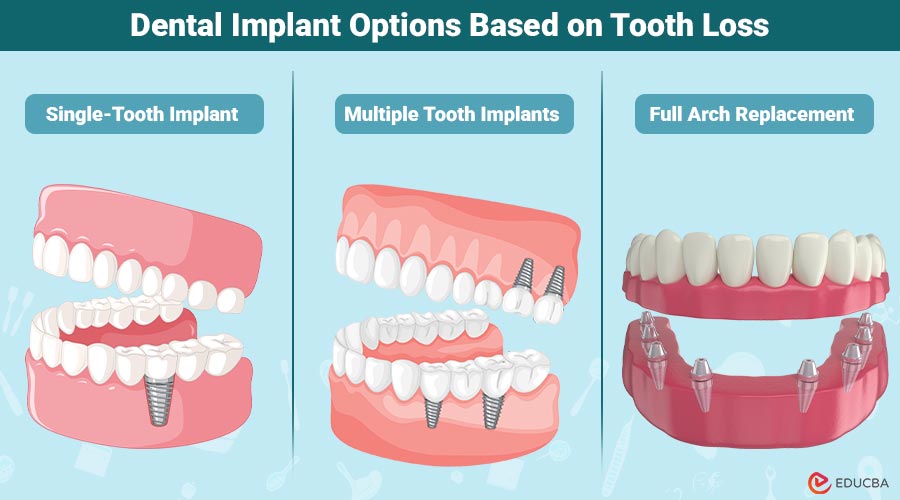
1. Single-Tooth Implant
A single tooth implant is probably the most common type of dental implant treatment. It is the straightforward solution when you are missing just one tooth. Perhaps you lost a molar in the back due to decay or a front tooth from an injury.
In this case, dentists place one endosteal implant post in the jawbone. After the gum tissues heal, an abutment and a single dental crown are attached to it. It is a complete, stand-alone tooth that fills the gap perfectly. A huge advantage here is that it does not affect the healthy teeth next to it. Other options, such as a traditional dental bridge, require dentists to file down the adjacent teeth to use them as supports. With a single-tooth implant, your healthy teeth are left completely untouched.
2. Multiple Tooth Implants
What if you are missing several teeth in a row? Using single implants for each one might seem like the obvious answer, but there is often a better way. This is where an implant-supported bridge comes in.
Rather than inserting an implant for each missing tooth, an oral surgeon can place two implants on either side of the gap. These two implants then act as anchors for a bridge of three, four, or even more prosthetic teeth. It works like a traditional bridge but uses strong implants, rather than natural teeth, for support. This approach offers excellent stability and is more cost-effective than using separate implants for every missing tooth. It also helps preserve the bone structure under the entire gap, not just where the posts are.
3. Full Arch Replacement
Losing most or all teeth in the upper or lower jaw can make replacement feel overwhelming. Traditional dentures can slip, feel uncomfortable, and make it hard to eat certain foods. Full arch replacement is a game-changing solution offering permanent replacement teeth. The most popular method is known as the All-on-4 treatment. As the name suggests, this method utilizes four implants strategically placed in the jaw. These implants are often angled to take advantage of the densest parts of the bone, helping make procedures faster. A full, custom-made denture is then securely attached to these four implants. This provides a complete set of permanent, non-removable, white teeth.
You can smile, eat, and speak with total confidence because they will not move or click like old-school dentures. In some cases, if additional support is needed, your surgeon may recommend an All-on-6 procedure, which utilizes six implants instead of four. The principle remains the same; it simply adds more stability for the long term. This method provides a permanent replacement smile that feels completely natural.
Quick Comparison of Dental Implant Options
Here is a simple breakdown of the main options we have discussed. It gives you a quick snapshot of what to expect.
| Factor | Single Implant | Implant-Supported Bridge | All-on-4 / All-on-6 |
| Best For | One missing tooth | 2-4 missing teeth in a row | Full upper or lower arch |
| Number of Implants | One | Usually two | Four or six |
| Cost (Relative) | $ | $$ | $$$ |
| Impact on Other Teeth | None | None | None |
| Primary Benefit | Preserves healthy teeth | Fewer implants needed | Replaces a full set of teeth |
What If You Do Not Have Enough Jawbone?
A common hurdle for many considering implants is the lack of sufficient jawbone density. A healthy jawbone is essential for securing an implant. Fortunately, modern implant dentistry offers several solutions to this problem. These procedures, often categorized as bone augmentation, focus on rebuilding the bone to create a solid foundation. The bone augmentation procedure typically involves adding bone or bone-like materials to the jaw.
A few common procedures include:
- Bone Grafting: This involves adding bone graft material to the jaw. Doctors can take the graft material from another part of your body, a donor source, or create it from synthetic materials. Over time, your body integrates this material, creating new, natural bone.
- Sinus Lift: This procedure is specific to the upper jaw, which often has less bone due to the proximity of the maxillary sinus. A sinus lift, known as sinus augmentation or elevation, raises the sinus floor and adds graft material to the created space. This provides enough height for dental implants.
- Ridge Expansion: Dentists can perform a ridge expansion if the jaw is too narrow for implants. This procedure involves splitting the jawbone ridge and packing graft material into the space to create a wider base for the implant.
These techniques often utilize bone additives and growth factors to accelerate healing and bone regeneration. Your dentist will determine if a bone augmentation is necessary during your initial evaluation. Though it adds time to the overall process, it makes successful dental implant surgery possible for many more people.
Exploring Mini Dental Implants
Another option in the world of implant dentistry is the mini dental implant. As their name suggests, mini dental implants are smaller in diameter than traditional implants. Mini implants usually consist of a single solid piece that screws into the jawbone, with a ball-shaped end protruding from the gum. Dentists often use them to stabilize a lower denture, preventing the slipping and discomfort that many denture wearers experience.
Special abutments on the denture snap onto the ball ends of the implants, holding them securely in place. The implant procedure for mini dental implants is less invasive than for traditional implants. Because they are smaller, the healing process can be quicker. However, they may not offer the same level of long-term durability for supporting a single crown or bridge as a standard endosteal implant. They are useful in certain cases and can be a great option for enhancing denture stability.
Benefits of Choosing Dental Implants
No matter which type of dental implant you choose, the benefits go far beyond simply filling a gap in your smile.
- Natural-Looking Smile: Dental implants appear and function similarly to natural teeth. The crowns are specially crafted to match your teeth’s shape, size, and color, making them almost impossible to tell apart.
- Long-Lasting Durability: Because dental implants fuse directly with your jawbone, they are incredibly strong and stable. With proper care—regular brushing, flossing, and dental checkups—they can last a lifetime, which other tooth replacement options often cannot guarantee.
- Prevents Bone Loss: The jawbone around a lost tooth may get smaller. They serve to stimulate the jawbone and prevent bone resorption. This helps maintain a healthy, strong jaw and preserves the facial structure.
- Overall Health and Confidence: Dental implants improve chewing, speaking, and your smile, boosting both oral function and self-confidence. Many people notice a significant improvement in their quality of life after getting implants.
Are You a Good Candidate for Implants?
Dental implants are highly successful, but they may not be suitable for everyone. To be a good candidate, several key factors must align. Your dental professional will thoroughly assess your situation; however, here are some general guidelines to follow. You need to be in good overall health. Conditions like uncontrolled diabetes or certain cancers can interfere with the healing process. It is also important to have healthy gums, free of active periodontal disease, to ensure the gum tissues heal properly.
Finally, and this is a significant point, you need to have sufficient healthy bone in your jaw to support the implant. Remember, the implant post needs a solid foundation. If you have been missing a tooth for a long time, some bone loss may have already occurred. But do not lose hope if your bone is a little thin. As we discussed, procedures like a bone graft can help rebuild the area. This adds some time to the process, but it enables many more people to receive dental implants successfully.
Final Thoughts
Whether you need a single tooth implant, multiple tooth implants, or a full arch replacement, there is a solution that fits your needs. Dental implants restore your smile and support long-term oral health. Talk to your dentist about the best type of implant for you—and take the first step toward a confident, lasting smile.
Recommended Articles
We hope this guide to dental implants helps you understand your options. Explore these recommended articles for additional tips and insights on restoring your smile.

