

Updated February 27, 2023
Introduction to Data Warehouse Process
Data Warehouse is a Data Compilation, Organization, and structural Management process which involves a series of activities performed over the given data. This process can be worked upon by a variety of data sources, which simply means that the data can be of heterogeneous nature. It can be defined as a method of altering the data collected from multiple sources into a similar structured form of readily usable facts/ figures, and for constructing it to be accessible to the business professionals for Analysis and Decision-making processes. A Data Warehouse also goes by the names ‘Decision Support System’, ‘Business Intelligence Solution’, ‘Analytic Application’, ‘Management Information System’, ‘Executive Information System’, etc.
Types of Data Warehouse Architecture
The Data Warehouse Architecture can be built based on two different process prototypes, such as the below:
- Centralized Architecture
- Distributed Architecture
1. Centralized Architecture
As the name says, the Centralized Data Warehouse process Architecture is a solitary unit of a system that is dedicated to the Data Warehouse processing. It is the traditional method for constructing a Data Warehouse system, and this Architecture is the preferred model for organizations of small to medium size. The small to medium-sized organizations deal with a much lesser amount of data when compared to the larger-sized organizations.
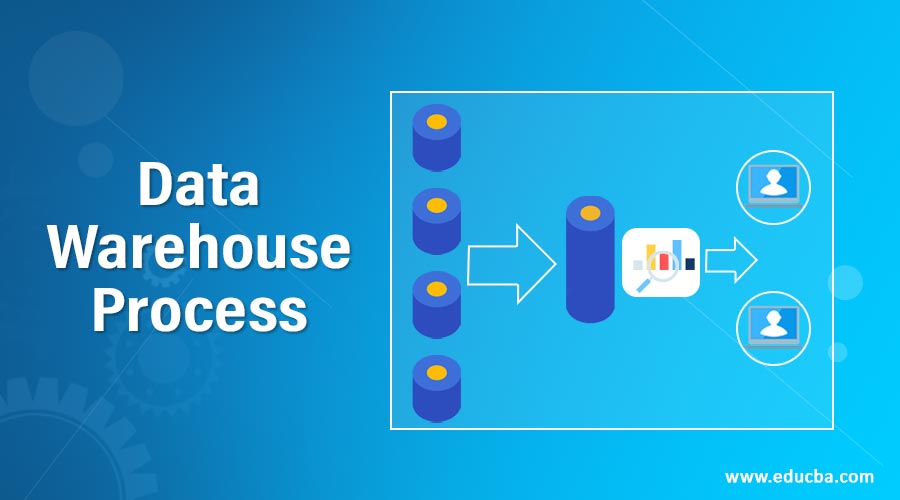
This Architecture is simpler in structure, and so it has a lesser number of components involved. The main components in this model are the multiple data sources, the centralized Data Warehouse, and the client units which receive the processed data from the centralized Data Warehouse. This Data Warehouse can process a diverse range of data sources, which can contain any type or form of data in them, as it is a common property of any Data Warehouse system.
This model is considered to be an efficient type of Architecture for an organization with nominal storage space, lesser hardware devices, limited funding, fewer technical support professionals, etc. The complete Data warehouse process takes place in one physical location, which minimizes the communication delays that cannot be handled by a smaller or medium-sized organization.
The outcome from this type of Data Warehouse Architecture is used as a Business Intelligence source input. Business Intelligence process involves the Data Warehouse’s processed data as the input for creating Analytical Results, and Generation of Reports for the data fetched from the system. These results and reports will further be used by the Business Stack Holders for structuring the business flow and make meaningful decisions to run the business successfully.
2. Distributed Architecture
The Distributed Data Warehouse process Architecture consists of the same outline for the system implementation. The main difference for a Distributed Data Warehouse system against the Centralized Data Warehouse system is that the components of the warehouse are not located in the centralized form. Instead, it is in a distributed form, where the data sources can be in different locations or system units, the data processing can be carried out in a dispersed way, etc.
This type of Architecture can be applied to larger organizations as well, as the distributed nature can aid to handle a larger amount of data for Analysis and Report generation. This model can surmount the disadvantages of the centralized Data Warehouse process Architecture, and hence it is seen as an alternative option for the Centralized model.
In this type of Architecture, all the activities are assigned in different functional units. The distributed processing involves the activities like the data collection from heterogeneous data sources, processing of the collected data, organizing and placing the processed data into the data warehouse system, retrieving the information from the data warehouse, utilizing the results for analytical processing, and report creation, and finally employing the generated results for business decision making.
Any Distributed Data Warehouse Architecture can be managed into five different types of configuration, such as:
- Client-Server Architecture
- Three – Tier Architecture
- N – Tier Architecture
- Cluster Architecture
- Peer – to – Peer Architecture
Client-Server Architecture
The Client-Server Architecture has two components, the client and the server, where the data collection, transformation, and loading is performed by the Client units, while the Server handles the data warehouse system development, processing the contents of the warehouse and the overall data management.
Three – Tier Architecture
The Three Tier Architecture contains the client as one tier, the server as one tier, and the rest of the connected systems into the third tier. The third tier unit can be used for enabling communication between the client system and the server system.
N – Tier Architecture
N – Tier is nothing but a multiple-tier Architecture, where the client-server architecture is connected with other intermediate units, such as the downstream applications, middleware structures, along with multiple client and server units.
Cluster Architecture
A Cluster system is where each node in the system is responsible for its own individual activity, and the nodes cannot function on their own without collaborating with other nodes. This allows the entities to be connected as a network and to process concurrently by utilizing the respective resources assigned to each node.
Peer – To – Peer Architecture
In the Peer – To – Peer Architecture, each node will be capable of achieving all the activities including the client, the server, the data processing, etc. The responsibilities can be shared amongst the nodes, hence each unit is called as the ‘Peer’ in the Data Warehouse system.
Advantages of Data Warehouse process
Below are the advantages of the Data Warehouse process Architecture,
- A well-designed Data Warehouse system can led to a higher performance during the Decision –Making Process.
- Highly efficient in terms of generating Business Intelligence solutions.
- Controls the wastage of time due to the regulated data processing.
- No Data Redundancy, enhanced Data Quality, Consistent and Reliable output Data.
Conclusion
The Data Warehouse process is an essential activity in Data Science Technology, as it plays a vital role in the Business Intelligence Model and the Business decision-making process. As the application of Data Warehouse is observed to be in business areas like Banking, Retail, Technology, Defence, etc, it is observed to be a growing technique for Data Management.
Recommended Articles
This is a guide to Data Warehouse Process. Here we also discuss the introduction and types of data warehouse architecture along with advantages. You may also have a look at the following articles to learn more –

