

Updated October 27, 2026
Picture three companies at a quarterly review, each saying the same sentence: “We monetized our data this year.” The first company studied its complaint logs and fixed a broken returns process. The second connected an assistant to its policy documents so staff stopped hunting through shared drives. The third signed an agreement that let an outside party use a defined set of its records to train AI systems, and it received a fee. All three are telling the truth. Only one received money from someone else. For anyone learning business analytics or exploring data-driven business models, understanding this distinction is essential. These data monetization examples show why creating value from data and earning revenue by selling or licensing data are not necessarily the same.
Key Takeaways
- “Data monetization” covers at least three mechanisms: internal savings, internal capability, and external licensing income.
- Each mechanism has a different payer, evidence, and trigger event.
- A strong business case names the mechanism first, then the proof, the rights, and the conditions.
What Are the Main Data Monetization Examples?
Three useful data monetization examples make the different mechanisms clear.
- Internal Savings: Data reveals a problem; fixing the problem reduces cost or rework.
- Internal Capability: Data powers a tool, such as search or an assistant, that helps people work better.
- External Licensing: A company grants an outside party defined rights to a selected collection, in exchange for compensation under a contract.
The same customer support archive could feed all three. That is why the label “monetization” alone tells you very little. A dataset is an input. It becomes money only when a specific mechanism, backed by specific evidence, turns it into revenue.
These three examples are not an exhaustive taxonomy. A paid analytics subscription or another data-enabled product can also bring in outside revenue. Here, licensing means compensation for agreed rights in a defined collection, rather than every business model that uses data.
Route One: The Savings Story
An illustrative example: A regional service business notices that a third of its repeat complaints trace back to one confusing form. It redesigns the form, and repeat contacts fall. That may be real economic value, but nobody paid the company for its data. The benefit shows up as avoided cost, which is notoriously easy to overstate.
To support the claim, you need evidence of the outcome and anything else that changed at the same time, such as staffing or seasonal volume. A falling chart is a starting point for analysis, not proof of savings.
Route Two: The Internal Tool Story
Now picture a company connecting an AI assistant to its current, approved documents so employees can ask questions in plain language. The value here depends on use. Do people trust the answers? Do they find information faster?
Are permissions respected so staff see only what they are entitled to? An AI interface alone proves nothing. This route also involves no outside payment. The company is using records internally, subject to the rights, privacy duties, and access restrictions that still apply.
Route Three: What Makes Licensing Income Different?
Of the three examples here, licensing is the route where another party pays for agreed rights to use a defined collection. That raises the bar on what has to be true. The company needs authority to grant those rights. Records it created itself, content supplied by customers, and material it licensed from vendors can carry very different permissions. The collection needs to serve a specific purpose, usually by connecting context, actions, and outcomes rather than being a pile of rows.
And the transaction needs signed terms, any required preparation, and the buyer’s acceptance before money moves. There is no universal price per row; usefulness depends on the task the records support.
Where a Real Licensing Route Fits?
This third route is the one SourceX works on. It licenses approved business records directly from companies for AI training and evaluation. Companies sign with SourceX rather than an AI developer, and SourceX handles the agreement, preparation, and payout under signed terms.
SourceX advertises payouts of up to US$4 million, a figure it describes as an upper bound for the largest enterprise datasets rather than a typical or guaranteed amount. The program targets established businesses, generally those with 50 or more full-time employees at their peak and several years of operating history, and its first fit check is a short questionnaire with no file uploads.
For learners, the structure is the lesson: an estimate of possible compensation is not an accepted transaction. The exact dataset, payout, and conditions are fixed only in a signed agreement, and payment follows the acceptance and invoicing steps those terms define.
Do Not Mix Up the Percentages
One more trap. Some programs pay a referral reward to a person who introduces an eligible company, but only after a qualifying paid transaction and the program’s other conditions are met. That reward has its own base and its own rules, and it is paid separately from the company’s licensing payment. A referral percentage, a supplier’s licensing payout, and a productivity gain are three different numbers. Putting them in the same spreadsheet column produces a meaningless figure.
How Should You Write It In a Business Case?
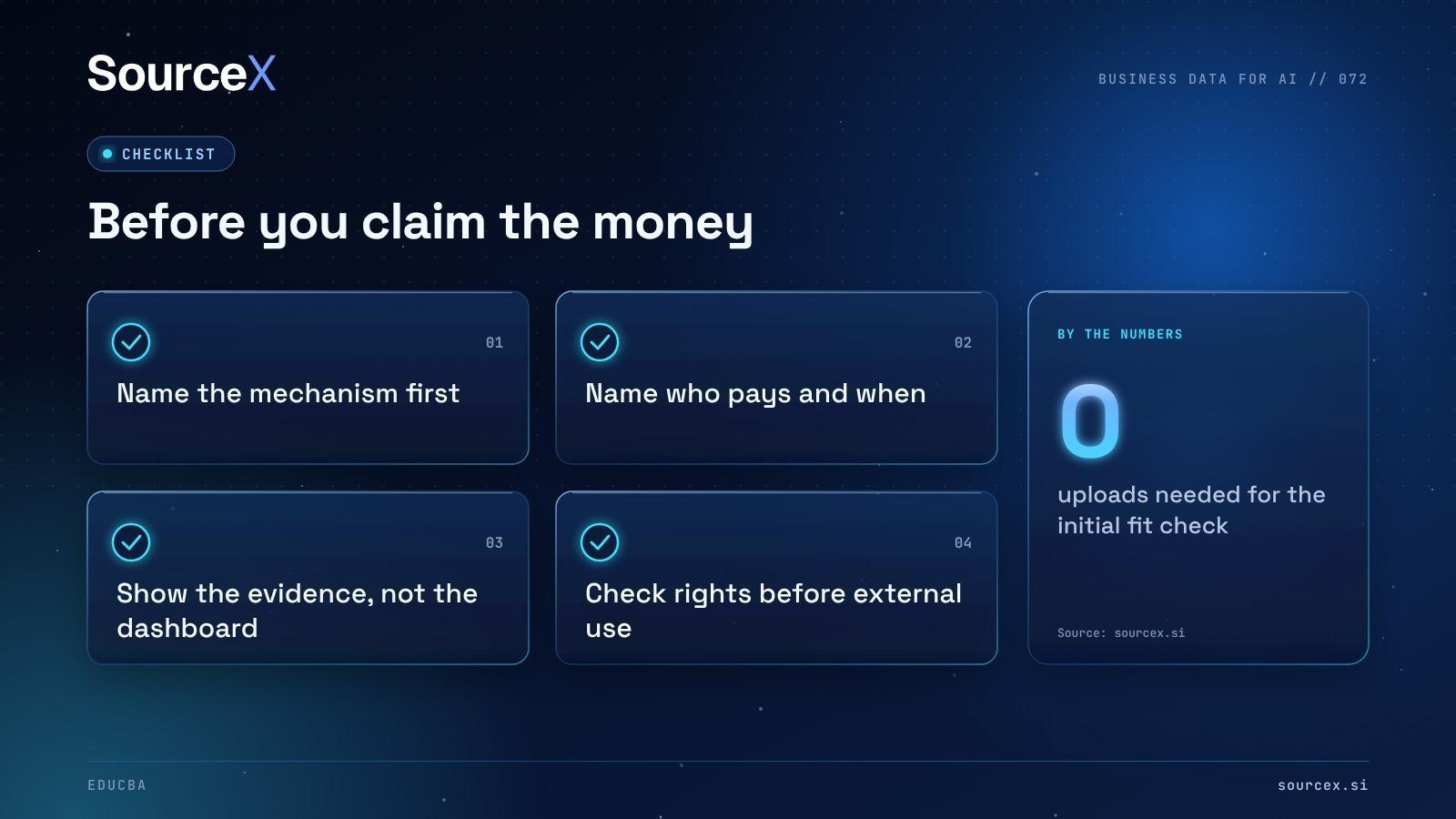
Image Source: SourceX
Start every data monetization claim with four plain answers:
- Mechanism: Are we reducing a cost, improving an internal task, or earning external licensing income?
- Payer: Who bears or pays the value, and when?
- Evidence: What would convince a skeptical reviewer the benefit is real?
- Conditions: Which rights, effort, and approvals must exist first?
Then test your next assignment or proposal. Find the phrase “monetize our data” and replace it with those four answers. If one of them stays blank, you have found the most important question left to research.
Next time someone in a quarterly review announces that the company monetized its data, you will know the follow-up question to ask: what kind of money, and who paid it? SourceX‘s external licensing route illustrates how the proposed benefits, granted rights, and payment conditions form separate parts of a data monetization business case.
About the Founder
Noah Loul is a four-time founder and CEO of SourceX, which licenses business data directly from companies for AI training and evaluation. He previously founded B2B Rocket, which Blackpearl Group acquired. His work focuses on building permission-based data infrastructure for AI.
Recommended Articles
We hope these data monetization examples help you understand how businesses can turn data into financial value and improve internal operations. Explore these recommended articles for more insights into data analytics, business strategies, and emerging technologies.