
Difference between Data Engineer vs Data Analyst
The following article provides an outline for Data Engineer vs Data Analyst. Data analytics is the study of datasets to draw inferences from the data utilizing specific systems software. It focuses on certain regions with defined objectives. Data engineers create and develop technologies that allow data scientists and analysts to focus on practical data collection and processing applications.
Data analysts are generally those who use data to generate insights. They may use technologies and perform data cleansing and processing on their own, but their result is insights. They don’t do much modeling if any at all. Data engineers are largely responsible for data infrastructure management, data processing automation, and large-scale model deployment. They may provide some analysis, but their primary role is that of master builders.
Analyst of Data:
- Involved in the conversion of numerical data into a usable format.
- Tools such as Microsoft Excel, SAS Miner, SPSS, and SSAS must be well-understood.
- Has some understanding of SQL, Python, R, and JavaScript.
- Data mining, data visualization, exploratory data analysis, and statistics are all skills that our team possesses.
Data Engineer:
- Participated in data preparation for operational and analytical reasons.
- Programming languages such as SQL, Java, SAS, and Python must be thoroughly understood.
- Hadoop, Pig, Hive, Apache Spark, MapReduce, NoSQL, and Data Streaming are all required frameworks.
- Experts in the creation of a big data warehouse using ETL.
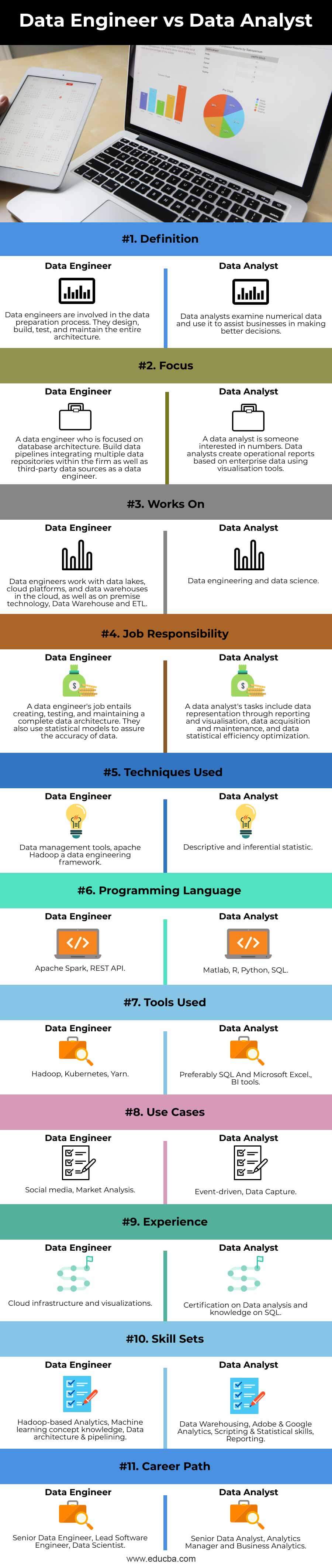
Head to Head Comparison Between Data Engineer vs Data Analyst (Infographics)
Below are the top 11 differences between Data Engineer vs Data Analyst:
Key Differences between Data Engineer vs Data Analyst
Let us discuss some of the major key differences between Data engineers vs Data Analysts:
- A data analyst is in charge of taking actions that affect the company’s present scope. A data engineer is in charge of creating a platform on which data analysts and data scientists can work.
- A data analyst employs descriptive analysis and static modeling approaches to summarise the data. A data engineer, on the other hand, is in charge of developing and maintaining data pipelines.
- A data analyst examines the data and delivers it in a way that teams can understand. They may need to assess current performance, plan for the future, and develop strategies to improve sales or website visits, as well as identify trends among various user groups.
- Data analysts typically undertake tasks similar to those performed by data scientists, such as data cleansing, analysis, and data visualization. However, data analysts are more concerned with data analysis and communication. The mindset of a data engineer is frequently more focused on building and optimizing.
- Machine learning knowledge is not required for data analysts. A data engineer does not need to know about machine learning, but he does need to know about core computing.
- Traditional firms can be transformed into data-driven businesses with the help of data analysts. Data engineers ensure that data is received, converted, stored, and made available to other users in a timely and accurate manner. Data engineers having a background in software development are more likely to be able to switch between and integrate technologies to reach a common aim.
- Through a thorough investigation, a data analyst ensures that the relevant data is available for business. DE to make sure that data is accurate and that they can adapt to changing business needs.
- The most critical talent, whether you’re a data engineer or a data analyst, is SQL. For someone with SQL and data analysis skills, data analysis is a wonderful career choice.
- A data analyst’s average annual pay is just about $59000. A data engineer’s annual salary might reach $90,8390. A data engineer might earn anywhere from $110,000 to $155,000 per year, depending on their talents, experience, and location. Those with more experience can expect to earn up to $172,603 per year on average.
Comparison Table of Data Engineer vs Data Analyst
Let’s discuss the top comparisons between Data Engineer vs Data Analyst:
|
|
Data Engineer |
Data Analyst |
| Definition | Data engineers are involved in the data preparation process. They design, build, test, and maintain the entire architecture. | Data analysts examine numerical data and use it to assist businesses in making better decisions. |
| Focus | A data engineer who is focused on database architecture. Build data pipelines integrating multiple data repositories within the firm as well as third-party data sources as a data engineer. | A data analyst is someone interested in numbers. Data analysts create operational reports based on enterprise data using visualization tools. |
| Works On | Data engineers work with data lakes, cloud platforms, and data warehouses in the cloud, as well as on-premise technology, Data warehouses, and ETL. | Data engineering and data science. |
| Job Responsibility | A data engineer’s job entails creating, testing, and maintaining a complete data architecture. They also use statistical models to assure the accuracy of data. | A data analyst’s tasks include data representation through reporting and visualization, data acquisition and maintenance, and data statistical efficiency optimization. |
| Techniques Used | Data management tools, apache Hadoop a data engineering framework. | Descriptive and inferential statistics. |
| Programming Language | Apache Spark, REST API. | Matlab, R, Python, SQL. |
| Tools Used | Hadoop, Kubernetes, Yarn. | Preferably SQL And Microsoft Excel., BI tools. |
| Use Cases | Social media, Market Analysis. | Event-driven, Data Capture |
| Experience | Cloud infrastructure and visualizations. | Certification on Data analysis and knowledge on SQL. |
| Skill Sets | Hadoop-based Analytics, Machine learning concept knowledge, Data architecture & pipelining. | Data Warehousing, Adobe & Google Analytics, Scripting & Statistical skills, Reporting. |
| Career Path | Senior Data Engineer, Lead Software Engineer, Data Scientist. | Senior Data Analyst, Analytics Manager, and Business Analytics. |
Conclusion
So, in this article, we covered the differences between Data Analytics and Data Engineer, as well as how ML and AI are used in these professions, and how to choose the correct job. While these jobs have a lot in common, they approach data in a very different way. Consider your abilities and specific interests in data science to determine which career is the greatest fit for you. These positions are excellent places to start for anyone interested in a career in data. Getting hands-on experience in this area will set you up for any data-related professional path.
Recommended Articles
This is a guide to Data Engineer vs Data Analyst. Here we discuss key differences with infographics and comparison tables respectively. You may also have a look at the following articles to learn more –

