


Updated June 10, 2026
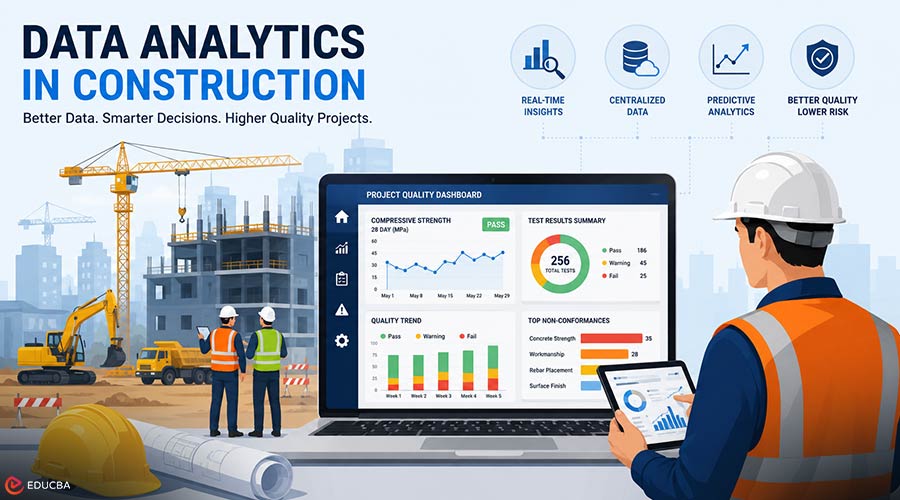
Ask a site engineer from fifteen years ago what quality control meant on a project, and the answer would likely involve slump tests, inspection logs, and countless phone calls whenever something failed to meet specifications. The data existed as test results, observation reports, and compaction records, but it was often stored in paper files or scattered across spreadsheets. Today, while field inspections and material testing remain essential, what happens to that information afterward has changed dramatically. By leveraging data analytics in construction, organizations can convert project data into meaningful insights that enhance quality, minimize rework, and enable more informed decision-making. This is what the shift toward data-driven quality control actually looks like in practice. Not a replacement for engineering judgment, but a significant upgrade to the information that judgment works with.
Quality Control Used to Be Almost Entirely Backward-Looking
The traditional quality control model was fundamentally reactive. You collected data during construction, reviewed it for compliance, and flagged anything that fell outside spec. If the concrete did not have enough strength, you investigated. If compaction was off, you re-rolled. The system worked up to a point. The limitation was not the testing itself. It was what happened to the results. A failing test on one project rarely provided any insight into the next one.
Patterns that existed across a body of work, certain mix designs consistently underperforming in cold weather, a particular subcontractor’s compaction results clustering just barely inside acceptable ranges, were invisible because nobody was looking across projects at once. The other problem was timing. By the time a report got written, reviewed, and distributed, the conditions it described were already in the past. For a fast-moving project, that lag matters. Analytics platforms that aggregate and visualize data in near-real-time close that gap in a way that monthly summary reports never could.
Construction Projects Generate More Useful Data Than Most Teams Actually Use
It is worth being specific about what “construction data” actually means, because the category is broader than it might seem. On a mid-size infrastructure project, data is being generated constantly across multiple fronts. Material testing alone can produce hundreds of individual records over a project’s life: concrete cylinders broken at 7 and 28 days, soil compaction tests at each lift, aggregate gradations, moisture-density curves, asphalt extraction and Marshall stability results. Add to that:
- Field inspection observations and non-conformance reports
- Environmental monitoring of temperature, humidity, and wind that affects curing and placement
- Equipment performance logs from GPS-equipped rollers and pavers
- Supplier certifications and mix design records tied to specific placements
Most organizations collect a lot of this. Fewer of them do anything systematic with it beyond satisfying the immediate compliance requirement. The gap between what is being gathered and what is being learned from it is, frankly, pretty wide, and that is also where the opportunity lies.
What Analytics Actually Reveals and Why It Is Not Magic?
It is worth being clear-eyed about what data analytics does and does not do in a quality context. It does not replace engineering expertise or eliminate the need for experienced inspectors. What it really changes is the depth of questions you can explore and the speed at which you can find answers. Trend analysis is probably the most immediately practical application. When you can visualize concrete strength results across dozens of pours, patterns emerge that are not visible when you are reviewing individual break reports.
Maybe the results consistently come in 10% below the design strength when ambient temperatures drop below a certain threshold. Maybe one supplier’s aggregate is producing more variable results than another’s. Those correlations exist in the data; you need a way to surface them. Predictive quality management is the next step. By analyzing historical project data, you can identify where risks are most likely to arise in an active job.
This is not perfect forecasting; construction is too variable for that. But it is considerably more useful than waiting for a problem to show up in a test result before acting. Benchmarking across projects, regions, or subcontractors is another area where aggregated data pays off. Organizations managing multiple concurrent projects can start comparing quality performance in a structured way, not just anecdotally, but with actual numbers. That is a different kind of management conversation, and usually a more productive one.
Material Testing Data: From Compliance Record to Strategic Asset
Testing results have always been the backbone of construction quality assurance. The question is whether they are treated as a compliance checkbox or as a body of information worth analyzing seriously. When testing data gets digitized, timestamped, and linked to specific project conditions, who placed the concrete, what the weather was, which supplier provided the aggregate, which crew ran the compaction, it becomes something you can actually query.
Find all the strength results from this mix design at temperatures below 50°F. Show me the compaction results for this subcontractor across three projects. That kind of analysis was technically possible before, but impractical. Digital systems make it routine. The material testing equipment itself has also evolved. Modern digital instruments reduce transcription errors, automatically log results, and, in some cases, integrate directly with project management platforms. The data integrity question of capturing accurate information consistently gets easier to answer when the collection process is less manual.
Technologies Driving Data Analytics in Construction
Cloud platforms play a critical role in supporting data-driven quality control and project management initiatives. When testing data, inspection records, and project documentation all live in a shared system rather than on individual laptops, the visibility problem largely solves itself. Project managers can see current quality status without waiting for a report. Regional offices can compare performance across sites.
Audits become data exports rather than document hunts. IoT sensors add a layer of continuous data that periodic testing can not provide. Embedded sensors in concrete can track curing temperature and moisture in real time, useful for post-tensioned elements, cold-weather pours, or any situation where curing conditions significantly affect final strength. Structural monitoring sensors on bridges or retaining walls can flag anomalous deflections or vibration signatures before they become visible damage.
AI and machine learning are the most hyped components of this stack and also the ones that require the most nuance. The realistic near-term applications are pattern recognition and anomaly detection tasks in which the volume of data exceeds what humans can review manually and in which historical patterns are meaningful predictors of future behavior. More speculative applications, like AI systems that autonomously modify construction processes based on quality signals, are further out and come with their own challenges around accountability and verification.
Business Benefits of Analytics-Driven Quality Control
The business case for analytics-driven quality control is not complicated. Rework is expensive in direct costs, in schedule impact, and sometimes in client relationships. Catching quality issues earlier in the process, when they are still containable, consistently costs less than addressing them after they have propagated. Beyond rework reduction, there are real gains in compliance efficiency. Regulatory and owner-required documentation that once took hours to assemble can often be generated directly from the project data platform. That is not a trivial benefit on projects with heavy reporting requirements.
There is also a less obvious benefit: organizational learning. Companies that systematically capture and analyze quality data across projects develop a body of institutional knowledge that does not walk out the door when experienced staff retire. The data’s patterns and benchmarks outlast individual employees, making them especially valuable in an industry with high workforce turnover.
Challenges of Implementing Data Analytics in Construction
It would be misleading to present this as a straightforward transition. Most construction organizations that have tried to implement data analytics programs have run into the same core problems, and they are worth naming honestly. Data quality is the first and biggest. Analytics is only as good as the information it uses, and construction data collection is notoriously inconsistent. Different field crews use different terminology. Some sites digitize everything; others still use paper forms that are transcribed later.
Legacy documentation systems do not talk to newer platforms. Before you can do meaningful analysis, you usually have to solve a data standardization problem, and that is more of an organizational challenge than a technical one. The workforce dimension is also significant. Field technicians and inspectors who have worked a certain way for years do not automatically embrace new digital workflows, especially when the immediate benefit to them is not obvious. Without training and change management, people often work around systems instead of using them effectively.
None of these challenges is insurmountable, but they do mean that the technology investment is only part of what is required. Organizations that get this right typically start with a specific, bounded problem, quality reporting for a particular project type, or materials tracking across a specific portfolio, and build from there rather than trying to transform everything at once.
What Does This Mean for People Building Careers in Construction and Engineering?
The skills that make someone effective in construction quality management are shifting. Engineering fundamentals and field experience still matter enormously; nobody’s replacing the judgment of someone who has seen a thousand concrete pours. But those fundamentals increasingly need to coexist with data literacy: the ability to work with project databases, read analytical outputs critically, and communicate findings in terms that connect to project decisions.
This does not mean every QA engineer needs to become a data scientist. It means understanding enough about how data flows through a project to ask good questions of the systems that manage it, and to recognize when an analytical output looks wrong. You can learn that skill set, and you should develop it deliberately rather than wait for it to appear in a job description.
Final Thoughts
Data analytics in construction is not replacing traditional quality assurance practices. Physical testing, field inspections, and engineering expertise remain fundamental to successful project delivery. What analytics does provide is a more effective way to use the vast amount of information construction projects already generate. Organizations that treat quality data as a strategic asset rather than a compliance requirement are experiencing measurable benefits, including reduced rework, improved efficiency, better decision-making, and stronger project outcomes. While the transition is not always simple, the industry’s direction is clear. The construction companies consistently delivering high-quality projects are not just better at engineering—they are better at using data to understand what is happening and respond faster when it matters most.
Recommended Articles
We hope this guide to data analytics in construction helps you understand its impact on quality control and project performance. Check out these recommended articles for more insights into construction technology and management.


