


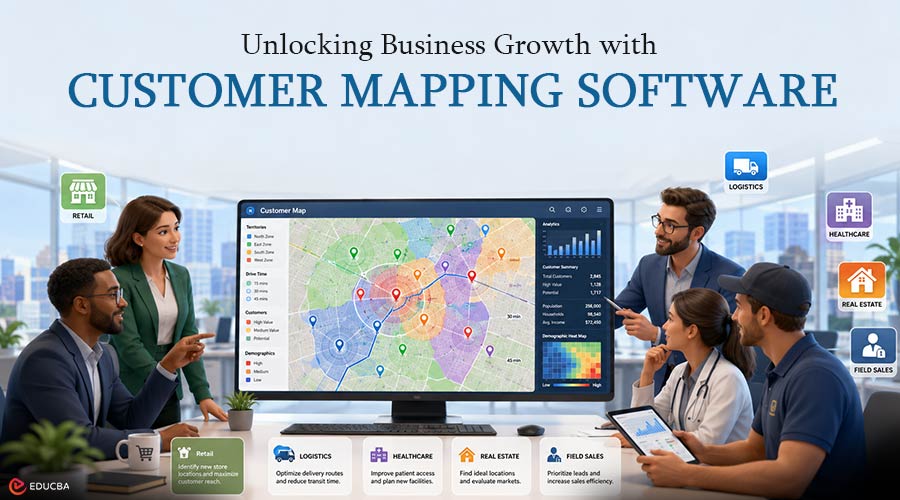
According to the IMARC Group, the global location intelligence market was valued at $21.5 billion in 2024 and is expected to reach $68.8 billion by 2033. That growth is not concentrated in one sector. Retail chains, logistics carriers, healthcare networks, and B2B sales teams all use customer mapping software to convert a list of customer addresses into a working analytical surface and layer business context on top. The choice of overlay and the decisions the map informs are what vary from one industry to the next.
Retail Chains and Multi-Unit Operators
Retail brands with more than a handful of stores rely on customer mapping software for site selection, cannibalization studies, and competitor monitoring. A regional grocer planning a new store opening needs to identify where existing customers come from, which census tracts deliver high basket sizes, and where the planned location will draw traffic from existing outlets. None of that is visible in a sales report.
A 2024 Forrester study found that retailers who link online research data to in-store visits achieve a 47% higher conversion rate than those who rely solely on in-store analytics. The advantage compounds across multi-unit operators because every new location decision feeds the next. Trade-area overlap, demographic skew, and travel-time bands all emerge from address-level data when it is plotted in customer mapping software.
Logistics and Distribution Operations
Carriers, third-party logistics providers, and private fleets use customer mapping software to plan routes, position distribution centers, and meet promised delivery windows. A regional carrier with five depots and several thousand drop points uses drive-time radii to identify which customers fall outside cost-effective service areas. The same data informs depot relocation, contract pricing, and SLA design.
Last-mile economics depend on accurate clustering of delivery points. A 5% reduction in route length across a 50-truck fleet yields fuel and labor savings that recover the cost of customer-mapping software within months. Larger operators run nightly route optimization against a live customer dataset and reconcile actual vehicle traces against the plan to identify driver-level inefficiency.
Real Estate Businesses Using Customer Mapping Software
Commercial brokers and residential developers use customer-mapping software to match prospect databases with listing inventory, demographic overlays, and transit corridors. A multifamily developer evaluating a parcel will pull median household income, age distribution, and commute patterns within a defined drive-time band before underwriting. Brokers handling corporate relocation use the same surface to match an employer’s workforce footprint against available office products.
Residential agents working buyer leads plot client search areas against active listings to spot zip codes with a tight supply of listings. Investment teams use customer-mapping software to scan portfolios for submarket concentration risk. The work that used to live in static market reports now happens on a single interactive canvas.
Core Functions of Customer Mapping Software
Most platforms in this category combine address geocoding, layered visualization, and territory boundary tools. A typical customer mapping tool form imports a spreadsheet of customer records, plots each address on a single canvas, and overlays demographic, competitor, or sales data on top. The result is a planning surface for site selection, route optimization, and territory design that does not require specialist training.
Selection often depends on import limits, depth of demographic overlays, drive-time radius calculations, and export formats. These should generate reports that executives can easily understand. Capability sets vary by vendor and price tier.
Field Sales Operations
Outside sales operations use customer mapping for territory design, account routing, and rep deployment. Alexander Group reports that organizations optimizing sales territories see a 10% to 20% increase in productivity. Companies that base their sales territory design on data rather than account count or geographic shape achieve 15% to 20% higher quota attainment.
The mechanics are straightforward. A sales operations lead loads the account file into customer mapping software, weights accounts by revenue or potential, draws territory boundaries that balance workload across reps, and assigns named accounts to each territory. The same surface supports route planning for the rep working on that book. Adjustments after a quota refresh or a rep change take hours, not days.
Restaurants and Quick-Service Brands
Multi-unit restaurant operators use customer-mapping software for trade-area analysis, geofenced marketing, and franchisee performance benchmarking. According to Fortune Business Insights, the global geofencing market is expected to grow significantly, as it is forecast to expand from $2.65 billion in 2024 to $12.23 billion by 2032. The use case is concrete. A quick-service operator sets up a virtual perimeter around each unit and pushes day-part promotions to mobile users entering the zone during lunch or dinner hours.
Trade area work runs on the same data. A 1,200-unit chain segments its trade areas by daypart skew, average ticket, and population density. The output drives menu engineering, hours of operation, and where the next 100 stores should open. Operators with multiple regional concepts use customer mapping software to keep brand placement aligned with neighborhood character.
Healthcare Systems and Insurance Carriers
Provider networks and payers use customer-mapping software to evaluate network adequacy, plan service-line expansion, and analyze claims patterns by region. A hospital system planning an ambulatory care site needs active patient addresses. It also requires competitor locations and population health data layered on the map. A payer doing the same work overlays member addresses on provider directories to identify access gaps that regulators will flag during network adequacy review.
Specialty practices use the same data to manage referral patterns and patient leakage. Where patients live tells the system where to staff, invest, and negotiate harder with payers. Insurance carriers offering ACA exchange products or Medicare Advantage plans use customer-mapping software to demonstrate compliance with network adequacy requirements.
Franchise Operators and Service Networks
Franchise systems with regional master licensees or multi-unit operators rely on customer mapping software for territory grants, expansion planning, and unit-level performance comparisons. A franchisor evaluating a new master agreement maps the existing unit network against population data and competitive density to define a defensible territory.
Performance benchmarking within a network depends on aligning unit-level results with territory characteristics. A regional franchise lead might compare units on average ticket, unit-level customer density, and traffic flow inside a 10-minute drive band to identify operators whose results fall short of the territory’s potential. Field service networks in HVAC, plumbing, and pest control use customer-mapping software for technician dispatch, route compression, and cross-sell targeting within their existing book of business.
Why Customer Mapping Software Works Across Industries?
The core function of customer mapping software is to visualize address data geographically. What each industry does with that function depends on the decisions the map needs to support. A retail operator and a home services franchisor work on the same canvas, then layer different overlays and ask different business questions.
Final Thoughts
Customer mapping software helps businesses transform customer address data into clear geographic insights. Businesses use it for site selection, territory planning, route optimization, and market analysis. This helps them make faster, data-driven decisions based on customer locations.
From retail and logistics to healthcare and franchise networks, customer mapping software benefits businesses operating in multiple regions. It reveals patterns that spreadsheets often miss. This helps companies improve efficiency, refine customer targeting, and uncover new growth opportunities.
Recommended Articles
We hope this guide on customer mapping software helps you understand how different industries use geographic insights to improve decision-making and uncover new growth opportunities. Explore these recommended articles for additional insights and strategies to strengthen your location intelligence and customer analysis efforts.


