


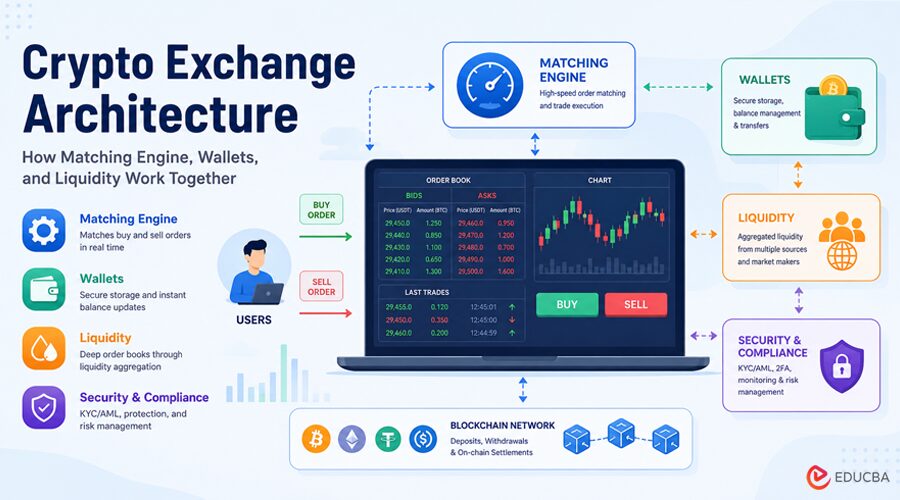
A crypto exchange architecture is the interaction between a cryptocurrency exchange’s software modules, connecting market order flow with user balances and blockchain ledgers. Its primary goal is to ensure accurate asset accounting and instant matching of buy and sell orders without data loss. The key components of a crypto exchange architecture include the Matching Engine, which instantly pairs buy and sell orders; the Wallet System, which verifies the availability of funds; and the Liquidity Layer, which maintains sufficient market depth.
Properly configuring these components minimizes balance errors, prevents platform slowdowns during heavy trading, and ensures high throughput while ensuring secure asset storage. Many founding teams begin this process by reviewing an open-source crypto exchange codebase, then deciding which modules to keep as-is and which to rebuild to meet their own compliance and scale requirements.
Core Components of a Crypto Exchange Architecture
A modern crypto exchange architecture comprises several interconnected modules that support the entire cryptocurrency trading lifecycle.
- Matching Engine: a computing module and high-performance exchange core that matches buy/sell orders, enforces market rules, etc.
- Order Book: a dynamic data structure where all active orders are processed/ranked in real time, forming current bid/ask prices.
- Wallet Infrastructure: a service for generating addresses, managing balances on the blockchain network, and organizing secure asset storage.
- Liquidity Layer: a software gateway that fetches quotes and aggregates deep order pools from external platforms.
- KYC/AML Module: a system for verifying user identity and analyzing cryptocurrency transactions, aimed at identifying suspicious activity.
- Admin Panel: A comprehensive administration interface for fine-tuning trading pairs, managing commission strategies, and monitoring the exchange’s financial status.
How does the Order Matching Engine work?
The Matching Engine is the main system that powers every crypto exchange architecture. It continuously compares incoming orders with existing market orders to execute trades as efficiently as possible.
Order Book Mechanics
The Order Book acts as a link between user orders and the Matching Engine. As soon as a new order is entered into the Order Book, the engine instantly analyzes it for matches with existing counter orders. The system executes orders based on price-time priority: first, the transaction is executed at the most favorable price (the best bid for the buyer, the best ask for the seller), and if the price is the same, the order received first is executed. This principle is effective because it ensures transparent pricing, eliminating the possibility of manipulation.
Order Types
Order types determine the conditions under which the Matching Engine decides to execute a trade. Correct processing depends directly on data synchronization among the engine, the order book, the recent transactions list, and the open orders table.
Main Types:
- Market: An order for immediate execution at the best available market price.
- Limit: A pending order that is placed in the order book and waits to be executed until the market price of the asset reaches/exceeds the specified level.
- Stop-limit: An order that remains inactive until the market price reaches a pre-determined stop-price level.
In addition to basic orders, crypto exchanges sometimes offer more complex order types, such as Fill-or-Kill, Immediate-or-Cancel, or Post-Only.
Matching Engine Performance
The performance of the Matching Engine determines how efficiently the crypto exchange architecture handles heavy trading volumes.
Key Features:
- Throughput: the maximum number of orders that the engine can accept/process per unit of time, observing all algorithmic checks without queue accumulation and failures.
- Latency: the time interval from the moment a trade request is received until the transaction result is recorded.
These metrics are critical for high-frequency trading (HFT), as in volatile conditions, a microsecond delay can lead to price slippage, causing orders to be executed at a less favorable price and rendering arbitrage strategies unprofitable. In the CEX architectures used by Merehead, order matching occurs in RAM, ensuring maximum execution speed and predictability. In DEX solutions, order matching occurs through smart contracts, which provides greater autonomy, but execution speed depends on the current network load and gas fees.
Wallet Architecture in Crypto Exchange Architecture
Wallet management is one of the most critical aspects of a secure crypto exchange architecture. Exchanges must balance fast transaction processing with maximum asset protection.
Hot vs. Cold Wallet Split
Separating assets between hot and cold storage is a security principle that balances operational efficiency and capital protection.
Main Types of Storage:
- Hot Wallet: a software module with constant online access. Purpose: instant transaction processing and liquidity.
- Cold Storage: an isolated circuit for the bulk of the reserves, eliminating the possibility of remote hacking.
At Merehead, clients independently configure the asset allocation percentages between these storage locations. This allows the exchange owner to flexibly manage liquidity and risk, quickly adjusting security parameters to trading volume and market volatility.
Wallet Segregation Models
Balance segregation is an architectural approach that separates user funds by purpose or role. Why? It eliminates the mixing of client assets, simplifies auditing, and improves security by isolating operational risks from reserves.
Popular Approaches:
- Split/Isolated vs. Unified: Isolated separates balances by target (spot/futures), minimizing the risk of margin liquidation. Unified combines assets into a single pool, providing traders with maximum convenience and instant liquidity, but it requires more complex risk management.
- Funding vs. Trading: Separation protects funding assets from market risks, while trading is optimized for engine speed, enabling transactions to be executed without unnecessary blockchain activity.
Security Layers
Security Layers is a system that blocks unauthorized access to assets, even if user credentials are partially compromised.
Types:
- 2FA: An additional level of verification (code/hardware key) that blocks access to attackers, even if they know the password.
- Device Fingerprinting: recording unique device parameters (IP, browser) to identify the session.
- Anti-phishing: digital marking of official emails, allowing the user to distinguish a genuine message from a phishing one.
- Withdrawal Confirmation: a verification protocol for transactions that exceed limits or are sent to new addresses. Requires confirmation (email/SMS).
Liquidity Aggregation in Crypto Exchange Architecture
A crypto exchange architecture relies on strong liquidity to ensure fast, efficient trading. Without sufficient liquidity, exchanges experience wider spreads, higher slippage, and poor user experience. Liquidity aggregation solves this problem by connecting exchanges to external trading venues and market makers, ensuring deeper order books and more competitive pricing.
External Liquidity Providers
Liquidity connection is implemented through partial or full aggregation:
| Characteristic | Partial Liquidity | Full Liquidity |
| Principle | Supplementing the internal glass with external data. | Full broadcast of the external market. |
| Flexibility | High: Exchange-controlled margins and spreads. | Low: dependence on supplier conditions. |
| Target | Optimization of own liquidity. | Quick launch of a deep market. |
Merehead implemented integration with over 40 blockchain nodes. This ensures high fault tolerance and independence from a single source. This approach eliminates the risk of a “dead order book” and ensures stable operation even with rare trading pairs, allowing the exchange to scale from day one.
Market Maker Mechanics
Exchange administrators can customize liquidity maintenance algorithms to adapt their behavior to market conditions and platform objectives.
Key Configuration Parameters:
- Quote Frequency: determines the price update interval. A high frequency ensures market synchronization, while a low frequency reduces system load and commission costs.
- Enable/Disable: Control bot activity for specific pairs, allowing for emergency trading stops during abnormal volatility to protect capital.
- Limit/Market Orders: Choose your execution strategy. Limit orders passively fill the order book, while Market orders allow the bot to balance prices and asset volumes.
The Merehead admin panel provides flexible configuration of all these parameters.
Simplified Data Flow in a Crypto Exchange Architecture
Every component within a crypto exchange architecture works together to ensure accurate trading, balance management, and transaction recording.
The Typical Workflow Follows These Steps:
- User Submits Order: The system validates the user’s order to ensure sufficient funds are available.
- Matching Engine: The engine finds a counteroffer in the order book and executes the trade.
- Wallet Update: The system performs internal transactions, instantly redistributing assets between participants’ wallets.
- Ledger & Transaction History:The system records transaction details in an immutable ledger and updates trade history and current balances.
This architecture ensures that the volume of purchased assets strictly matches the ledger data. Any change in wallets is a direct consequence of a confirmed transaction.
Final Thoughts
A well-designed crypto exchange architecture is the foundation of every reliable cryptocurrency trading platform. By integrating a high-speed Matching Engine, secure Wallet Infrastructure, robust Security Layers, and effective Liquidity Aggregation, exchanges can deliver fast trade execution, protect user assets, and maintain stable performance even during periods of intense market activity.
Whether building a centralized or decentralized trading platform, understanding crypto exchange architecture helps developers, entrepreneurs, and exchange operators create scalable, secure, and high-performance cryptocurrency exchanges that meet both user expectations and regulatory requirements.
Recommended Articles
We hope this guide on crypto exchange architecture helps you understand how matching engines, wallet infrastructure, and liquidity work together to power secure cryptocurrency trading. Explore these recommended articles for more insights on blockchain technology, cryptocurrency exchanges, digital wallets, crypto security, and trading platforms.

