


Conversion Rate Optimization Skills: Overview
Many marketers allocate most of their time and budget to generating traffic. More ads, more content, more outreach the focus is always on increasing the number of people entering the top of the funnel. However, if the bottom conversion rate remains unchanged, the return on investment stays mediocre. Eventually, the math stops working. This is where conversion rate optimization skills become essential. Instead of asking, “How do we get more traffic?”, CRO asks, “How do we get more value from the traffic we already have?” Improving a page’s conversion rate from 2% to 4% effectively doubles output without increasing traffic spend. That multiplier effect is why strong conversion rate optimization is among the most valuable assets a modern marketer can develop.
Unlike surface-level tactics, real CRO expertise is multi-disciplinary. It blends psychology, data analysis, UX understanding, copywriting, and structured experimentation. Marketers who master these conversion rate optimization skills consistently outperform those who rely on generic best-practice checklists.
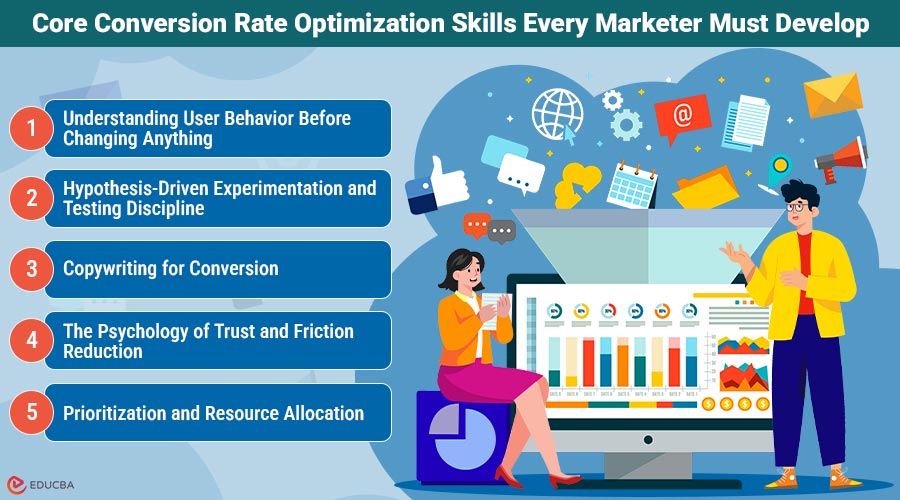
Core Conversion Rate Optimization Skills Every Marketer Must Develop
Developing strong conversion rate optimization skills requires depth across several areas, not just tactical adjustments. The most successful CRO practitioners focus on the following core competencies.
1. Understanding User Behavior Before Changing Anything
The most common mistake marketers make in CRO is going straight to the solution without properly defining the problem. A marketer sees that the conversion rate is low, notices a blog post suggesting that red CTAs perform better than green ones, changes the button color, and calls it optimization. Actually, that is not optimization. That is blindly guessing with some extra steps. Proper CRO is about uncovering the reasons people do not convert. For this, one needs to conduct both qualitative and quantitative research before implementing any changes. Tools like Hotjar or Microsoft Clarity create heatmaps that highlight clicks, scrolls, and pauses, showing whether users see the call to action or whether something earlier in the journey causes the problem.
Moreover, session recordings unveil real user behaviors in a way that aggregate analytics never will. Qualitative research provides the missing context that behavioral data can not deliver: it explains the reasons behind user behavior. Exit surveys, post-purchase interviews, and onsite polls give you insight into how your customers share their doubts, questions, and the factors that finally persuaded them to take action. Using that language in your marketing communications generally yields better results than writing marketer-centric copy without customer insights.
2. Hypothesis-Driven Experimentation and Testing Discipline
CRO done without structured experimentation results in anecdotes, not insights. A change in the webpage that increases the conversion rate might be due to the change you made, seasonality, a change in the traffic source, or random variance. Without a controlled experiment, you can not distinguish between these, and you will end up making changes that give you a sense of progress but do not actually lead to a reliable increase in performance.
An effective experiment method relies on well-defined hypotheses. A hypothesis is not just a test of a shorter form. It is “Since users drop off most at the form stage and session recordings indicate a hesitation over the number of fields required, reducing the form from eight fields to four will most probably increase submissions”. That level of detail matters because it enables testable predictions, defines the testing method, and reveals whether the test succeeds.
3. Copywriting for Conversion
Conversion problems are mostly communication problems. People land on a page, struggle to understand the offer, question its relevance, feel unsure about the next step, and leave. Sometimes a better design can help, but most often, better copy is what really makes the difference.
Conversion copywriting is a specialized discipline distinct from content writing or brand copywriting. The main focus is tailoring the message to the reader’s level of awareness, addressing objections that hinder the reader from taking the desired action, and providing sufficient clarity and urgency to elicit a specific response. Such skills are not natural or intuitive but are learnable ones through study and deliberate practice with real feedback loops.
4. The Psychology of Trust and Friction Reduction
Conversion, at its core, is a trust issue. People who feel that your product will genuinely fulfill its promises, that their private data is secure, and that the transaction process is easy, are likely to become customers at a higher rate than those who still have some doubts. CRO practitioners who understand the psychological factors of trust will know how to embed it into the very fabric of page design and copy. Social proof is the strongest trust mechanism that most marketers can use. Reviews, testimonials, case studies, client logos, and usage statistics all help eliminate the perceived risk of the decision by showing that others, ideally similar to the prospect, have already made this choice and reaped the benefits.
The level of detail included in social proof is hugely important. A testimonial saying “this product changed my business” is not convincing enough. However, “we increased our close rate by 34% in the first 90 days” is totally believable and hence persuasive. Practitioners like Mark Evans have built reputations on helping businesses understand that conversion optimization is not about tricks or manipulation; it is about removing the legitimate obstacles that prevent genuinely interested prospects from taking an action that benefits them. That framing shifts CRO from a tactical exercise into a customer-centric practice that produces more durable results.
5. Prioritization and Resource Allocation
Identifying the first things to test is a mastery that requires time and hugely affects the return on investment of a conversion rate optimization (CRO) program. Marketers who have realized the greatest benefits from CRO have wisely distributed their testing efforts. Impact, effort, and confidence frameworks facilitate prioritizing a testing backlog by evaluating each opportunity based on the level of impact a win might have, the effort required to implement the test, and the confidence that the hypothesis is reasonable based on research.
Prioritize tests that offer high impact, require low effort, and carry high confidence, regardless of how appealing other opportunities seem. High-traffic pages with low conversion rates should be prioritized first. The same percentage increase on a page with 10, 000 visitors per month generates five times as much impact as the same increase on a page with 2, 000 visitors. By weighting your optimization roadmap around traffic, you concentrate efforts on areas that deliver the fastest compounding results.
Final Thoughts
Traffic acquisition will always be important, but without strong conversion rate optimization skills, marketers leave significant revenue untapped. CRO is not about tricks or random tactics. It is about understanding user behavior, forming research-backed hypotheses, improving communication, building trust, and testing systematically. When marketers develop comprehensive conversion rate optimization skills, they stop relying solely on traffic growth and start unlocking exponential returns from existing visitors. In a competitive digital landscape where acquisition costs continue to rise, mastering CRO is no longer optional it is a core competitive advantage.
Recommended Articles
We hope this guide on conversion rate optimization skills helps you improve performance and drive measurable growth. Explore these recommended articles for more insights and strategies to strengthen your marketing results.

