


What is Contextual Advertising?
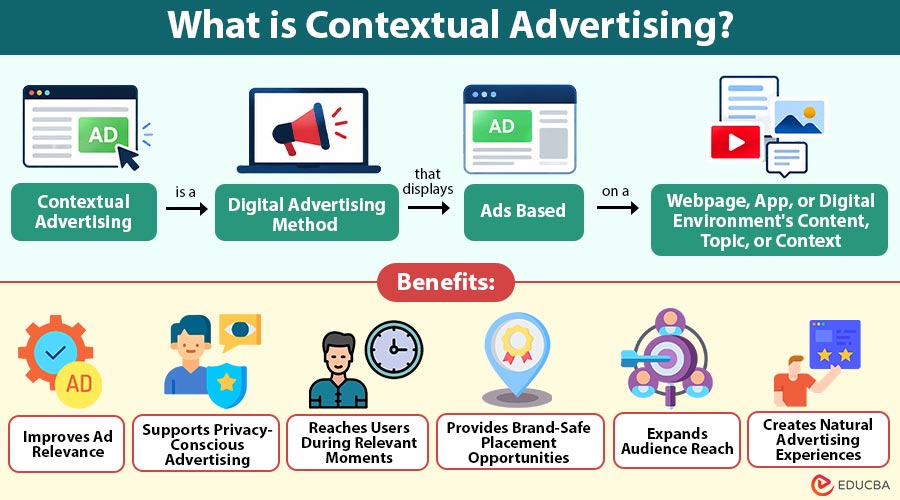
Contextual advertising is a digital advertising method that displays ads based on a webpage, app, or digital environment’s content, topic, or context.
Instead of relying mainly on a user’s personal browsing history, contextual advertising analyzes the content a person is currently viewing to determine which advertisement may be relevant. For example, an article about running shoes may display advertisements for sports footwear, fitness equipment, or athletic clothing.
This approach helps advertisers reach audiences when they are already consuming content related to a product or service. It can improve advertising relevance while reducing dependence on individual-level behavioral data.
Table of Contents:
- Meaning
- Working
- Types
- Examples
- Benefits
- Limitations
- Difference
- How to Create an Effective Contextual Advertising Strategy?
- Applications
- Metrics for Measuring Contextual Advertising
Key Takeaways:
- Contextual advertising matches advertisements with relevant webpage content, topics, keywords, and digital environments.
- It can improve ad relevance while reducing dependence on individual browsing histories and behavioral tracking.
- Effective contextual strategies require suitable topics, semantic targeting, content exclusions, relevant creatives, and performance monitoring.
- Advertisers measure contextual campaigns using impressions, click-through rates, conversions, acquisition costs, and the return on ad spend.
How Does Contextual Advertising Work?
Contextual advertising uses technology to analyze digital content and determine which advertisements are appropriate for that environment.
Below are the main steps involved in contextual advertising:
1. Content Analysis
The system examines webpage text, keywords, images, categories, and themes to understand the content and advertising environment.
2. Topic Identification
The system identifies the content’s primary topics and themes to determine which advertising categories are contextually relevant.
3. Audience Relevance
Advertisers select topics, keywords, and categories that correspond with their target audience, products, services, and campaign objectives.
4. Ad Matching
The advertising platform compares analyzed content with campaign criteria to select advertisements that closely match the surrounding context.
5. Ad Placement
The selected advertisement appears within or around relevant content, creating a natural connection between the advertisement and the webpage.
6. Performance Measurement
Advertisers track impressions, clicks, conversions, engagement, and return on advertising spend to evaluate campaign effectiveness and optimize performance.
For example, suppose a user reads an article about home workouts. A contextual advertising system may identify terms and themes related to exercise, fitness, and training. It can then display an advertisement for workout equipment or fitness clothing.
The key point is that the advertisement is selected based on the content being viewed, rather than solely on the user’s previous online behavior.
Types of Contextual Advertising
Contextual advertising can take different types depending on the content environment, targeting method, and advertising format.
1. Keyword-Based Contextual Advertising
Keyword-based advertising matches ads with specific words or phrases in digital content, helping advertisers reach users interested in related products.
2. Topic-Based Advertising
Topic-based advertising places ads based on the content’s broader subject, helping brands reach audiences interested in specific areas.
3. Semantic Contextual Advertising
Semantic contextual advertising analyzes the overall meaning and surrounding context of content to select advertisements that accurately match its subject.
4. Category-Based Advertising
Category-based advertising targets predefined content categories, allowing advertisers to place ads across relevant websites and digital environments.
5. Contextual Video Advertising
Contextual video advertising selects ads based on video subjects, titles, descriptions, spoken content, or classifications to improve relevance.
Examples of Contextual Advertising
Below are some examples of contextual advertising across different industries and online content categories.
1. Fitness
An article about strength training may display ads for gym equipment, sportswear, or fitness apps relevant to readers’ current online interests.
2. Travel
A travel guide about visiting Paris may show advertisements for hotels, flights, travel insurance, sightseeing services, or local travel experiences.
3. Technology
A webpage discussing laptops may display advertisements for computers, accessories, software, or technology retailers relevant to readers researching technology products.
4. Finance
An article explaining investment strategies may feature advertisements for financial education platforms, investment services, or personal finance tools for readers.
5. Food
A recipe page may display advertisements for kitchen appliances, grocery delivery services, cooking products, or ingredients related to the featured recipe.
Benefits of Contextual Advertising
Below are some key benefits of contextual advertising that explain its value for advertisers and audiences.
1. Improves Ad Relevance
Ads related to the surrounding content are more likely to feel useful to users. Relevance can increase attention and improve engagement.
2. Supports Privacy-Conscious Advertising
Contextual advertising can work without depending entirely on detailed user profiles or individual browsing histories. This makes it useful as advertisers adapt to changing privacy expectations and data practices.
3. Reaches Users During Relevant Moments
Context matters because a person’s current activity can strongly indicate what they may be interested in at that moment. For example, someone reading about hiking may be more receptive to an advertisement for outdoor equipment.
4. Provides Brand-Safe Placement Opportunities
Advertisers can define suitable topics and exclude categories that may not align with their brand. Careful contextual controls can reduce the likelihood of advertisements appearing beside unsuitable content.
5. Expands Audience Reach
Advertisers can reach people who consume particular types of content without requiring extensive individual behavioral data. This can provide access to new audiences with relevant interests.
6. Creates Natural Advertising Experiences
When an advertisement connects logically with the surrounding content, it can feel less disruptive. A relevant advertisement may complement the user’s content experience instead of appearing unrelated.
Limitations of Contextual Advertising
Here are some key limitations of contextual advertising that highlight the challenges advertisers may face when using this approach.
1. Inaccurate Content Classification
Advertising systems may misinterpret webpage content, leading to ads that don’t accurately match the surrounding subject.
2. No Guaranteed Purchase Intent
Users may read relevant content for research or information without having any immediate intention to purchase the advertised product.
3. Ambiguous Keywords
Certain words can have multiple meanings, making it challenging for automated systems to understand context and select appropriate advertisements.
4. Brand Safety Concerns
Relevant content may discuss sensitive events, controversial subjects, or negative topics that could create an unsuitable environment for brand advertisements.
5. Limited Individual Targeting
Contextual advertising focuses on content rather than detailed user profiles, so it may offer less personalized targeting than behavioral advertising.
6. Dependence on Quality Content
Poorly categorized, limited, or unclear content can reduce targeting accuracy and make it difficult to deliver highly relevant advertisements.
Difference Between Contextual Advertising and Behavioral Advertising
The table below highlights the key differences between the two:
| Basis | Contextual Advertising | Behavioral Advertising |
| Targeting Basis | Current content or environment | User’s previous online behavior |
| Main Signals | Keywords, topics, categories, meaning | Browsing activity, interactions, and interests |
| User Profile | May not require an individual profile | Commonly relies on user-level data |
| Relevance | Based on current content | Based on inferred user interests |
| Privacy Approach | Can reduce dependence on behavioral tracking | Often involves greater use of behavioral data |
How to Create an Effective Contextual Advertising Strategy?
A successful contextual advertising campaign requires more than selecting a few keywords.
1. Define the Campaign Objective
Decide whether the campaign aims to increase brand awareness, drive website traffic, collect leads, or increase sales. The objective influences targeting and measurement decisions.
2. Identify Relevant Topics
Select subjects that closely connect with the product or service. Broader categories can increase reach, while narrower topics can improve relevance.
3. Select Appropriate Keywords
Choose keywords that accurately represent the product, customer need, and content environment. Include variations and related terms where appropriate.
4. Use Semantic Targeting
Where available, use systems that evaluate content meaning rather than matching isolated keywords. This can help reduce irrelevant placements.
5. Set Content Exclusions
Identify topics, websites, or environments that may create brand-safety concerns. Exclusions can help prevent advertisements from appearing alongside unsuitable content.
6. Develop Relevant Ad Creative
The advertisement should complement the context without becoming overly dependent on it. Clear messaging, useful offers, and strong calls to action can improve campaign performance.
7. Monitor Campaign Results
Track impressions, click-through rates, conversions, cost per acquisition, and other relevant metrics. Compare performance across topics and placements to identify stronger opportunities.
Applications of Contextual Advertising
Contextual advertising can support marketing activities across many industries.
1. E-Commerce
Online retailers can display product ads alongside reviews, buying guides, comparison articles, and shopping content that matches consumers’ interests.
2. Education
Educational platforms can promote courses alongside content about professional skills, academic subjects, certifications, career development, and learning opportunities.
3. Automotive
Automotive brands can display advertisements alongside vehicle reviews, maintenance guides, comparisons, driving advice, and automobile-related content.
4. Financial Services
Banks and financial companies can advertise alongside content covering personal finance, loans, savings, investments, insurance, and financial planning.
5. B2B Marketing
Business-to-business companies can target professional content covering industries, technologies, software solutions, business challenges, and workplace requirements.
Metrics for Measuring Contextual Advertising
Advertisers can use several metrics to evaluate the performance, efficiency, and effectiveness of contextual advertising campaigns.
1. Impressions
Measures the total number of times an advertisement is displayed to users across selected digital content.
2. Click-Through Rate
Measures the percentage of advertisement impressions that result in users clicking the displayed advertisement.
3. Conversion Rate
Measures percentage of users who complete a desired action, such as purchasing, registering, or submitting an inquiry.
4. Cost Per Click
Measures average amount an advertiser pays each time a user clicks the ad.
5. Cost Per Acquisition
Measures the average advertising cost required to generate one desired customer action or conversion.
6. Return on Ad Spend
Measures the revenue generated from advertising compared with the total amount spent on the campaign.
7. Engagement Rate
Measures how actively users interact with advertisements through actions such as clicks, views, shares, or other engagements.
Final Thoughts
Contextual advertising connects advertisements with relevant digital content based on keywords, topics, categories, and meaning. It helps advertisers reach audiences without relying heavily on individual behavioral data. Its effectiveness depends on accurate content analysis, suitable placements, engaging creatives, and performance measurement, while supporting relevance and privacy in digital advertising.
Frequently Asked Questions (FAQs)
Q1. What is the main purpose of contextual advertising?
Answer: The main purpose is to place advertisements in environments where the surrounding content naturally relates to the product, service, or marketing message.
Q2. Is contextual advertising suitable for small businesses?
Answer: Yes. Small businesses can use contextual campaigns to focus advertising budgets on specific subjects and content environments related to their offerings.
Q3. Can contextual advertising be used for brand awareness?
Answer: Yes. It can introduce a brand to audiences while they consume content connected with the industry, product category, or customer need.
Q4. Does contextual advertising require cookies?
Answer: Contextual advertising can operate without relying on individual tracking cookies because targeting can be based primarily on the content surrounding an advertisement.
Recommended Articles
We hope that this EDUCBA information on “Contextual Advertising” was beneficial to you. You can view EDUCBA’s recommended articles for more information.


