


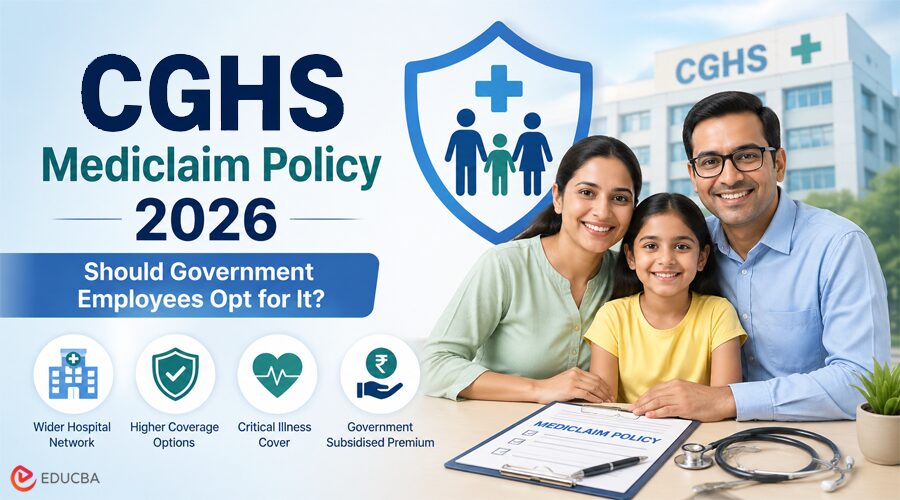
For many years, government employees in India have used the Central Government Health Scheme (CGHS) for healthcare support. It offers outpatient care, hospital treatment, and specialist services through wellness centers and impaneled hospitals. In 2026, the CGHS Mediclaim Policy was introduced for new beneficiaries, raising an important question: should government employees rely solely on CGHS, or consider the new Mediclaim Policy as an additional layer of protection? This article explains how the CGHS Mediclaim Policy works and whether it is worth opting for.
Understanding CGHS and the New Mediclaim Policy
CGHS is a government-funded healthcare facility available to central government employees, pensioners, and their dependents. It functions through dispensaries and impaneled private hospitals, covering OPD consultations, medicines, diagnostic tests, and hospitalization. The new mediclaim policy introduced for fresh CGHS beneficiaries is a structured group insurance arrangement that offers cashless hospitalization across a broader network of hospitals, potentially beyond the standard CGHS impaneled list. This means the CGHS Mediclaim Policy can serve as complementary coverage alongside regular CGHS benefits.
Key Features of the New CGHS Mediclaim Policy 2026
The new CGHS Mediclaim Policy includes several measures to improve access to healthcare and financial protection for government employees.
Key highlights include:
- Cashless treatment at a wider hospital network, including non-CGHS impaneled hospitals
- Coverage amounts range from ₹5 lakh to ₹15 lakh per family
- Coverage for pre-existing diseases after a standard waiting period
- Inclusion of critical illness insurance riders for conditions such as cancer, organ failure, and stroke
- Maternity benefits for employees below a certain age
- No room rent sub-limit in premium tiers
- The government partly subsidizes the annual premium.
CGHS vs. New Mediclaim Policy: A Comparison
The traditional CGHS offers significant advantages, including subsidized OPD medicines, specialist referrals, and lifetime pensioner benefits. However, it has limitations, including a limited hospital network, longer waiting times in some cities, and limited availability in non-CGHS cities. The Mediclaim Policy aims to address these gaps. By allowing treatment in a broader network of hospitals, the policy gives employees more flexibility in choosing healthcare providers. Another important difference is the availability of critical illness insurance under the Mediclaim Policy. While CGHS covers treatment costs, a mediclaim policy can provide additional financial support through lump-sum benefits.
Should You Opt In? Factors to Consider
Deciding whether to enroll in the CGHS Mediclaim Policy depends on several personal and professional factors.
- Location: Employees posted in cities with limited CGHS dispensaries will benefit significantly from the wider hospital network
- Family health needs: Families with elderly dependents or chronic conditions benefit from enhanced coverage
- Critical illness risk: Those with a family history of cancer or heart disease should consider the critical illness insurance add-on
- Premium affordability: The government subsidy on premiums makes this policy relatively affordable
- Existing CGHS coverage: In cities with strong CGHS infrastructure, opting out may be justified.
The Role of Critical Illness Insurance
Critical illness insurance provides a lump sum payout upon diagnosis of specific life-threatening diseases, regardless of actual treatment costs. Patients can use this payout to cover treatment costs, travel expenses, loss of income, or home care needs. Common critical illnesses covered include cancer, heart attack, kidney failure, organ transplant, stroke, and paralysis. For government employees, bundling critical illness insurance with the new mediclaim policy ensures comprehensive financial protection beyond mere hospitalization reimbursement.
How Premiums Work Under the CGHS Mediclaim Policy?
The premium for the CGHS Mediclaim Policy depends on several factors, including:
- Age of the employee
- Chosen sum insured
- Number of family members covered
- Optional add-ons such as critical illness coverage.
The government offers the policy through a tender process and partially subsidizes it, which makes the Mediclaim Policy premium generally lower than comparable private health insurance plans. The insurer selected by the government typically publishes premium tables and coverage details.
Claim Process Under the CGHS Mediclaim Policy
Employees can file claims either on a cashless basis at empaneled hospitals or through reimbursement. For cashless claims, the employee presents the insurance card at the hospital TPA desk. For reimbursement claims, original bills, discharge summaries, investigation reports, and prescriptions must be submitted within the stipulated claim filing window, typically 30–60 days from discharge.
Final Thoughts
The government introduced the CGHS Mediclaim Policy 2026 to complement existing CGHS healthcare benefits for central government employees. With its wider hospital network, optional critical illness coverage, and government-subsidized premium, it provides additional financial protection beyond the traditional CGHS system. For employees living in cities with limited CGHS facilities or those seeking broader hospital access, the CGHS Mediclaim Policy can be a valuable addition to their healthcare planning. Before making a decision, employees should carefully evaluate their family’s healthcare needs, available CGHS infrastructure, and the benefits offered under the CGHS Mediclaim Policy.
Recommended Articles
We hope this guide on the CGHS Mediclaim Policy helps you understand how the new policy works and how it compares with traditional CGHS healthcare benefits for government employees. Explore the recommended articles below to learn more about government health schemes, mediclaim policies, and financial planning for medical security.

