


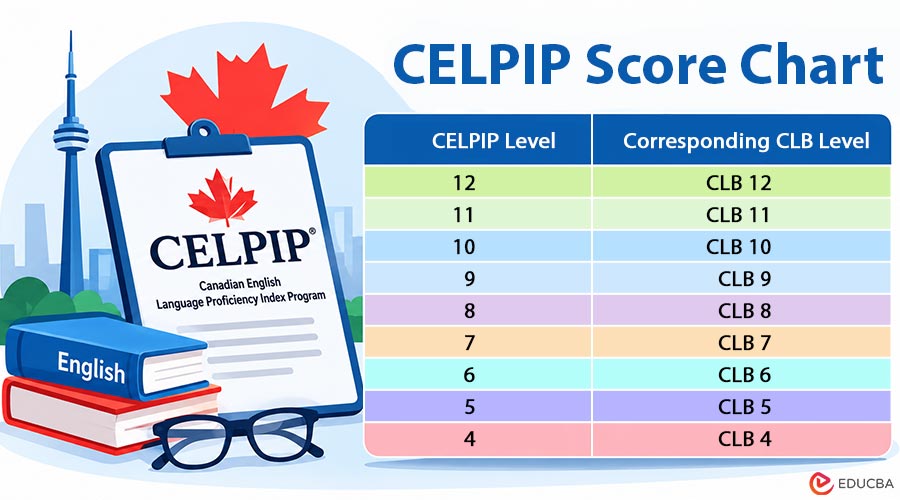
You have received your CELPIP results, but what do those numbers actually mean for your immigration application? The CELPIP score chart helps you understand how your test results correspond to Canadian Language Benchmark (CLB) levels and whether you meet the language requirements for Express Entry. Having a Reading score of 7 and a Listening score of 9 may seem straightforward, but Express Entry evaluates each language skill against the specific Canadian Language Benchmark (CLB) levels required. To understand what your CELPIP scores mean, consult the CELPIP score chart and check whether you meet the language requirements for your chosen immigration program.
If you have not taken the official exam yet, a timed CELPIP practice test can help you assess your current proficiency, identify weaker language skills, and understand how much preparation you may need to reach your target score.
What Are CELPIP Scores and CLB Levels?
The Canadian English Language Proficiency Index Program (CELPIP) is an English-language test that measures an individual’s communication skills in real-life situations.
The CELPIP-General test assesses four language skills: Listening, Reading, Writing, and Speaking. The Canadian Language Benchmarks (CLB), on the other hand, are a standardized system for describing English-language proficiency in Canada.
In Canada, Immigration, Refugees and Citizenship Canada (IRCC) uses CLB levels to establish language requirements for immigration programs and calculate selection points.
There is a clear distinction between the two: CELPIP provides your test results, while CLB identifies the corresponding proficiency level for immigration purposes. For Express Entry, candidates must take the CELPIP-General test rather than CELPIP-General LS, which assesses only Listening and Speaking.
CELPIP Score Chart: CELPIP and CLB Relationship
A useful feature of CELPIP scoring is that levels 4–12 correspond directly to the same-numbered CLB levels. The CELPIP Score Chart provides a straightforward reference for understanding this relationship and interpreting individual test results. This makes it easier to understand your CLB level without using an additional conversion formula.
| CELPIP Level | Corresponding CLB Level |
| 12 | CLB 12 |
| 11 | CLB 11 |
| 10 | CLB 10 |
| 9 | CLB 9 |
| 8 | CLB 8 |
| 7 | CLB 7 |
| 6 | CLB 6 |
| 5 | CLB 5 |
| 4 | CLB 4 |
The CELPIP Score Chart shows how each CELPIP score corresponds to a specific CLB level for the four language skills individually. For example, a Listening score of 9 corresponds to CLB 9 in Listening; it does not mean that the applicant has achieved an overall CLB 9 across all four skills.
Understanding the different CELPIP CLB levels is particularly useful for Express Entry applicants. CLB 7 is the minimum language requirement for some immigration programs, while CLB 9 may help applicants earn additional points through certain skill-transferability factors.
CLB 10 is another important benchmark because core language points reach their maximum at this level.
How to Read Your CELPIP Score Report?
Your CELPIP score report provides a separate result for each language skill assessed in the exam. The following is a fictional example:
| Language Skill | CELPIP Score | CLB Level |
| Listening | 9 | 9 |
| Reading | 8 | 8 |
| Writing | 7 | 7 |
| Speaking | 9 | 9 |
The applicant has achieved at least CLB 7 in all four language skills. As a result, the applicant meets the Federal Skilled Worker’s minimum language requirement of CLB 7 in all four abilities.
However, the applicant has not achieved CLB 9 in all four skills. This distinction matters because a high score in one ability cannot compensate for a lower score in another when a program requires a specific minimum in each skill.
Therefore, Express Entry eligibility and CRS calculations are based on individual skill scores, not on the average of the four results. Using the CELPIP Score Chart to review each result separately can help applicants identify whether they meet the required CLB level in every language ability.
What CELPIP Score Do You Need for Express Entry?
The CELPIP score for Express Entry depends on the immigration program and, in some cases, the applicant’s occupational category. Each Express Entry program has its own minimum language requirements. The CELPIP Score Chart helps applicants match their scores to these requirements.
Federal Skilled Worker Program
Applicants using English as their first official language must achieve at least CLB 7 in Listening, Reading, Writing, and Speaking, which corresponds to a CELPIP score of 7 in each skill.
Meeting the program’s minimum language requirement does not automatically make you eligible. Applicants must also meet other criteria, including the applicable selection-factor requirements.
Canadian Experience Class
The Canadian Experience Class (CEC) has different language requirements depending on the applicant’s Training, Education, Experience, and Responsibilities (TEER) category under the National Occupational Classification (NOC).
- TEER 0 or 1: CLB 7 in all four language abilities, equivalent to CELPIP 7 in each skill.
- TEER 2 or 3: CLB 5 in all four language abilities, equivalent to CELPIP 5 in each skill.
Applicants should identify their NOC classification before determining which language requirements apply to them. They can then refer to the CELPIP Score Chart to check their results against the relevant CLB levels.
Federal Skilled Trades Program Requirements
The minimum language requirements for the Federal Skilled Trades Program are as follows:
- Listening and Speaking: CLB 5, equivalent to CELPIP 5.
- Reading and Writing: CLB 4, equivalent to CELPIP 4.
These are minimum language requirements, not guarantees of overall program eligibility or an invitation to apply. Applicants must also meet all other applicable immigration requirements.
How CELPIP Scores Affect Your Express Entry CRS Points?
The Comprehensive Ranking System (CRS) ranks Express Entry candidates based on factors such as age, education, work experience, and language proficiency. Language test results contribute to CRS points through both core human-capital factors and skill-transferability factors.
A CLB 9 CELPIP result is particularly valuable because achieving this level in all four language skills can increase skill-transferability points when combined with qualifying education or work experience.
For example, applicants with foreign work experience may earn additional CRS points when they also achieve the required language proficiency level.
Core points for first-official-language proficiency reach their maximum at CLB 10 or higher. This means that improving your language proficiency from CLB 9 to CLB 10 can make a difference. However, achieving CLB 11 or CLB 12 will not increase your core language points further.
By using the CELPIP Score Chart to identify the CLB level for each skill, applicants can better understand their current language proficiency and identify areas that may need improvement to support their Express Entry goals.
How to Get Ready for Your Desired CELPIP Score?
Begin by comparing your current scores with the Canadian Language Benchmark (CLB) requirements for your chosen immigration program. Use the CELPIP Score Chart to identify your weakest language skill, and focus on improving it rather than spending time on skills you already perform well in.
Practicing under timed conditions will help you become familiar with the question formats and manage the test duration.
Analyze your mistakes, practice all four language skills regularly, and compare your practice scores with your target scores for the official test. Remember that practice scores are estimates and should not be considered official CELPIP results.
Turning Your CELPIP Scores into an Express Entry Plan
Understanding the CELPIP scoring system will help you interpret your results and identify Express Entry language requirements. The CELPIP Score Chart makes it easier to connect individual test scores with the corresponding CLB levels.
Once you have identified your CLB levels, you can assess whether you meet the language requirements, understand how your results may affect your CRS score, and set realistic preparation goals before applying.
Recommended Articles
Explore our guide to the CELPIP Score Chart to understand CLB levels, interpret your test results, and identify the scores required for Express Entry. Learn how to improve your CELPIP performance and prepare for your Canadian immigration journey with targeted practice and preparation strategies.

