


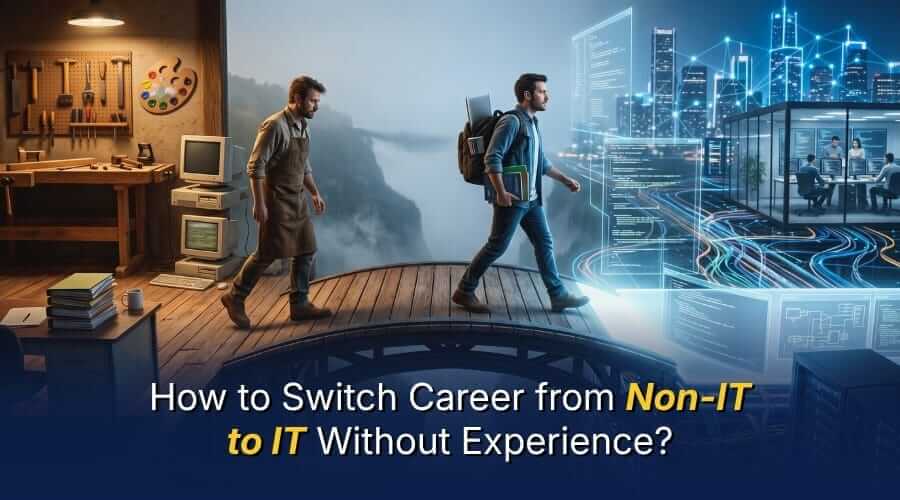
Let me say something that might sound obvious but genuinely needs to be said: you do not need a computer science degree to successfully switch careers to IT. You probably knew that already. However, knowing it and actually believing it enough to act on it are two very different things.
Many people spend years telling themselves they will look into a career switch in IT “when things settle down a bit.” Teachers, warehouse supervisors, call center managers, NHS admin staff, smart and capable professionals who quietly talk themselves out of the idea before properly exploring it. What many of them have in common is the assumption that the technical gap is larger than it actually is.
It is not small. However, it is closeable. Moreover, that matters more than almost anything else in this conversation.
Why Consider a Career Switch to IT?
Most people thinking about making this kind of move have a loose version of the same mental list. No technical background. No idea where to start. Worried about the cost.
Not sure if they are “the type” for IT. Possibly a vague memory of struggling with GCSE ICT in 2003.
None of those things are disqualifying. However, sitting with them indefinitely is.
The UK IT industry has a skills gap that has been growing for years. Companies are actively seeking people who can be trained for roles in cloud support, cybersecurity, help desk, and infrastructure. These are not niche specialisms. They are foundational roles found in almost every medium-to-large organization in the country, and there are more vacancies than qualified people to fill them.
That dynamic is useful to understand before you start your career switch to IT, because it changes the framing entirely. You are not trying to muscle into a saturated market. You are walking towards a door that is, frankly, already open.
Step One: Work Out Which Part of IT Actually Appeals to You
IT is not one thing. This sounds obvious, but a lot of people treat it like a monolith: “I want to get into IT,” without thinking much about what that means in practice. Moreover, that vagueness tends to stall momentum quite quickly.
Some roles are almost entirely people-facing. Some roles involve almost no human interaction. Some IT jobs are methodical and process-driven. Others are reactive, unpredictable, and problem-solving under pressure. The technical requirements vary widely depending on the direction you take.
Common Starting Points for a Career Switch to IT:
- IT Support / Helpdesk: diagnosing and resolving hardware and software issues, usually the most accessible entry point and often the launchpad for other specialisms
- Cloud Computing: working with platforms like AWS, Azure, or Google Cloud; vendor certifications are well-recognized and relatively achievable for beginners
- Cybersecurity: protecting systems and data from threats; there are entry-level certifications (CompTIA Security+) that do not require years of prior IT experience
- Networking: configuring and managing the infrastructure that connects systems; CompTIA Network+ is a standard starting credential
- Data and Reporting: using tools like SQL, Power BI, or Excel to analyze and present business data; increasingly in demand across almost every industry
Spend some time on this before you do anything else. Read job descriptions. Look at what a day in these roles looks like. Talk to people if you can. The clarity you get from that exercise is worth more than rushing into the first course you see advertised.
Step Two: Stop Do Not Undervalue What You Have
Here is something most people find genuinely surprising when they first hear it: a significant portion of what IT employers want from junior hires is non-technical. It is the stuff you have almost certainly spent years developing without thinking of it as a skill at all.
The ability to explain a technical problem to someone who does not understand it. Staying calm when something breaks at the worst possible moment. Keeping track of multiple things at once without letting any of them fall over. Understanding what a frustrated user actually needs, rather than what they said they need. These matter enormously in IT support environments, and they are not things you can pick up from a certification course.
If you have worked in customer service, you already know how to manage expectations under pressure. If you have done project coordination, you understand workflow and dependencies. If you have worked in healthcare or education, you understand both urgency and patience simultaneously. None of that goes to waste. The technical knowledge is the gap. Moreover, gaps can be filled.
Step Three: Find a Program Built Around Getting You a Job and Not a Mere Certificate
There is a lot of noise in this space, and some of it can waste both time and money. YouTube tutorials are free and useful for exploration. However, saying “I watched some videos and experimented with it” is rarely a compelling pitch to a hiring manager. Likewise, a certificate from a platform with no connection to actual employers often carries limited value in the job market.
What you want is a structured pathway that moves you from where you are now to a point where employers will take your application seriously. That means real certifications, CompTIA A+, AWS Cloud Practitioner, Microsoft Azure Fundamentals, alongside career coaching, CV support, and ideally some direct employer connection.
Organizations like Fortray approach career switch to IT training in exactly this way, building traineeship programs around what employers are actually looking for rather than just ticking a training box.
When you are comparing programs, push on a few things:
- What certifications will you earn?
- Is career support built in, or is it an afterthought?
- Are there 0% finance options?
- What are actual graduates doing now?
Programs that struggle to answer those questions clearly are usually programs built around selling you something, not building your career.
Step Four: Build a Study Routine That Fits Your Actual Life
Ambition and available time rarely match up neatly. Most people making this kind of career change are working full-time, supporting families, and paying their way. Eight hours of uninterrupted study time does not exist for most of them.
The good news is that it does not need to. IT certifications at the entry level, CompTIA A+, Network+, Security+, and the foundational cloud qualifications are achievable with consistent study sessions of one to two hours a day. Not every day is perfect. Just most days being something.
Three to six months of focused effort can put you in a credible position for junior IT roles and help you successfully switch to an IT career. That timeline varies depending on the program, your study pace, and which certifications you are targeting. However, the point is that the window is not as long as people assume. It is manageable.
The one thing that derails people more than anything else is not difficulty, but losing momentum around week six when the novelty wears off. Build your routine before that happens. Treat study time like a commitment to someone else. It is much harder to cancel on yourself once the habit has quietly established itself.
Step Five: Build Evidence as You Go, Not Just at the End
A certificate tells an employer you passed a test. Evidence tells them how you think.
While you are training, look for ways to create a visible trail of genuine engagement. AWS, Azure, and Google Cloud all offer free tiers that let you build and test without paying. TryHackMe is widely used for hands-on cybersecurity.
Cisco Packet Tracer lets you simulate networking environments. These are not complicated to access, and using them gives you something concrete to talk about in an interview.
Document what you are building on LinkedIn. Not polished thought leadership, just honest posts about what you are learning and what surprised you. People respond well to genuine progress documented in real time. It also signals to recruiters that you are active and serious, which matters more than most people realize at this stage.
Step Six: Reframe Your Previous Experience on Paper
A career changer’s CV needs to do something slightly different from a standard application. The goal is not to hide your non-IT background; it is to reframe it in terms relevant to your career switch into IT.
Lead with your certifications and training. Make it immediately clear, before anyone reads your work history, that you have done the technical groundwork. Then use your previous roles to demonstrate the soft skills and transferable attributes that round out the picture.
Your LinkedIn profile needs the same treatment. The headline especially. Something like “Career Changer | CompTIA A+ | AWS Cloud Practitioner” is more searchable and more credible than “Looking for opportunities in IT.” Recruiters use keyword filters.
Make sure you show up.
The Financial Reality of a Career Switch to IT
Salary figures are one thing. The actual financial anxiety of making a change is another.
Entry-level IT support roles in the UK typically range from £22,000 to £28,000. That is not transformational on its own, but it is a foundation. Mid-level cloud and cybersecurity roles, which many people reach within 2 to 3 years, regularly pay £40,000 to £55,000. For someone currently in a capped or low-growth role, the trajectory matters as much as the starting point.
On training costs: look specifically for programs offering 0% finance options. Spreading the investment over several months, with no interest, makes the decision considerably less daunting and allows you to start without waiting to save the full amount upfront.
What the First Few Months in an IT Role Actually Feel Like?
Nobody expects a new hire with six months of training under their belt to arrive knowing everything. What they do expect is someone willing to follow the process, ask sensible questions, document what they learn, and not be precious about starting at the bottom.
The people who progress quickly after a career switch to IT are almost always the ones who treat every support ticket or technical issue as something worth understanding properly.
That approach, and the pace of progression it tends to produce, is available to anyone. It does not require a particular background. It just requires showing up the right way.
Final Thoughts
If this has moved your thinking at all, even from “I am not sure” to “I would like to find out more,” the IT Career Switch program from Fortray is worth a proper look.
The right time to switch careers to IT is rarely when everything is perfectly aligned. It is usually about three months after the moment you first thought seriously about it. Which means, in all likelihood, now. Want an IT Career Switch? The most important step is simply to start and build momentum consistently over time.
Recommended Articles
We hope this guide on making a career switch to IT helps you understand the transition process, explore entry-level tech roles, and build confidence in starting a new career path. Explore these recommended articles for more insights on IT certifications, cybersecurity, cloud computing, career development, and beginner-friendly tech skills.


