


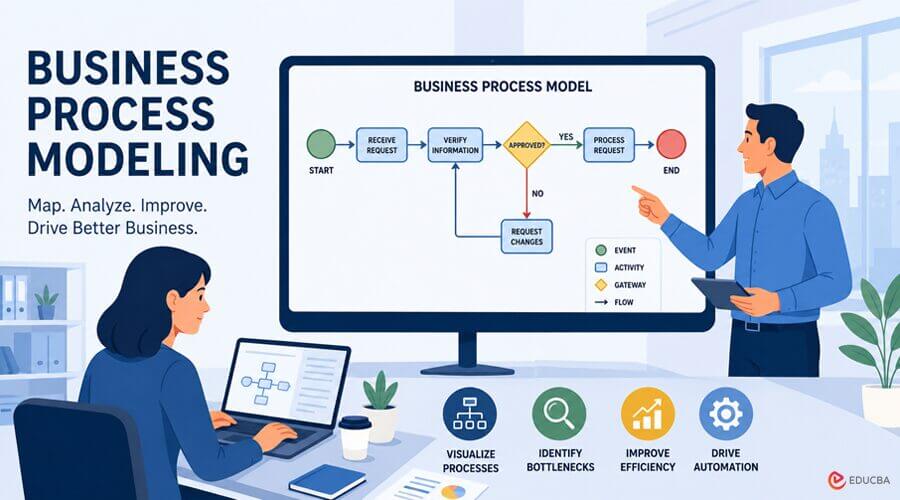
For years, business process modeling lived quietly in the background of large organizations. It was the domain of a handful of analysts who drew diagrams, documented workflows, and handed them off to management. Today, that picture looks very different. As companies chase efficiency, transparency, and faster decision-making, the ability to map, analyze, and improve how work actually flows has moved from a niche specialty to a skill that professionals across finance, operations, IT, and project management are expected to understand. If you are investing in your own development, understanding process modeling is one of the more practical bets you can make.
What Business Process Modeling Actually Means?
At its core, business process modeling is the practice of creating a visual representation of how a task or a series of tasks gets done inside an organization. Think about something as ordinary as approving an expense report. An employee submits a request, a manager reviews it, finance checks the numbers, and finance eventually releases the money. Written out in paragraphs, that description is easy to misread. When drawn as a model with clear steps, decision points, and responsibilities, it becomes something a whole team can look at and instantly understand.
The most widely adopted standard for this is BPMN, short for Business Process Model and Notation. BPMN gives professionals a shared visual language made up of standardized symbols: circles for events, rectangles for activities, diamonds for gateways where decisions branch off, and arrows that show how work moves from one stage to the next. Because the notation is standardized, a diagram created by an analyst in one department can be read by a developer, an auditor, or an executive without a translation guide. That common vocabulary is exactly why BPMN has become the default in so many industries.
Why This Skill Matters More Than It Used To?
Several forces have pushed process modeling into the spotlight. The first is complexity. Modern organizations run on dozens of interconnected systems, and a single customer request might touch a CRM, an ERP, a payment processor, and three different teams before it is fulfilled. Without a clear map, inefficiencies hide in the gaps between these systems. Modeling brings those gaps into the light.
The second force is accountability. Regulators, auditors, and leadership increasingly want documented, repeatable processes rather than tribal knowledge that lives in one employee’s head. When a process is modeled properly, it can be reviewed, improved, and defended. It also survives employee turnover, which is a quiet but serious risk for any team that relies on undocumented routines.
The third and perhaps most important force is automation. You cannot automate a process you do not understand. Before you can hand a workflow to software, you must map it clearly enough to account for every step, exception, and handoff. This is where modeling and technology meet, and it is also where the field is changing fastest.
The Arrival of AI in Process Modeling
Traditionally, building a process model was slow and manual. An analyst would interview stakeholders, sketch a draft, circulate it for feedback, and revise it several times before it reflected reality. For a large process, this could take weeks. The diagrams were also static: once drawn, they rarely kept pace with how the process actually evolved on the ground. Artificial intelligence is reshaping this workflow in meaningful ways.
Instead of starting with a blank canvas, professionals can now describe a process in plain language and have an automatic first draft of a compliant diagram generated. Tools such as BPMN AI let users turn a written description of a workflow into a structured, standards-based model in a fraction of the time it once took. That shift matters because it removes the biggest barrier to entry, the tedious mechanical work of placing shapes and connectors correctly, and lets people focus on the substance of the process itself.
The benefit is not only speed. When software handles the heavy lifting of drafting, subject-matter experts who are not trained analysts can participate more directly. A finance manager who knows the approval process inside out no longer needs to depend entirely on a technical team to capture it. They can describe it, review the generated model, and refine it collaboratively. This democratizes a skill that specialized tools once kept out of reach, and it tends to produce documentation that more accurately reflects reality because the people closest to the work help create it.
How to Start Building the Skill?
If you want to add process modeling to your professional toolkit, the good news is that the learning curve is gentler than most technical disciplines. Begin by learning the handful of core BPMN symbols and what they represent. You do not need to memorize the entire specification; a working grasp of events, activities, gateways, and flows will let you read and build most everyday diagrams.
Next, practice on processes you already know well. Map how your team onboards new employees, approves purchase orders, and resolves support tickets. The act of translating something familiar into a formal model teaches you far more than studying theory in isolation, and it quickly reveals inefficiencies you had stopped noticing. Once you are comfortable, experiment with AI-assisted tools to see how quickly you can move from a rough idea to a polished, shareable diagram.
Finally, connect the skill to the broader disciplines around it. Process modeling sits at the intersection of project management, business analysis, operations, and increasingly data science. Professionals who can both map a process and reason about how to improve or automate it are unusually valuable, precisely because that combination is still rare.
A Skill Worth the Investment
Business process modeling is no longer a back-office curiosity. It has become a practical, transferable competency that strengthens whatever field you already work in, whether that is finance, technology, marketing, or management. AI-assisted tools have dramatically lowered the barrier to entry, which means professionals who invest a little time now can position themselves well as organizations increasingly rely on documented, automatable, and continuously improved workflows. Learning to see your work as a process and to model it clearly is one of those quiet skills that pay dividends throughout your career.
Recommended Articles
We hope this guide to business process modeling helps you understand its importance and practical applications. Explore these recommended articles to learn more and strengthen your process improvement skills.


