


Updated September 3, 2026
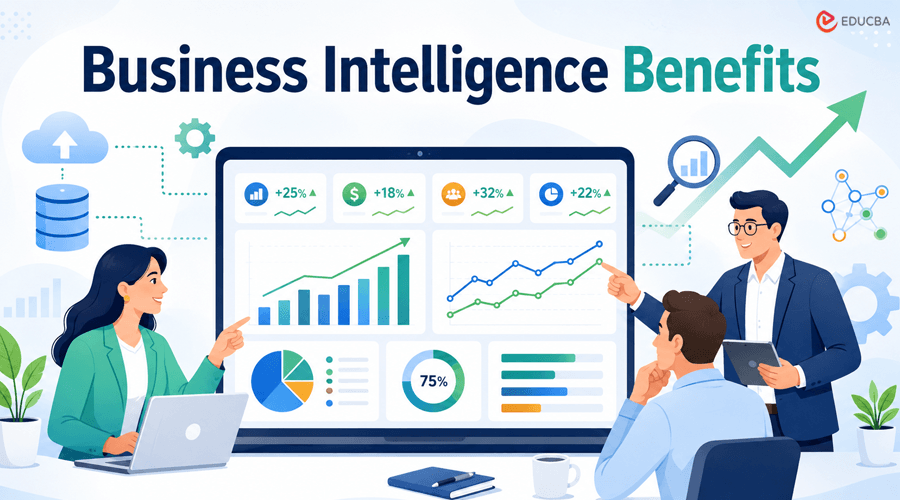
Businesses generate more data today than at any other point in history. Sales platforms track customer purchases, marketing tools measure campaign performance, websites collect behavioral data, and internal systems record everything from inventory levels to employee productivity.
The challenge is no longer collecting information. The challenge is understanding what that information actually means.
This is where business intelligence, often called BI, becomes valuable.
Business intelligence brings data from different parts of an organization together and turns it into useful insights. Instead of relying mainly on assumptions, managers can use reports, dashboards, trends, and performance indicators to understand what is happening inside their business and make more informed decisions.
As competition grows and markets change faster, using reliable information can help businesses make better decisions and stay ahead. Understanding the benefits of business intelligence helps organizations see how data can support better performance, efficiency, and long-term growth.
What is Business Intelligence?
Business intelligence refers to the technologies, processes, and tools organizations use to collect, analyze, and present business data.
A BI system may pull information from customer relationship management software, accounting platforms, websites, sales systems, marketing tools, inventory software, and other company databases.
It can then display that information through dashboards, charts, reports, and other visual tools.
For example, a company could use a business intelligence dashboard to see:
- Which products generate the highest revenue?
- Which marketing channels attract the most customers?
- Which locations are performing above or below expectations?
- How customer retention is changing?
- Whether operating costs are increasing.
- Which departments are meeting their targets?
Instead of reviewing information separately across several platforms, decision-makers can see important business metrics in one place.
Business Intelligence Benefits
Here are some business intelligence benefits that help companies make better decisions, improve efficiency, and achieve sustainable growth.
Improves Business Decision-Making
One of the biggest business intelligence benefits is improved visibility.
When important information is scattered across spreadsheets, emails, accounting systems, and departments, managers may struggle to understand the organization’s overall condition.
Business intelligence helps create a clearer picture.
A sales manager, for example, may notice that revenue increased last quarter. That sounds positive, but a BI dashboard could reveal that acquisition costs increased even faster. Without that context, the company could incorrectly assume its performance improved.
Business intelligence allows organizations to examine several metrics together instead of evaluating individual numbers in isolation.
This can lead to more balanced decisions.
Improves Marketing Performance
Marketing is one area where companies often collect enormous amounts of information.
Businesses may track website visitors, search rankings, email performance, paid advertising campaigns, conversion rates, lead sources, customer acquisition costs, and dozens of other metrics.
“Business intelligence is most useful when it connects marketing activity to real business outcomes. Traffic and impressions can look impressive, but the more important question is whether those efforts are producing qualified leads, customers, and sustainable revenue,” says David Finberg, CEO of Peaks Digital Marketing.
Marketing teams can easily become focused on surface-level metrics such as impressions or traffic. Business intelligence helps organizations look deeper and understand which channels are producing qualified leads, sales, and long-term customer value.
For example, one campaign may generate significantly more website traffic than another. However, a smaller campaign could produce customers who spend more money and remain with the company longer.
When marketing data is connected with sales and customer information, businesses can make stronger decisions about where to invest their budgets. This is one of the important business intelligence benefits for organizations looking to improve marketing efficiency and return on investment.
Helps Identify Trends and Opportunities
Business intelligence can also help organizations identify patterns earlier.
A company may not immediately notice a gradual decline in customer retention, rising delivery times, increasing product returns, or declining conversion rates.
These changes can be difficult to recognize when information is reviewed manually.
Dashboards and automated reports can make emerging patterns easier to detect. For instance, if customer cancellations increase for three consecutive months, managers can investigate before the issue becomes much larger.
The same principle applies to opportunities.
A retailer may notice unexpectedly strong demand for a certain product category. A service company may discover that customers from one industry are significantly more profitable than others.
These insights can influence pricing, marketing, hiring, inventory, and product development decisions.
Increases Operational Efficiency
Business intelligence is not limited to sales and marketing.
Operations teams can use BI to understand how efficiently an organization is functioning.
Companies can analyze factors such as:
- Average processing times
- Inventory turnover
- Delivery performance
- Staffing levels
- Equipment utilization
- Customer support response times
- Operating costs
- Supplier performance.
When this information becomes visible, inefficiencies are easier to identify.
A company might discover that one stage of its order fulfillment process creates unnecessary delays. Another organization may learn that certain products remain in inventory much longer than expected. Management can then focus improvement efforts where they are most likely to have an impact.
Supports Better Decisions in Time-Sensitive Industries
Accurate information matters even more in industries where timing, coordination, and service quality directly affect customers.
“When multiple teams, schedules, and operational requirements have to work together, having clear and reliable information makes decision-making much easier. It helps leaders identify where attention is needed instead of relying on fragmented updates,” says Sharon Amos, Director at Air Ambulance 1.
This does not mean every decision should be automated. Instead, BI gives managers better information so they can apply their own experience and judgment more effectively. Data provides context. People still make the decisions.
For organizations operating in time-sensitive environments, timely, reliable information can be one of the most valuable business intelligence benefits.
Enables Data-Driven Decision-Making
Many business decisions have traditionally relied heavily on intuition.
Experience remains valuable, particularly when managers understand their customers and industry well. However, intuition becomes more powerful when it is supported by reliable evidence.
Consider a company deciding whether to open another location.
Management may believe there is strong demand in a particular area. Business intelligence could support that assumption by analyzing existing customer locations, regional sales patterns, demographic information, product demand, and operational costs.
The company can then decide with greater confidence. BI does not eliminate uncertainty. No system can predict every market change. It simply helps organizations make decisions using more complete information.
Helps Departments Work From the Same Information
Another common business problem is that departments sometimes use different versions of the same information.
Finance may calculate revenue differently from sales. Marketing may define a qualified lead differently from the sales department. Operations may maintain separate spreadsheets that management cannot see.
These differences can create confusion. A strong business intelligence system can standardize metrics across the organization. When teams work from the same dashboards and definitions, conversations become more productive. Instead of debating whose numbers are correct, employees can focus on what the numbers mean and what actions should follow. This becomes especially valuable as companies grow and communication becomes more complicated.
Makes Performance Easier to Measure
Organizations often establish goals around revenue, customer satisfaction, productivity, costs, retention, or market growth.
Business intelligence makes it easier to track progress toward those goals.
Managers can create key performance indicators and monitor them regularly through dashboards.
For example, a company may track:
| Business Area | Possible BI Metric |
| Sales | Revenue growth and conversion rate |
| Marketing | Customer acquisition cost |
| Finance | Profit margin and cash flow |
| Customer Service | Response time and satisfaction score |
These metrics give leadership a clearer understanding of whether the company is moving in the right direction. They also make it easier to investigate why performance improves or declines.
Improves Business Forecasting and Planning
Historical data can also help businesses prepare for future demand. Companies can analyze previous sales patterns, seasonal changes, customer behavior, and market trends to create more informed forecasts. A retailer may use previous sales data to estimate inventory needs before a busy season. A marketing team may compare past campaigns to estimate the potential return from future spending. A service company could study historical demand to determine when it may need additional staffing.
Forecasts will never be perfectly accurate, but better data can reduce unnecessary uncertainty.
Ensures More Reliable Business Insights
Business intelligence is only as reliable as the information behind it.
If companies use incomplete, duplicated, or inaccurate data, dashboards can produce misleading conclusions.
Organizations should therefore consider data quality before investing heavily in BI.
This may include establishing consistent definitions, removing duplicate records, connecting important systems, and deciding which metrics are actually useful.
Companies should also avoid creating dashboards simply because the technology allows it. Too much information can become another form of confusion.
The most useful BI systems focus attention on the metrics that directly influence important business decisions.
This is important because the business intelligence benefits organizations expect can only be achieved when the underlying data is accurate, relevant, and properly managed.
Makes Data-Driven Insights More Accessible
Business intelligence was once associated mainly with large corporations that could afford expensive data infrastructure and specialized analytics teams.
That is changing.
Cloud-based platforms, integrations, automated reporting tools, and user-friendly dashboards have made business intelligence more accessible to smaller organizations.
Companies do not necessarily need enormous data departments to benefit from BI.
Even relatively simple dashboards that connect sales, marketing, financial, and operational information can help business leaders understand performance more clearly.
The goal is not to collect every possible data point.
The goal is to turn relevant information into decisions.
Final Thoughts
Business intelligence helps companies move from fragmented information toward a clearer understanding of how their organization is performing.
The business intelligence benefits extend across many areas of an organization. BI can reveal marketing opportunities, highlight operational problems, improve forecasting, measure progress, support collaboration, and help different departments work from the same information.
Most importantly, business intelligence helps managers ask better questions.
Why did revenue increase? Which customers are most profitable? Where are operations slowing down? Which marketing investments produce meaningful results? What changes should the business make next?
Technology cannot answer every strategic question on its own.
However, when reliable data is combined with human judgment and industry experience, companies can make decisions with greater clarity and confidence.
As organizations continue generating more information, businesses that learn to interpret that data effectively will be better positioned to adapt, compete, and grow.
Recommended Articles
We hope this guide helps you understand the business intelligence benefits, from improving decision-making and identifying trends to increasing operational efficiency and supporting better forecasting. Explore these recommended articles for more insights on business intelligence, data-driven decisions, BI dashboards, analytics, and business growth.


