


Building High-Performance Marketing Teams Through Technical Training and Analytics
Marketing teams must understand data, use advanced tools, and measure the real impact of their work. When a team lacks the technical skills to do this, decisions often rely on guesswork rather than clear insights. This is one of the biggest challenges organizations face when building high-performance marketing teams. Modern marketing goes far beyond creative campaigns. It requires understanding analytics dashboards, working with marketing automation tools, and using customer data to guide decisions. Because of this shift, many companies are investing in technical training and analytics skills to support their teams. When marketers understand the tools they use and the data behind their campaigns, they can make better decisions, optimize strategies faster, and improve overall results. This combination of technical training and analytics is essential for building high-performance marketing teams that consistently deliver measurable outcomes.
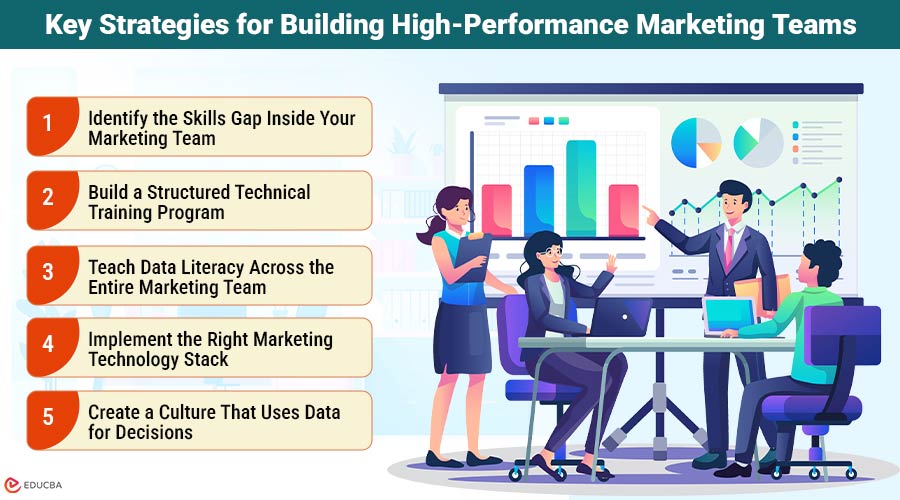
Key Strategies for Building High-Performance Marketing Teams
The following strategies outline practical steps organizations can take to strengthen skills, leverage analytics, and build high-performance marketing teams.
1. Identify the Skills Gap Inside Your Marketing Team
Before improving performance, you need to understand where your team stands today. Many companies assume their marketing teams already have the right skills, but when you look closely, there are often clear gaps. Some team members may be great at content or campaigns but struggle with analytics tools. Karen Noryko, Career Content Director at Jobtrees, said, “In career development research, one pattern appears again and again people often believe they have mastered a skill until they try applying it in a more complex situation. That is why structured skill assessments are useful. They help both employees and managers see where strengths exist and where additional learning could make the biggest difference.”
The first step is to review your team’s existing skills and identify where improvement is needed. Look at areas like analytics, marketing automation, SEO tools, CRM systems, and data interpretation. You do not need everyone to become a technical expert, but your team should be comfortable using the tools that drive marketing decisions. Ask your team which tools they use regularly, what they feel confident doing, and where they struggle. You can also review past campaigns to see where technical knowledge could have improved results.
Research shows that businesses with a clear plan grow about 30% faster than those operating without one. When you understand the gaps and create a plan to improve them, the team becomes much stronger over time. Ashley Durmo, CEO of Chalet, highlights, “Teams perform better when expectations and capabilities are clearly understood. Once leaders identify where knowledge gaps exist, it becomes much easier to introduce targeted training or tools that help employees work more confidently.” Once you know where improvement is needed, you can build training that actually helps your team perform better.
2. Build a Structured Technical Training Program
Once you know where your team needs improvement, the next step is building a training program that helps them develop those skills. Many companies expect marketers to learn tools on their own, but this often leads to slow progress and inconsistent knowledge across the team. “When organizations expect people to learn complex tools without guidance, progress usually becomes uneven. Structured learning environments help teams understand not only how to use the technology but also how to interpret the results it produces,” says Kyle R Smith, Director of Boost Promotional Products.
A structured training plan makes learning easier and more organized. Instead of random tutorials or occasional workshops, your team should have clear opportunities to build their technical skills over time. Training can happen in several ways. Some companies run internal sessions where experienced team members teach others how to use certain tools. Others provide access to online courses or certifications on platforms such as Google Analytics, SEO tools, CRM systems, or marketing automation software. Hands-on practice is also important.
Let team members apply what they learn to real campaigns rather than just studying theory. In an interview, Bill Sanders, from TruePeopleSearch, mentions, “Information tools are only useful when people understand how to apply them in real situations. Whether someone is researching public records or analyzing marketing data, practical experience usually turns basic knowledge into real skill.”
3. Teach Data Literacy Across the Entire Marketing Team
Many marketing teams collect a lot of data, but not everyone on the team knows how to use it properly. Dashboards show traffic numbers, conversion rates, and engagement metrics, but those numbers only matter if people understand what they mean. Anastasia Sartan, CEO of GetGenAI, explains, “AI and analytics tools can generate a huge amount of information, but the real value appears only when teams know how to interpret it. Data becomes useful when marketers can connect the numbers they see to the decisions they need to make.” Data literacy simply means helping marketers read and use marketing data. Your team should know how to review campaign results, identify trends, and recognize when something is working or failing.
For example, if a campaign drives many website visits but few sign-ups, your team should be able to quickly spot the problem. It might be the wrong audience, weak messaging, or a landing page that is not convincing visitors. When marketers understand the numbers, they can diagnose problems more quickly and improve their campaigns. This skill has become extremely important in modern marketing. According to research, marketing analytics influences about 53% of marketing decisions in organizations today. This means data now guides more than half of marketing strategy rather than intuition.
“In technology-driven industries, decisions increasingly rely on analyzing patterns in data rather than relying only on assumptions. When teams become comfortable working with metrics and dashboards, they can respond to problems and opportunities much more quickly,” adds Htet Aung Shine, Co-Founder of NextClinic. But many marketers still feel uncomfortable working with analytics tools. That is why companies need to actively train their teams to understand metrics, dashboards, and performance reports.
4. Implement the Right Marketing Technology Stack
Once your team understands the basics of analytics and technical tools, the next step is making sure they have the right systems to work with. Many marketing teams struggle not from a lack of talent, but from using disconnected tools that complicate their work. Charles Martinez, CMO of BindSafe, explains, “Complex work becomes much harder when the tools supporting it do not fit together properly. When systems are scattered, people end up spending more time navigating software than actually solving problems.” A robust marketing technology stack helps teams manage campaigns, track results, and better understand customer behavior. Instead of switching between multiple spreadsheets and dashboards, the right tools bring everything together in one place.
Most high-performing marketing teams rely on a few core platforms. Analytics tools help track website performance and campaign results. CRM systems store customer and lead data, enabling marketers to understand the full journey from first contact to conversion. Marketing automation tools help manage email campaigns, lead nurturing, and follow-ups without doing everything manually. Another important part of the stack is reporting dashboards. These allow teams to see performance data quickly without spending hours compiling reports. When dashboards are easy to access, marketing teams can review performance regularly and make faster decisions.
Ákos Doleschall, Managing Director at Hustler Marketing, adds, “When data from different systems connects properly, it becomes much easier to understand what is actually happening inside a campaign. Patterns start to appear, and those patterns help teams make better decisions about what to improve.” But tools alone are not enough. Your team must also understand how the tools connect. For example, when website analytics, CRM data, and email platforms work together, marketers gain a much clearer picture of how campaigns are performing.
5. Create a Culture That Uses Data for Decisions
Technology and analytics tools are helpful, but they only matter if the team actually uses them to guide decisions. Many companies install analytics platforms but still rely on guesswork when planning campaigns. Data becomes valuable only when it guides real decisions. When people rely only on assumptions, it is easy to overlook patterns that the numbers are already showing,” shares Raj Dosanjh, CEO of Rentround. High-performing marketing teams build a habit of looking at data before making decisions.
When planning a campaign, they review past results to understand what worked and what did not. When a campaign is running, they monitor performance closely and adjust if something is not performing well. This habit of checking the data becomes part of the team’s daily workflow. Instead of waiting until the end of a campaign to review results, marketers regularly monitor performance metrics. They test new ideas, measure the impact, and learn from the results.
Nikita Gabdrakhmanov, Chief Flight Instructor at Wayman College of Aeronautics, notes, “In aviation training, decisions are constantly guided by instruments and measurable signals rather than intuition alone. The same principle applies in many professional fields consistent monitoring and small adjustments usually lead to better outcomes over time.” Testing plays an important role here. Simple experiments, such as testing different headlines, landing pages, or ad creatives, can yield useful insights. Over time, these small improvements add up, making campaigns much stronger.
6. Encourage Collaboration Between Marketing, Product, and Data Teams
Marketing teams rarely work in isolation. Their work often overlaps with product teams, sales teams, and data analysts. When these groups collaborate well, marketing becomes much more effective. David Krauter, Owner of Websites That Sell, mentions, “When different teams share insights regularly, it becomes much easier to understand what customers actually need. For example, in health and wellness services, product experts, customer-facing teams, and analysts often see different parts of the same story, and combining those perspectives leads to better decisions.” Data teams also play an important role. They help marketers understand customer behavior, analyze trends, and uncover insights that may not be obvious from basic analytics dashboards.
When marketing teams regularly communicate with these groups, they gain access to much richer information. This helps them create campaigns that are more relevant and better aligned with real customer needs. Collaboration also improves speed. When teams share information openly, marketers can test ideas faster, launch campaigns more quickly, and adjust strategies without waiting for long approval processes. Research also shows how important collaboration is inside organizations.
According to research, 97% of employees and executives say poor collaboration directly impacts workplace success. The same report also shows that teams with stronger collaboration see higher engagement and better productivity. For marketing teams, this matters a lot. When marketing, product, sales, and data teams share insights and work closely together, campaigns become more accurate and much easier to execute.
7. Measure Team Performance and Keep Improving Skills
Building a strong marketing team is not something that happens once and stays the same forever. Skills change, tools evolve, and marketing channels keep shifting. High-performing teams treat improvement as a continuous process, not a one-time effort. “Customer expectations change quickly, especially in industries like fashion, where trends, buying behavior, and digital platforms evolve constantly. Teams that regularly review what is working and what is not tend to adapt much faster than those relying on the same approach year after year,” says Eli Harel, Partner at Lice Busters.
One helpful step is tracking clear performance indicators. This may include campaign results, lead generation numbers, customer acquisition cost, conversion rates, and the overall impact marketing has on revenue. Reviewing these numbers regularly makes it easier to see what the team does well and where it needs to improve. “When people analyze large sets of information, patterns begin to appear that might not be obvious at first glance.
Consistently reviewing data helps teams understand which efforts are producing meaningful results and which areas need adjustment,” adds Bill Sanders, from Fast People Search. Performance reviews can also highlight training opportunities. For example, if campaigns are generating traffic but not converting, the team may need better landing pages or messaging. If reporting takes too long, it might indicate that more training on analytics tools is needed.
Final Thoughts
Building high-performance marketing teams requires more than creativity. Modern marketers need strong technical skills, data literacy, and access to the right technology. When teams understand the tools they use and know how to interpret performance data, they can make smarter decisions and improve campaign results. Companies that invest in technical training, analytics education, and collaborative workflows create marketing teams that are more confident, more efficient, and better prepared for the demands of modern digital marketing. By focusing on skill development, technology integration, and data-driven decision-making, organizations can continue building high-performance marketing teams that deliver stronger performance and long-term business growth.
Recommended Articles
We hope this guide on building high-performance marketing teams helps you strengthen your marketing strategy. Check out these recommended articles for more insights and practical strategies to improve your marketing team’s performance.

