


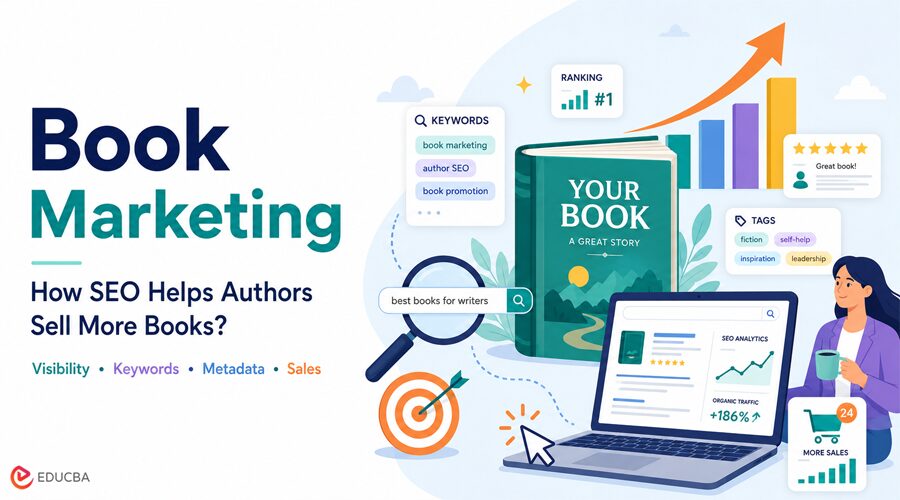
You put your manuscript together, and yet nobody is locating your book. This is the issue with many first-time authors, who respond by producing high-quality work but sell nothing. That is where SEO is important for affecting book marketing.
Competition within the digital book industry has increased rapidly. Bowker’s (2024) report explains that over 2.6 million new titles were self-published in one year in the United States alone, demonstrating the congestion in the space.
Readers currently learn about books through Google search results, the Amazon store, and social media streams. SEO has become the main driver of book marketing nowadays, since search visibility determines book rankings.
This article describes the importance of SEO in book marketing in 2026, and how an author can make it work in 5 steps, and why smart positioning can place a manuscript on the bestseller list.
Understanding SEO in Book Marketing
SEO links your book to those readers who already search for some topics connected with your work. Strong book marketing employs search data, content optimization, and platform algorithms to enhance discoverability and sales performance.
What SEO Really Means in Book Marketing Today?
SEO means optimizing your book and online presence so search engines can easily understand, rank, and show them to readers. Efficient marketing employs keyword research, optimized metadata, well-organized descriptions, and valuable content to align with the reader’s search intent.
Whenever possible, search engines look at book titles, subtitles, descriptions, author bios, web pages, and backlinks. When your marketing program aligns with real search terms, your book will appear in meaningful search results. Strategic optimization focuses on discoverability and conversions, whereas random promotion relies on luck and short-lived attention.
Why Book Marketing Without SEO Struggles in 2026?
Every year, millions of books are released to market, and algorithms determine which receive exposure. Weak marketing is a failure because it does not recognize ranking signals as well as search behavior.
Common issues include:
- Poor keyword targeting that does not match reader queries
- Weak metadata that confuses search engines
- Low engagement signals, such as short page visits
Book marketing requires consideration of keywords, click-through rates, reviews, dwell time, and category relevance. The importance of search intent lies in the distinction between informational and buying searches, and your content should align with each.
Building a Results-Driven Book Marketing Strategy with SEO
Book marketing is a powerful process that starts with research and proceeds with active optimization. SEO provides structure, data, and measurable progress that random promotion cannot deliver.
Keyword Research as the Core of Book Marketing
Keyword research forms the backbone of book marketing because it reveals what readers type into search engines. Writers who know how to sell a book begin by analyzing demand, competition, and related search terms.
Search tools can help you find phrases related to your topic, genre, and your readers’ pain points. When you make those terms automatically appear in titles, subtitles, and product descriptions, your marketing begins to smack of the real book market demand. Keywords strategy enhances ranking systems and qualified traffic.
Optimizing Metadata for Stronger Book Marketing Performance
Metadata comprises title, subtitle, description, your categories, and your backend keywords. Smart book marketing treats metadata as a hierarchical device rather than a formality.
Refined titles do not ramble on about the benefits or keywords. Categories should match real reader interests instead of broad competition zones. Strong descriptions answer reader questions and improve conversions. In the competitive Amazon book market, optimized metadata increases discoverability and relevance within the platform’s algorithms.
Search Intent and Reader Behavior in Book Marketing
Reader behavior shapes book marketing decisions. Informational intent focuses on learning, while buying intent focuses on purchasing.
If someone searches for a beginner’s investing guide, they expect practical advice. If they search for the best investing book for beginners, they are more likely to buy it. Effective marketing aligns content with both stages. Matching intent improves click-through rates and strengthens conversions because readers feel understood.
Authority Building Through Content and Strategic Book Marketing
Search engines reward authority and trust. Sustainable Marketing achieves credibility by providing valuable information and a regular presence.
Establishing Author Credibility Through Educational Content
Authors establish authority by writing useful articles, guides, and interviews concerning their subject. Book marketing strategies include guesting, blogging, and podcasting.
When your book competes with the best marketing books in your niche, you need to show that you are the marketing experts by the depth and examples. Regular educational content develops backlinks and signals of trust. Over time, search engines will recognize that you are an expert and rank your pages higher.
The Role of Professional Guidance in Book Marketing
Many authors struggle because they handle everything alone. Professional book marketing support brings structure and advanced strategy.
A professional approach often includes:
- Deep keyword research and competitive analysis
- Conversion-focused description writing
- Launch planning and ranking strategy
Professional book marketers are knowledgeable about algorithm behavior and audience targeting. A professional book marketer can help reduce the learning curve and avoid costly mistakes. Book advertising companies that are reliable, offer positioning, analytics tracking, and optimization of campaigns. Many authors choose the best book marketing services because expert guidance accelerates growth and improves long-term results.
Data, Analytics, and Performance Tracking in Book Marketing
Modern book marketing relies on measurable data. Guesswork wastes time, while analytics guide improvement.
Measuring Visibility and Engagement
Google Search Console shows which keywords bring visitors to your website. Amazon ranking information provides category performance and keyword visibility.
The success of marketing can be measured using click-through rates, impressions, and conversion metrics. When impressions are deep and conversions are low, then you might need to revise your description. Monitoring engagement makes sure that your strategy is performance-oriented.
Refining Book Marketing Strategy Using Real Data
Book marketing evolves based on data. When performance deteriorates, authors should revise the descriptions, and when the competition increases, they should test new keywords.
Even little modifications can result in quantifiable expansion. Indicatively, a nonfiction writer increased conversions by rephrasing the initial three lines of description to respond to an identifiable pain point. The increase in shrinkage was observed within a month as engagement rose. Regular testing and optimization enforce long-term authority.
Collaboration Between Authors and Publishers in Modern Book Marketing
SEO is now relied upon by traditional and independent publishing models. Book marketing today demands that both publishers and authors work together to ensure maximum exposure.
How Publishers Integrate SEO into Book Marketing?
Most publishers are currently using hybrid publishing models that incorporate digital optimization alongside print distribution. SEO-optimized posts include keyword research, focused categories, and content marketing assistance.
Digital-first strategies focus on physical distribution only after establishing an online presence. Book marketers who include SEO in their publishing strategy enhance initial sales momentum and pickup.
Why Must Authors Understand Book Marketing Fundamentals?
Authors need to know Marketing principles even when dealing with publishers. Knowledge will enable you to judge the campaigns and recommend improvements.
When writers learn how to market their books, they develop individual authority and connections with their audiences. Powerful Marketing is effective for email list growth, social media expansion, and branding.
Common SEO Mistakes That Weaken Book Marketing Results
Errors reduce visibility and lead to lost potential sales. Smart Marketing does not take shortcuts and is about long-term development.
Poor Keyword Targeting and Over-Optimization
Stuffing with keywords spoils readability and ranking. Book Marketing involves using useful content to incorporate keywords.
Competition in highly saturated categories is less visible. Focusing on specific phrases can be more effective since the competition is not too high. Not considering readers’ intent leads to low traffic and conversions.
Weak Descriptions and Low Engagement Signals
Generic summaries fail to persuade readers. Generic summaries do not convince readers. Good Marketing employs vivid imagery, emotional appeal, and a well-organized structure.
From Manuscript to Bestseller: A Practical Book Marketing Roadmap
A clear roadmap transforms theory into action. Structured Marketing reduces confusion and builds measurable progress.
Step-by-Step Execution Plan
Authors should approach Book Marketing as a phased process rather than a single launch event.
Key steps include:
- Complete and professionally edit the manuscript
- Conduct in-depth keyword research
- Optimize title, subtitle, and metadata
- Launch with SEO foundations in place
- Build authority content and backlinks
- Monitor rankings and adjust strategy
One business author applied this roadmap before release. She identified underserved keywords in the book market and optimized her listing accordingly. Within three months, her book ranked in a niche category and gained steady organic traffic. Structured Book Marketing produced consistent visibility instead of short spikes.
Turning Visibility into Sustainable Sales
Organic traffic compounds over time because search rankings build authority. Reviews increase trust and strengthen conversions.
Strategic positioning within categories improves bestseller potential when competition is realistic. Long-term marketing focuses on retention and reader loyalty rather than short-term hype.
Final Thoughts
A smart strategy must support strong writing because visibility drives sales. SEO now defines modern Book Marketing in 2026.
Discoverability is a competitive advantage that such authors can achieve in a saturated book market. Professional strategy maximizes payoff and minimizes effort waste.
For authors prepared to go beyond simple promotion, Parker Publishers provides organized book marketing services designed to enhance rankings, exposure, and future sales. The right strategy can turn your manuscript into measurable success.
Recommended Articles
We hope this helps you understand how SEO can improve your book’s visibility and increase sales. Explore these recommended articles for more insights into book promotion, author branding, SEO strategies, publishing, and digital marketing for authors.

