
Introduction to Blockchain Development Tools
Blockchain development tools are specialized software frameworks, platforms, and libraries designed to help developers create, test, and deploy blockchain applications. These tools provide ready-made functionalities such as smart contract deployment, consensus algorithms, debugging, cryptographic operations, and network simulation.
In simple terms, blockchain tools are the equivalent of IDEs, APIs, and testing platforms in traditional software development. Still, they are tailored for the unique requirements of decentralized and distributed systems.
Why are Blockchain Development Tools Important?
Here are the key reasons why blockchain development tools play a important role in building efficient, secure, and scalable applications:
1. Reduce Complexity
Provide pre-built libraries, frameworks, and templates that simplify tasks like smart contract creation, transaction handling, and cryptographic operations.
2. Improve Accuracy
Offer debugging, testing, and auditing features to minimize risks of vulnerabilities or costly errors in deployed contracts.
3. Accelerate Development
Enable faster prototyping, simulation, and deployment, allowing developers to test ideas before going live on mainnet.
4. Ensure Security & Compliance
Help maintain adherence to blockchain standards and best practices, ensuring that applications are both secure and interoperable.
5. Enhance Scalability
Provide infrastructure support (e.g., APIs, SDKs, node services) to help developers scale their applications without having to build everything from scratch.
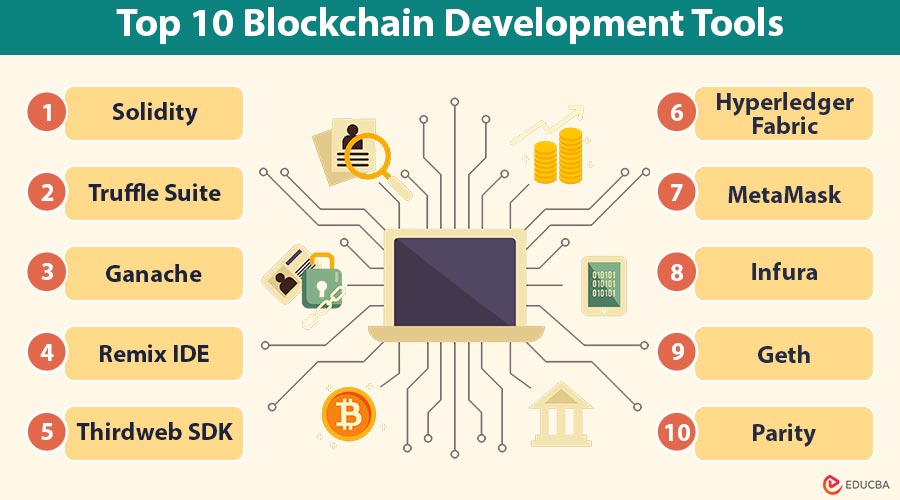
Top 10 Blockchain Development Tools
Let us explore some of the most widely used blockchain development tools in the industry:
#1. Solidity
Solidity is a object-oriented, high-level programming language that is mostly used for creating Ethereum blockchain smart contracts. It compiles into bytecode that runs on the Ethereum Virtual Machine (EVM), making it the foundation for most Ethereum-based dApps.
Use Cases:
- Creating ERC-20 and ERC-721 (NFT) tokens
- Building decentralized finance (DeFi) applications, like lending platforms and exchanges, becomes seamless with expert DeFi Smart Contract Development that ensures security, automation, and trustless transactions.
- Creating DAOs and governance mechanisms
Pros:
- Widely adopted across Ethereum and EVM-compatible blockchains
- Large and active developer community with continuous updates
- Strong ecosystem of tutorials, libraries, and frameworks
Cons:
- Beginners have a steep learning curve because of the complicated syntax.
- Prone to vulnerabilities if not carefully audited (e.g., reentrancy attacks)
- Debugging large smart contracts can be difficult
#2. Truffle Suite
The Truffle Suite is a development framework for Ethereum that simplifies the entire dApp lifecycle — from writing and testing smart contracts to deployment and integration.
Use Cases:
- End-to-end Ethereum dApp development
- Automated smart contract testing with JavaScript or Solidity
- Simulating deployments before moving to live networks
Pros:
- Rich ecosystem including Ganache (local blockchain) and Drizzle (front-end libraries)
- Strong documentation and community support
- Automates repetitive development tasks (migrations, deployment, testing)
Cons:
- Primarily focused on Ethereum and EVM-compatible chains
- Learning curve for complete suite setup
- Can be resource-intensive, especially when running Ganache alongside other tools
#3. Ganache
Ganache is a personal Ethereum blockchain for developers, available as both a desktop application and a CLI tool. It allows instant smart contract deployment and testing without the need for real gas fees.
Use Cases:
- Testing smart contracts in a local blockchain environment
- Simulating mining and transaction confirmations
- Debugging Ethereum transactions before mainnet deployment
Pros:
- Extremely fast prototyping and testing
- User-friendly interface for transaction visualization
- Allows developers to control block times and mining speed
Cons:
- Limited to the Ethereum ecosystem
- Not suitable for enterprise-level blockchain projects
- Cannot fully replicate real-world conditions on a blockchain mainnet.
#4. Remix IDE
Remix IDE is a powerful web-based development environment tailored for Solidity smart contracts, enabling developers to write, compile, deploy, debug, and analyze code efficiently with built-in tools, plugins, and real-time feedback.
Use Cases:
- Writing and testing Solidity smart contracts
- Performing static analysis to catch errors early
- Debugging deployed contracts directly on Ethereum networks
Pros:
- Browser-based (no installation required)
- Supports plugins for extensibility
- Real-time code compilation and debugging features
Cons:
- Limited project management compared to IDEs like VS Code
- Not ideal for large-scale professional development projects
- Requires constant internet access for full functionality
#5. Thirdweb SDK
The Thirdweb SDK is a powerful toolkit that enables developers to build, deploy, and manage blockchain applications effortlessly, using pre-built smart contract templates, APIs, and SDKs across multiple programming environments.
Use Cases:
- Creating and managing NFTs (minting, selling, and trading)
- Building DeFi apps, such as staking and token exchanges
- Deploying DAOs and governance protocols
Pros:
- No need for deep blockchain coding knowledge
- Pre-built smart contract templates for rapid development
- Cross-chain support (Ethereum, Polygon, Avalanche, Solana, etc.)
Cons:
- Less control compared to writing smart contracts from scratch
- Some advanced features may require customization beyond templates
- Dependency on Thirdweb’s infrastructure and updates
#6. Hyperledger Fabric
Hyperledger Fabric is an open-source enterprise-grade blockchain framework hosted by the Linux Foundation. It supports modular and permissioned networks, making it suitable for large organizations.
Use Cases:
- Supply chain management and tracking
- Banking and financial services (cross-border payments, settlements)
- Government services and healthcare data management
Pros:
- A permissioned network ensures high security and privacy
- Modular architecture allows customization for business needs
- Highly scalable and enterprise-focused
Cons:
- Complex setup and configuration for beginners
- Not ideal for public blockchain or open DeFi projects
- Requires significant infrastructure resources for deployment
#7. MetaMask
MetaMask is a mobile software and browser plugin that serves as a cryptocurrency wallet and entry point to blockchain applications. It allows users and developers to connect to Ethereum and other networks.
Use Cases:
- Testing smart contracts with different accounts
- Interacting with dApps directly in the browser
- Managing multiple wallets and tokens
Pros:
- Easy to integrate with web3.js and dApps
- Supports multiple networks beyond Ethereum
- User-friendly interface for both users and developers
Cons:
- Security risks if misconfigured or if phishing attacks occur
- Heavily depends on browser security
- Not ideal for managing large-scale enterprise assets
#8. Infura
Infura is a blockchain infrastructure service that provides scalable and reliable Ethereum and IPFS APIs. It eliminates the need for developers to run full blockchain nodes.
Use Cases:
- Building dApps that require blockchain data access
- Scaling applications without managing infrastructure
- Connecting to Ethereum and IPFS networks instantly
Pros:
- High reliability and uptime
- Reduces the complexity of running full nodes
- Developer-friendly with multiple API endpoints
Cons:
- Centralization concerns (relies on Infura’s servers)
- Limited customization compared to self-hosted nodes
- Costs may increase with higher usage at scale
#9. Geth
Geth, also known as Go Ethereum, is the official Ethereum client written in the Go programming language. It allows developers to run full nodes, mine Ether, create wallets, manage accounts, and interact with Ethereum networks.
Use Cases:
- Running Ethereum mainnet or testnet nodes
- Mining Ether and managing transactions
- Creating wallets and managing accounts programmatically
Pros:
- Full control over the Ethereum node and data
- Widely utilized and regarded as reliable by the Ethereum community
- Supports JSON-RPC APIs for integration
Cons:
- Requires significant technical expertise to set up and maintain
- Consumes high storage and bandwidth resources
- Synchronization can be slow on large blockchains
#10. Parity
Parity, rebranded as OpenEthereum, is a lightweight, modular Ethereum client built for speed, scalability, and efficiency, enabling developers to run private networks and build enterprise-grade decentralized applications.
Use Cases:
- Running private and permissioned Ethereum networks
- Enterprises building scalable dApps
- High-performance synchronization for blockchain research and testing
Pros:
- Faster than Geth in some sync scenarios
- Modular and lightweight architecture
- Supports private and permissioned chains
Cons:
- Development and maintenance have slowed in recent years
- Smaller user base compared to Geth
- Less community support and fewer active contributors
Final Thoughts
Blockchain development tools are essential for building secure, efficient, and scalable decentralized applications. From Solidity and Truffle Suite to Thirdweb SDK and Hyperledger Fabric, each tool offers unique functionalities, use cases, and benefits. The needs of your project, the target blockchain, and your level of programming experience will all influence which combination is best. Leveraging these tools can significantly reduce complexity, accelerate development, and ensure reliable, production-ready blockchain applications.
Recommended Articles
We hope that this EDUCBA information on “Blockchain Development Tools” was beneficial to you. You can view EDUCBA’s recommended articles for more information-


