


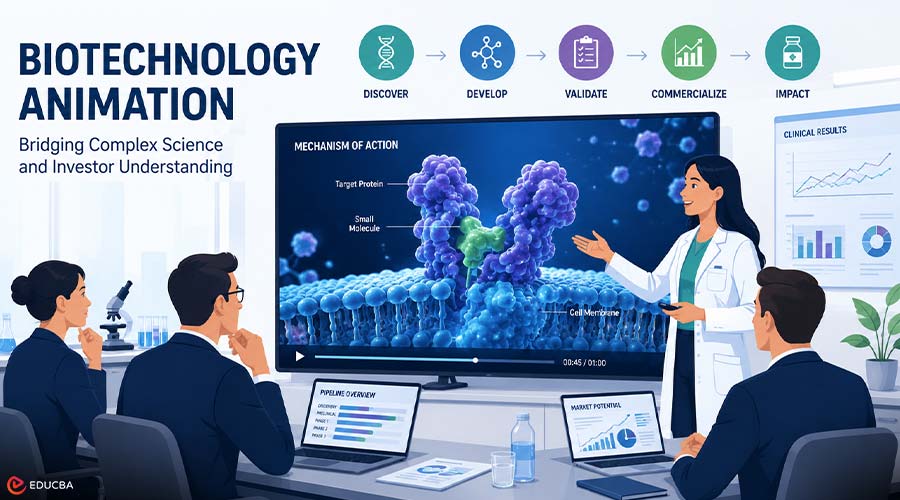
The journey of a drug from initial discovery to the pharmacy shelf is one of the most sophisticated paths in the modern economy. For biotech startups, this path is paved with numerous hurdles, the most significant of which is often not the science itself, but the ability to fund it. In the competitive world of biopharma investment, the gap between a groundbreaking laboratory breakthrough and a successful funding round is often caused by a communication problem. This is where biotechnology animation has emerged as a powerful solution.
The problem is as follows: on one side, you have scientists who live in the world of proteomics, genomic sequencing, and complex metabolic pathways; on the other, you have investors who, while financially savvy and strategically brilliant, lack a PhD in molecular biology. When a startup presents a slide deck filled with static 2D graphs and dense technical jargon, it creates an additional barrier. Modern biotechnology animation helps bridge this gap by transforming invisible scientific processes into visually engaging and easy-to-understand stories.
The Invisible Problem of Biotech Pitching
In any other industry, a prototype can be touched, felt, or seen in action. A software startup can demo an app, and a hardware company can show a physical model. But in drug discovery, the product is often an invisible molecular interaction occurring at a scale the human eye cannot perceive. Traditional formats like white papers, static diagrams, and raw trial data often fail to convey the complexity of new therapies. If an investor cannot visualize how a drug works, they perceive a higher level of risk. This is where biotechnology animation becomes a strategic asset, helping transform an abstract chemical formula into a dynamic, cinematic reality.
The Power of Biotechnology Animation in Molecular Visualization
Modern medicine is advancing toward more complex treatments, including gene therapy, CAR-T cell therapies, and mRNA platforms. These technologies are inherently spatial and temporal. Using advanced 3D visualization allows a startup to show the exact “mechanism of action” (MoA). Imagine a pitch where, instead of explaining “targeted protein degradation,” the founder plays a 60-second 3D sequence. Investors see the E3 ligase recruit the target protein, tag it for destruction, and direct it to the proteasome for elimination.
This level of molecular visualization provides several benefits:
- Ensures accuracy. It proves the startup has a deep, functional understanding of its science.
- Saves time. It replaces a twenty-minute technical explanation with a one-minute visual narration.
- Standardizes the message. Every investor, regardless of their background, leaves with the same mental model of how the drug works.
Converting Clinical Trial Data Into a Compelling Narrative
While data is the core of a biotech company, storytelling is a necessity because investors fund projects when they understand exactly how a specific disease is being targeted and cured. 3D animation allows startups to turn their clinical trial data into a compelling narrative. Instead of a bar chart showing reduced viral load, an animation can visualize the therapy’s real impact on patient tissue. For biotech startups, this is the key to convincing any skeptical investor, as when a venture capitalist can see the drug discovery process from the identification of a novel pocket on a protein to the successful delivery of a payload into a cell, the overall trust in the project deepens.
In this high-stakes environment, the quality of the animation matters as much as the science. A poorly rendered animation can actually hurt a startup’s credibility. This is why many leading innovators partner with experts like VOKA. By leveraging realistic, medically accurate 3D assets, the agency helps startups build brand identity.
How Biotechnology Animation Accelerates the Path to Market?
The ultimate goal of any biopharma investment is to reach the market and help patients. However, the regulatory and fundraising cycles are notoriously slow. 3D animation acts as a catalyst in this process, influencing several aspects:
- Fundraising speed: Startups that use high-quality 3D visuals often find that their “time to close” for a funding round is reduced. Clarity leads to faster decision-making.
- Regulatory clarity: When presenting to regulatory bodies, a clear MoA animation can help reviewers grasp the safety and efficacy profiles more quickly, potentially smoothing the path for Investigational New Drug applications.
- Partnership potential. Large pharma companies pursuing M&A are more likely to engage with startups that clearly present their value through strong scientific storytelling.
Final Thoughts
We are currently in a “golden age” of biotechnology, but the sheer complexity of discoveries threatens to outpace companies’ ability to explain them. For a biotech startup, the ability to communicate is a competitive advantage as vital as their intellectual property. This is why biotechnology animation is no longer simply a marketing tool. It has become a critical component of the biotech business model. It brings the lab’s invisible work to the market’s attention.
By transforming complex molecular interactions into an engaging experience, startups can secure the venture capital they need to turn a scientific hypothesis into a life-saving reality. In the end, through the power of 3D, complex concepts become clear, risky investments become reliable, and lab-grown experimental products can become market-ready solutions.
Recommended Articles
We hope this guide to biotechnology animation helps you better understand scientific storytelling in biotech. Check out these recommended articles for more such topics.

