


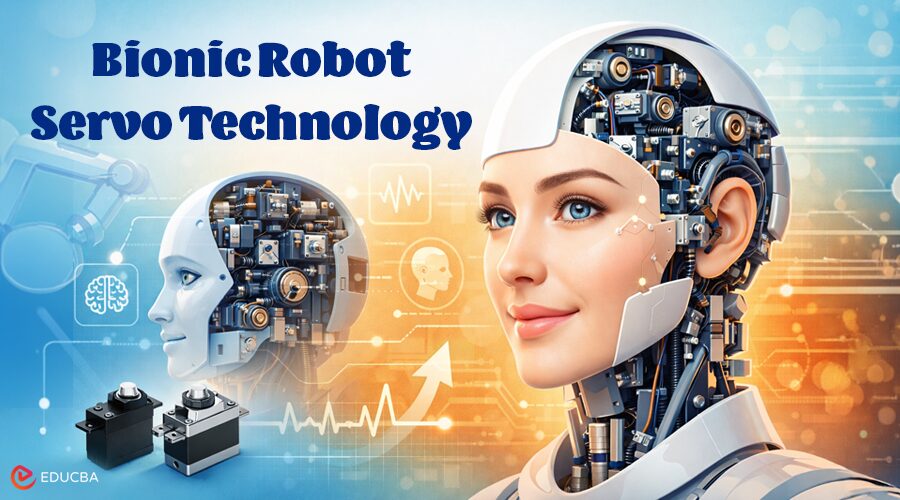
Beyond AI Algorithms: How Servo Technology Enables Smooth Robotic Expressions?
When bionic robots took the stage at the China Central Television (CCTV) Spring Festival Gala, the most-watched national gala in China, with their delicate, lifelike facial expressions, they instantly became a viral tech sensation. Public discussions almost unanimously centered on artificial intelligence, with terms like speech recognition, intelligent motion planning, emotional simulation, and deep learning algorithms dominating online conversations.
Most viewers attributed the robots’ natural, fluid movements solely to breakthroughs in AI technology. However, by slowing down the footage and breaking down the underlying technical logic, a crucial yet overlooked truth emerges: No matter how cutting-edge the algorithms or precise the decisions, robots must physically “move” in the real world through hardware; otherwise, all intelligent decisions are nothing but a castle in the air.
This is where Bionic Robot Servo Technology plays a decisive role. For modern bionic robots, agility and expression are not produced solely by AI but by the deep integration of intelligent algorithms with high-precision servo hardware systems.
For bionic robots, the core ability to achieve dynamic expression never belongs solely to AI. It is the result of in-depth collaboration between software algorithms and hardware drive systems, a universally recognized core technical logic in the R&D of high-end bionic robots.
Physical Mechanical Movement Driven by Bionic Robot Servo Technology
Many people mistakenly think that screen imaging or algorithmic special effects generate a robot’s facial expressions. In reality, every subtle expression is the physical execution of precision mechanical structures, with no room for virtual modification.
The slight raise of eyebrows, the natural pull of mouth corners, the faint contraction of facial contours, and the agile blinking of eyes all these human-like, seemingly effortless expression details fundamentally rely on advanced Bionic Robot Servo Technology to deliver high-precision, continuous, and jitter-free angle output and posture control.
This process imposes extremely stringent requirements on the drive hardware: Even a millisecond of lag in the drive system’s response will break the continuity of movements and cause stuttering; minor deviations in angle output or unstable power transmission will result in stiff, rigid expressions that completely lose their bionic quality.
Engineers cannot apply ordinary low-end drive devices to high-end bionic robotics because differences in hardware execution capabilities create significant gaps in dynamic performance.
Revealing the Core Hardware of Gala Robots
The bionic robots featured at this year’s CCTV Spring Festival Gala are equipped with 32 high-precision, high-performance servos inside their facial structures, forming a micro-drive matrix covering the entire face.
Among these, the core drive units responsible for critical regulation tasks are exclusively supplied by Kpower, the professional manufacturer behind Kpower Servos. These micro servos are hidden within the bionic facial mechanics, taking up no external space while performing ultra-fine angle adjustments.
They convert digital signals generated by AI algorithms into real, smooth, and visible physical movements, acting as the vital bridge between software intelligence and hardware execution, the essence of Bionic Robot Servo Technology.
Unlike robotic limb movements, which prioritize power output and load capacity, facial bionic expression control demands precision, continuity, and stability from servos, a widely acknowledged technical challenge in the industry.
Every angle change corresponding to an expression requires smooth transitions within an extremely narrow motion range, with zero jitter or stuttering allowed. Backlash errors, response delays, and power fluctuations inherent in standard servos are visually magnified in facial displays, directly undermining the overall bionic effect.
To meet these rigorous standards, Kpower Servos utilize digital closed-loop control technology, an essential component of modern Bionic Robot Servo Technology.
This technology provides:
- Real-time signal feedback
- Automatic operational correction
- Stable high-frequency motion control.
As a result, problems common to standard servos, such as jitter, stuttering, and angle deviation, are eliminated, enabling robots to produce natural and fluid expressions.
A Critical Requirement in Advanced Bionic Robot Servo Technology
In multi-servo collaborative facial drive scenarios, high precision from a single servo is far from sufficient; overall execution consistency is another core indicator determining bionic quality, and a formidable technical threshold in the high-end bionic robot sector.
The dozens of servos embedded in the Gala robots’ faces must receive algorithmic commands simultaneously and drive the facial mechanics in sync. The operation curves, response speeds, and output forces of all servos must be highly aligned; even a tiny timing or force deviation from one servo will create an unnatural, disjointed expression that fails to replicate human-like subtlety.
Through extensive R&D and manufacturing expertise, Kpower has overcome this challenge by achieving high-performance uniformity across batch-produced micro servos.
This level of consistency ensures:
- Perfect synchronization among multiple servos
- Smooth collaborative movement
- Natural facial expression reproduction.
Such performance standards are essential for high-end bionic robots and demonstrate the maturity of modern Bionic Robot Servo Technology.
Technical Logic Breakdown
From the perspective of professional bionic robot technical logic, the division of labor between software and hardware is clear and irreplaceable: Artificial intelligence algorithms act as the “brain” for decision-making, mapping motion paths, generating expression commands, and simulating emotional logic; servos, as core execution components, translate virtual commands into real physical actions, delivering precise power output and posture control for every movement.
This technical logic confirms an industry truth: Poor execution hardware can compromise even the most advanced AI algorithms and precise decision commands, leading to weak performance or failure to achieve basic dynamic expression. Ultimately, what truly enables bionic robots to break free from stiffness and achieve natural, agile expressions is never a single technological breakthrough, but rather the seamless integration and deep collaboration between AI algorithms and the underlying drive systems.
The Rise of Domestic Hardware
In recent years, China’s domestic micro-precision drive systems have achieved significant breakthroughs, gradually reducing reliance on overseas servo manufacturers.
Advancements include:
- Miniaturized servo design
- Micro-angle precision control
- High-frequency operational stability
- Multi-servo collaborative consistency.
These innovations have enabled domestic companies to produce high-performance servo systems suitable for advanced robotics applications.
The appearance of these robots on the CCTV Spring Festival Gala stage represents more than entertainment. It serves as a large-scale demonstration of the reliability and maturity of China’s Bionic Robot Servo Technology.
Companies such as Kpower are now capable of supporting critical robotics applications, including:
- Bionic robots
- Humanoid robots
- Intelligent interactive devices
- Precision automation equipment.
Industry Reflection
Meanwhile, while the public eagerly discusses the AI-driven intelligence revolution, robotics professionals must focus more on upgrading execution hardware. “Software + hardware” together drive the growth of the robotics industry, not software alone. The leap from intelligence that “computes and decides” to intelligence that “moves and acts” depends entirely on enhancing hardware performance.
The Spring Festival Gala bionic robots captivate audiences with smooth, lifelike movements, showcasing that true emotional expression and natural interaction depend not only on advanced AI algorithms but also on high-performance drive systems within their mechanical structures.
Final Thoughts
Returning to technical fundamentals, the key to making bionic robots “move and come alive” is never AI alone. It is high-performance, precision servos, represented by Kpower Servos, that convert virtual algorithmic commands into real, delicate, and fluid physical movements, endowing robots with human-like facial expressiveness.
Looking ahead, as humanoid robots and bionic interactive devices become more popular, the importance of drive hardware will grow. Kpower and other domestic high-end servo manufacturers are expected to leverage their advanced technical capabilities to strengthen their global standing and drive the industrial adoption of robotics.
Recommended Articles
We hope this guide on Bionic Robot Servo Technology helps you understand how precision servos and AI work together to create lifelike robotic movements and expressions. Explore the recommended articles below to learn more about robotics technology, artificial intelligence, and advanced automation systems.


