


Updated August 1, 2026
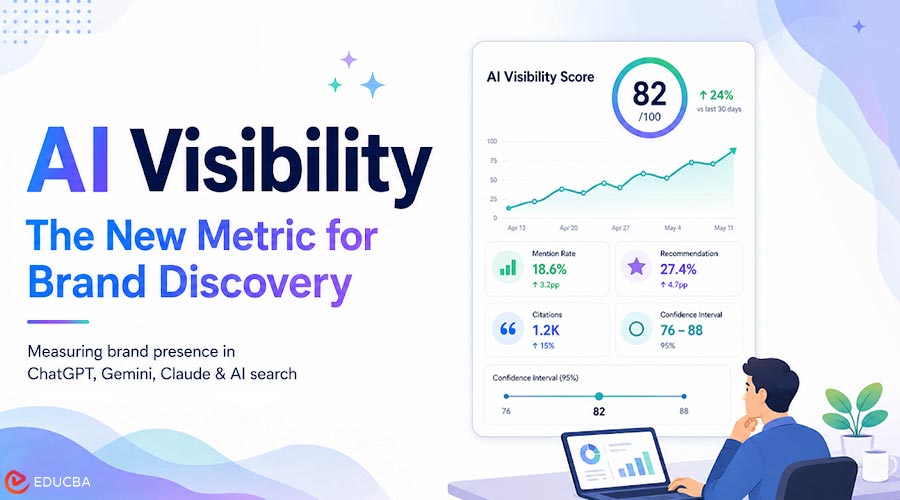
If you have studied digital marketing or analytics in the last fifteen years, you learned to measure visibility in familiar units: search rankings, impressions, share of voice, and click-through rate. These metrics are all based on the traditional customer journey, where users enter a query into a search engine and select a result from a list of links. That assumption is now only partly true. A rapidly growing share of product research happens inside conversational AI: people ask ChatGPT, Gemini, Claude, or Perplexity for a recommendation and act on the answer. As a result, AI visibility has emerged as an important performance indicator for modern businesses.
The AI visibility metric measures how often, how prominently, and how positively AI assistants mention a brand when responding to relevant user queries. For students and analytics practitioners, AI visibility provides a valuable case study in defining, operationalizing, and accurately measuring a new metric without drawing misleading conclusions.
Key Takeaways
- AI visibility measures how frequently and favorably AI assistants mention a brand.
- It deserves its own measurement because generated answers are variable and toned in ways search rankings are not.
- A credible score comes from sampling many prompts across multiple AI models, extracting structured signals such as mentions, position, recommendations, and citations, and aggregating those signals using weighted calculations.
- Because the data is noisy, confidence intervals and significance testing are essential for distinguishing a real trend from statistical noise.
What “AI Visibility” Actually Means?
At its simplest, AI visibility answers a question every brand now asks: When a potential customer asks an AI assistant about a product or service category, does the assistant mention the brand, and if so, does it recommend or dismiss it? AI visibility is the AI-answer-layer equivalent of a search ranking: not a position on a results page, but a measure of your presence and standing inside generated answers.
AI visibility requires its own metric because it behaves differently from traditional SEO. A search engine returns a stable, rankable list. An AI assistant returns a generated answer that can change with phrasing, that names a shifting subset of brands, and that carries a tone (enthusiastic, neutral, skeptical). You cannot capture that with a single rank number.
The Measurement Challenge
One reason AI visibility has become such an interesting analytics topic is that large language models are non-deterministic. Ask the same assistant the same question five times, and you may get five slightly different answers — different brands, different order, different emphasis. That means you cannot measure AI visibility by asking once. A single prompt is an anecdote, not data. To produce a reliable metric, you need a sampling design, much like any survey:
- Define the population of questions: Assemble a fixed, representative set of prompts that reflect the many ways a real user might ask about a category — “best CRM for startups,” “recommend a CRM,” “what CRM should a small business use,” and so on.
- Sample across models and repetitions: Run those prompts against each major assistant, multiple times, on a regular cadence.
- Extract structured signals from each response: Was the brand mentioned? In what position? Was it explicitly recommended? Was the sentiment positive?
- Aggregate into a comparable score: This is the same logic you would apply to any measurement of a noisy, variable phenomenon — and it is why credible AI-visibility tools describe a documented methodology rather than a black box.
Components of an AI Visibility Metric
So what goes into the number on the dashboard? A well-designed AI visibility score combines several distinct components because simply being mentioned is not the same as being recommended first. One common approach to how the score works combines factors such as:
- Mention rate: Across all sampled prompts, how often does the brand appear?
- Position: When it appears, how prominently? Being named first carries more weight than being buried in a long list.
- Recommendation Rate: How often is the brand actively recommended rather than merely listed?
- Citation: In search-enabled modes, is the brand’s own source cited?
The scoring system weights each component and combines them into a single, comparable score that ranks brands within the same industry. If you want the full formula and the reasoning behind the weights, the methodology page is the place to look — and it is a good example, for analytics students, of turning a fuzzy concept into a defensible composite index.
Why Statistical Analysis Matters?
Most casual write-ups skip this part, even though it deserves close attention. Because the underlying data is sampled and noisy, a responsible AI visibility metric must distinguish real changes from random variation.
Imagine a brand’s score ticks up by two points month over month. Is that a genuine improvement, or just the natural jitter of a probabilistic system? Without a confidence interval, you cannot tell — and you will end up celebrating (or panicking over) noise. This is exactly the trap that a solid statistical design avoids: a proper method attaches an uncertainty range to each score and only reports a change as meaningful when it exceeds that range.
You apply the same discipline taught in introductory statistics or data analysis—sampling, aggregation, confidence intervals, and significance testing—to a brand-new domain. For anyone studying data science or analytics, AI visibility is a clean, contemporary example of why those fundamentals matter outside the textbook.
Why AI Visibility Matters for Businesses?
The practical stakes are straightforward. If AI assistants increasingly sit between customers and their purchase decisions, then a brand’s standing inside those assistants becomes a real commercial asset — one that, until recently, nobody was measuring. Tracking it lets a business answer questions it previously could not: Are we gaining or losing ground in AI recommendations? How do we compare to competitors? Did our content and PR efforts actually move the needle?
The first step is simply to establish a baseline — to find out what the models say today. Helloranked offers a free AI visibility checker as an entry point, and once you have a baseline, improving it becomes a measurable, iterative process rather than guesswork.
Final Thoughts
AI visibility represents one of the newest frontiers in digital marketing analytics. As users increasingly rely on ChatGPT, Gemini, Claude, and other AI assistants to discover products and services, businesses need new ways to understand how these AI assistants represent them in AI-generated conversations. Unlike traditional SEO metrics, the AI visibility metric accounts for dynamic recommendations, changing response patterns, and brand sentiment. By using consistent measurement and statistical methods, organizations can track AI visibility, compare competitors, and improve their presence over time.
Recommended Articles
We hope this guide helps you understand AI visibility and its growing importance in digital marketing. Explore these recommended articles to learn more about AI marketing and emerging digital marketing trends.


