


AI Training Data: Overview
The quality of the data utilized for training an Artificial Intelligence (AI) system determines how effective the system will be. For instance, consideration of data is essential during the training of models for recommendation systems, self-driving cars, language translation tools, and other such AI systems. It determines the performance and reliability of the model. This article discusses the various types of AI training data, its sources, and the various challenges that arise during its collection and utilization.
What is AI Training Data?
AI training data is the collection of information utilized to teach a machine learning (ML) model how to perform a specific task. This data serves as the basis for any training an AI system undertakes in the learning process for identification, prediction, or classification of dependent and independent variables. As an illustration, training an AI system to recognize cats in images requires the provision of hundreds of labeled images, both containing and not containing cats. The AI model trains with the data to master the corresponding visual patterns.
Types of AI Training Data
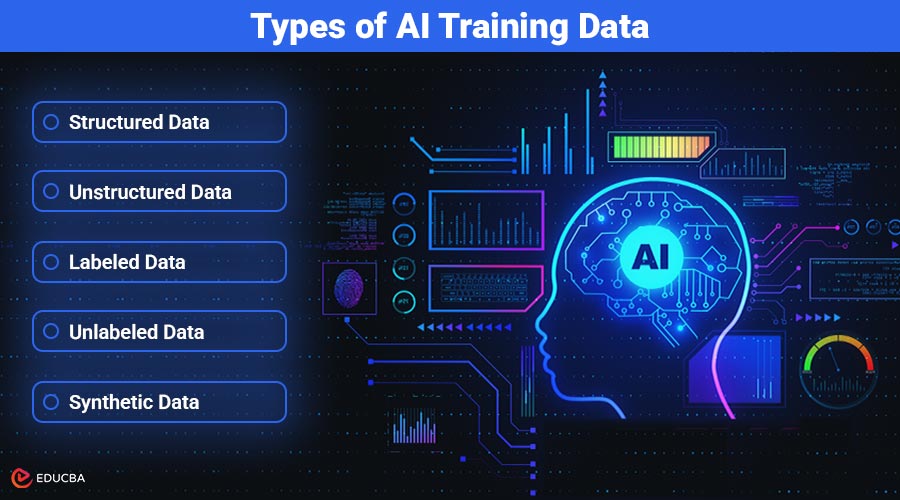
Training data can take on various forms, depending on what you need it for. Here are the main types you should know about:
1. Structured Data
This type consists of well-defined and organized information, like spreadsheets, databases, or tables. It is commonly found in business intelligence and often drives models used for fraud detection, financial forecasting, and customer segmentation.
2. Unstructured Data
Unstructured data is a bit messier; it includes information that does not fit neatly into tables—think text, audio, images, and videos. Examples range from social media posts to video clips and scanned documents. Researchers and developers frequently utilize this kind of data in natural language processing (NLP), computer vision, and speech recognition.
3. Labeled Data
Labeled data comes with tags or classifications, making it perfect for supervised learning. For example, in an image recognition task, each picture might be tagged as “dog,” “cat,” or “car.” This tagging helps the model understand the connections between inputs and the expected outputs.
4. Unlabeled Data
Unsupervised or semi-supervised learning uses unlabeled data that lacks annotations. Clustering algorithms can sift through this data to uncover hidden patterns or groupings.
5. Synthetic Data
Synthetic data is created artificially through algorithms or simulations, often stepping in when real-world data is hard to come by, sensitive, or costly to gather. It is becoming more popular in areas like autonomous driving and medical research.
Sources of AI Training Data
AI training data can come from a variety of sources:
1. Public Datasets
Numerous universities, research institutions, and government agencies make public datasets available for anyone to use. Some well-known examples are ImageNet for image classification, COCO for object detection, and various datasets found on Kaggle.
2. Web Scraping
Market researchers, sentiment analysts, and business intelligence teams often gather data from websites using scraping tools. However, it is important to keep legal and ethical considerations in mind, particularly regarding terms of service and user privacy.
3. User-Generated Data
Many tech companies depend on data generated by their users, such as clicks, purchases, or uploaded content. For instance, social media platforms utilize data from user interactions to train their algorithms.
4. Sensors and IoT Devices
In sectors like transportation and agriculture, sensors, cameras, and connected devices collect data. This information is crucial for real-time analytics and predictive maintenance.
5. Crowdsourcing and Manual Labeling
Platforms like Amazon Mechanical Turk enable companies to outsource data labeling tasks to human workers. This approach is often essential for creating high-quality labeled datasets.
Challenges in AI Training Data
Training data is crucial, but it comes with its fair share of challenges:
1. Data Quality
Noisy, inconsistent, or incomplete data can greatly reduce a model’s accuracy. That is why it is crucial to clean, preprocess, and validate the data to ensure it meets the required standards.
2. Bias and Fairness
If the data has biases, the model will likely mirror those biases, which can lead to unfair or discriminatory results. For instance, facial recognition systems mainly trained on light-skinned faces might struggle to identify darker-skinned individuals accurately.
3. Privacy and Ethics
Gathering and using personal data raises serious privacy concerns. Organizations are required to follow regulations like GDPR, ensuring data is anonymized or collected with proper consent when necessary.
4. Scalability
Training large AI models demands a massive amount of data. Effectively managing, storing, and processing this data at scale requires a strong infrastructure and the right tools.
5. Cost and Labor
Getting high-quality labeled data can be both time-consuming and pricey. In fields like healthcare or law, it often necessitates expert annotations.
Final Thoughts
AI training data is crucial for intelligent systems. Developers, data scientists, and decision-makers need to grasp the different types, sources, and challenges that come with it. The need for high-quality, diversified, and ethically generated training data will only grow as AI develops and becomes a more integral part of our everyday lives. Remember, a well-trained AI does not just start with code; it all begins with the right data.
Recommended Articles
We hope this comprehensive guide to AI training data helps you understand its types, sources, and challenges. Check out these recommended articles for more insights and strategies to improve your AI projects.


