


Updated July 27, 2026
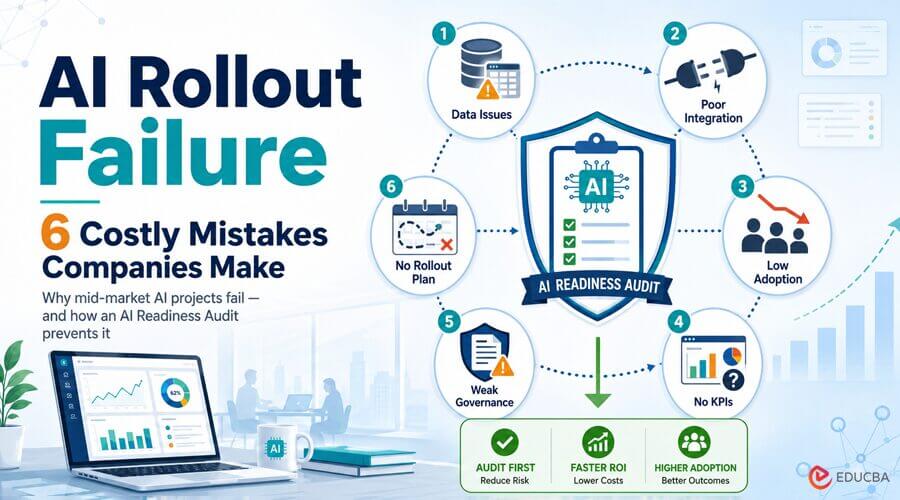
The Pattern Nobody Wants to Admit
Most AI rollout failures in mid-market companies do not stem from bad technology. They happen because of bad preparation.
The tools were fine. The vendor demos looked great. However, six months in, adoption was low, results were thin, and leadership was frustrated.
This article breaks down exactly what went wrong and what an AI Readiness Audit would have caught before the first dollar was spent.
Key Takeaways
- Most mid-market AI rollout failures trace back to skipped preparation, not to bad tools.
- Data problems, skills gaps, and integration issues are the three most common root causes
- A structured audit surfaces these blockers before deployment, not after
- Companies that audit first consistently see faster ROI and higher adoption rates
- An AI Readiness Audit is the difference between a rollout and a result.
The Pattern Nobody Wants to Admit About AI Rollout Failure
The uncomfortable truth is that most AI rollout failure scenarios follow a predictable pattern. Leadership approves an AI initiative, a vendor is selected, and deployment begins before the company has assessed whether it is actually ready.
By the time problems become visible, the budget has already been spent, teams have lost confidence, and the AI initiative is labeled a failure.
Failure Pattern #1: The Data Was Never Ready
This is the root cause of more AI rollout failures than any other single issue.
The company had data. Plenty of it. However, it was scattered across four systems, maintained by three different teams, and formatted differently across sources.
The AI model trained on that data produced outputs no one could trust.
What the data landscape looked like before the rollout:
| Data Source | Problem Found | Impact |
| CRM | Duplicate records, 30% missing fields | Skewed customer predictions |
| ERP | Inconsistent product codes across years | Broken inventory models |
| Marketing Platform | No historical data before 2021 | Insufficient training volume |
| Finance System | Manual entry errors throughout | Corrupted cost analysis outputs |
No AI tool can perform reliably on data like this. A proper AI Readiness Audit evaluates data quality before deployment and identifies exactly what must be cleaned, standardized, and prioritized to prevent AI rollout failure.
Failure Pattern #2: The Tools Did Not Fit the Stack
The AI vendor gave an impressive demo. In the demo environment, everything connected seamlessly.
In the real environment, the tool could not pull data from the company’s on-premise ERP. The API integration took four months. By then, the team had lost interest.
Common stack incompatibilities that kill rollouts:
- Legacy on-premise systems with no API or outdated API standards
- Cloud tools that require data residency the company cannot meet
- No single source of truth for the AI tool to pull from reliably
- Security and access controls that block the integrations the tool needs
- Vendor contracts that restrict data sharing with third-party AI platforms.
A tool that works in a demo environment and fails in yours is not a vendor problem. It is a readiness problem.
An audit maps your integration landscape first, so you evaluate tools against your actual environment rather than a hypothetical one.
Failure Pattern #3: Nobody Trained the People
The software was deployed. The training session was one hour long. The recording was uploaded to a shared drive nobody checked.
Three months later, fewer than 20% of the intended users were actively using the tool. This is one of the clearest signs of AI rollout failure: the technology exists, but the people do not adopt it.
The adoption killers found most often:
- No change management plan before or during rollout
- No internal AI champion to drive adoption at the team level
- Training that covered features rather than real daily workflows
- No feedback loop for employees to report problems or confusion
- Leadership that mandated the tool without explaining the business reason.
Buying AI is a technology decision. Getting people to use it is a culture decision. A readiness assessment identifies adoption risks before deployment begins, helping companies avoid AI rollout failure caused by poor change management.
Failure Pattern #4: There Was No Success Metric
When the six-month review arrived, nobody could agree on whether the rollout had worked.
Sales said it helped. Finance said it was hard to measure. Operations said it created extra work. Leadership wanted a number and nobody had one.
Signs a rollout had no real success framework:
- No baseline metrics captured before deployment
- No defined KPIs tied to business outcomes
- No reporting structure for tracking AI performance
- AI impact buried inside broader team metrics
- No timeline for when ROI was expected.
You cannot optimize what you never measured. You cannot justify what you never defined. An AI Readiness Audit forces the success-definition conversation before deployment, preventing AI rollout failure caused by unclear expectations.
Failure Pattern #5: Governance Was an Afterthought
The AI tool went live in the customer service department. Three weeks later, a customer complained that an AI-generated response contained inaccurate information about their account.
Nobody knew who owned the issue. Nobody knew how to roll back the output. Nobody had documented what the tool was allowed to do. This is a dangerous form of AI rollout failure because it can damage customer trust and create legal risk.
Governance gaps that appeared after the fact:
| Governance Area | What Was Missing |
| Output Review Process | No human-in-the-loop for high-stakes decisions |
| Incident Ownership | No designated AI system owner |
| Vendor Liability | No clause covering AI errors in the contract |
| Bias Monitoring | No process to check outputs for discriminatory patterns |
| Employee Policy | No guidelines on what staff could share with AI tools |
Governance feels like overhead until something goes wrong. Then it feels like the only thing that mattered.
Failure Pattern #6: The Strategy Was “Start and See What Happens”
There was no phased plan. No prioritized use case. No cross-functional steering committee.
The decision was made in a leadership meeting, a vendor was selected, and deployment began six weeks later. The rollout touched too many departments at once, created competing priorities, and collapsed under its own weight. This is one of the most preventable forms of AI rollout failure.
What a structured rollout plan looks like instead:
Phase 1: Audit and Prioritize (Weeks 1 to 4)
Complete the AI readiness assessment. Identify the one or two use cases with the highest impact and lowest deployment risk.
Phase 2: Pilot with Measurement (Weeks 5 to 12)
Deploy in one department with a clear KPI, a feedback loop, and a defined success threshold.
Phase 3: Evaluate and Expand (Months 4 to 6)
Review pilot results against baseline metrics. Scale to additional departments only after the pilot validates the approach.
A rollout without a roadmap is not a strategy. It is a guess with a budget attached.
What the Companies That Got It Right Did Differently?
The mid-market companies that report strong AI results share a consistent pattern.
They did not start with a tool. They started with an honest assessment of where they stood.
The audit-first difference in practice:
| Approach | Avg. Time to Positive ROI | Avg. Adoption Rate at 6 Months |
| No Audit, Direct Deployment | 18 to 36 months | Under 30% |
| Lightweight Self-assessment | 12 to 18 months | 40 to 50% |
| Structured AI Readiness Audit | 3 to 9 months | Over 70% |
The audit does not add time to the process. It removes the time wasted on the wrong decisions and dramatically reduces the risk of AI rollout failure.
The Most Honest Question to Ask Right Now
Before your next AI initiative, before the next vendor demo, before the next leadership presentation on AI strategy, answer this question honestly:
Do you know exactly where your organization stands in terms of data quality, integration capability, team skills, and governance readiness?
If the answer is no, an audit is the right next step. Not a new tool, not a new vendor, and not another pilot built on an unstable foundation.
Final Thought
A lack of innovation does not cause most AI rollout failure stories. A lack of readiness causes them.
The companies that succeed with AI are not necessarily the ones with the biggest budgets or the most advanced tools. They are the ones that take the time to understand their data, systems, people, governance, and success metrics before deployment begins.
An AI Readiness Audit is not an extra step in the process. It is the foundation that turns an AI rollout into a measurable business result.
Frequently Asked Questions (FAQs)
Q1. How do I know if my previous AI rollout failed because of readiness issues?
Answer: Look for three signals: low adoption rates after 90 days, inability to measure ROI, and integration problems discovered after deployment. All three point to a readiness gap an audit would have caught.
Q2. Is it too late to run an AI Readiness Audit after an AI rollout failure?
Answer: No. An audit after a failed rollout helps diagnose exactly what went wrong and what needs to be fixed before the next attempt. It is actually one of the most valuable times to run one.
Q3. How long does it take to fix the gaps an audit uncovers?
Answer: It depends on the gap. Data quality fixes typically take 60 to 90 days. Integration upgrades can take 3 to 6 months. Skills training can begin immediately and show results within 30 days.
Q4. What if leadership does not want to delay the next AI project for an audit?
Answer: Frame the audit as acceleration, not delay. A 3- to 4-week audit reduces the risk of an 18-month failed deployment. The business case for that tradeoff is straightforward.
Q5. Can an AI Readiness Audit be run while an existing AI project is in progress?
Answer: Yes. An audit running in parallel with an active deployment can surface mid-course corrections before the rollout reaches a point of no return.
Q6. Who should be involved in an AI Readiness Audit from our side?
Answer: At minimum: IT or engineering leadership, a department head from the primary use case area, a finance or operations representative, and someone with HR or change management oversight.
Recommended Articles
We hope this guide helps you understand the most common causes of AI rollout failure and how an AI Readiness Audit can prevent costly mistakes before deployment. Explore these recommended articles for more insights into AI implementation, digital transformation, data governance, change management, and enterprise AI strategy.


