


Updated August 31, 2026
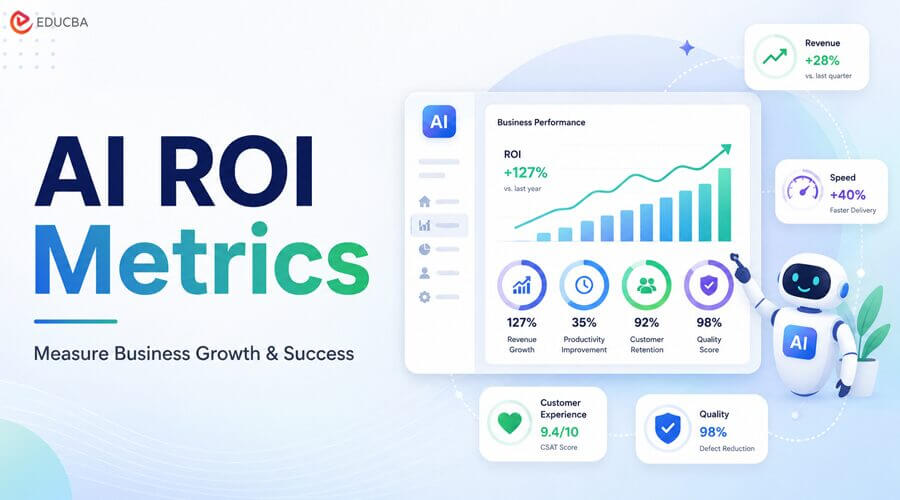
When leaders ask, “What is the ROI on our AI investment?” the answer almost always starts and stops at cost savings. How many hours did we cut? How many roles did we automate? How much did we shave off support tickets? Cost savings are easy to count, which is exactly why they dominate the conversation. However, they measure only half the equation: how much cheaper the business became. They say nothing about how much better, faster, or more valuable it became. A company can automate its way to a leaner cost base while its revenue, customer loyalty, and competitive position quietly stall. The organizations pulling real, durable returns from AI have shifted their scorecards. They still track efficiency, but they weight it against a broader set of AI ROI metrics that capture growth, quality, speed, and experience.
Here are the AI ROI metrics that actually matter and how to measure them.
1. Revenue Impact, Not Just Expense Reduction
The most overlooked AI ROI metric is incremental revenue: the sales you would not have closed without AI in the loop. This shows up as higher conversion rates, larger average order values, better upsell and cross-sell rates, and shorter sales cycles.
The reason it gets ignored is attribution. Revenue lift is harder to isolate than a headcount reduction. However, it is also where the bigger number usually lives. A recommendation engine that lifts conversion by two points, or a lead-scoring model that helps sales focus on the right accounts, can dwarf the savings from automating a back-office task.
“We stopped judging AI by how much it saved us and started judging it by how much it earned us. When we layered AI-driven product recommendations and smarter merchandising into the funnel, the metric that moved was not payroll. It was revenue per session and repeat purchase rate. Cost savings are a footnote next to a durable lift in customer lifetime value.” Rafael Sarim Oezdemir, Head of Growth at EZContacts.
How to measure it: Run holdout or A/B tests where one segment gets the AI-driven experience and a control group does not. The revenue delta between them, not a top-line correlation, is your defensible number.
2. Cycle Time and Time-to-Value
Speed compounds. When AI cuts the time to produce a proposal, close the books, resolve a ticket, or ship a campaign, you do not just save labor. You free capacity to do more, respond faster, and capture opportunities before competitors do.
Track cycle time (how long a process takes end to end) and time-to-value (how quickly a new initiative starts producing results). A marketing team that goes from two weeks to two days on creative production is not just cheaper; it can test more ideas, react to trends in real time, and learn faster than anyone stuck on the old clock.
“In performance creative, velocity is the ROI. AI lets us go from a handful of ad concepts a week to dozens, which means we find the winning creative faster and kill the losers before they burn budget. The metric I care about is not ‘hours saved on production.’ It is how many creative iterations we can test per dollar and how quickly we reach a profitable ad. Speed to a winning concept beats cost per concept every time.” Cody Schuiteboer, president and CEO of Best Interest Financial.
How to measure it: Baseline your process time before AI, then track the reduction. Multiply reclaimed time by throughput (more campaigns, more proposals, more tests) rather than only by hourly cost.
3. Output Quality and Error Reduction
Faster and cheaper mean nothing if quality drops. The best AI deployments improve consistency, meaning fewer errors, less rework, and more standardized output, which protects revenue and reputation in ways a cost dashboard never captures.
Measure error rates, rework frequency, defect rates, and quality-assurance pass rates before and after deployment. In client-facing and service businesses especially, a mistake caught early or avoided entirely is worth far more than the minutes it took to prevent.
“In renovation and interior design, a small error early, like a wrong measurement or a misread client brief, turns into an expensive problem on site. We use AI to catch inconsistencies, generate design options quickly, and keep documentation tight. The return is not the design hours we save. It is the costly mistakes we do not make and the trust we keep with clients because the work is right the first time.” Kur Win Lau, Founder of My Reno Service.
How to measure it: Track defects or revisions per project and the cost of rework. A drop in error-related costs is real ROI that rarely shows up in a “savings” line item.
4. Customer Experience and Retention
AI that speeds response times, personalizes interactions, and resolves issues on the first contact drives satisfaction, loyalty, and retention. Moreover, retaining existing customers costs much less than finding new ones, and loyal customers tend to spend more over time.
Watch CSAT, Net Promoter Score, first-contact resolution rate, response time, and, most importantly, churn and retention. A support bot that deflects tickets looks like cost savings; a support experience that keeps customers renewing is worth multiples more.
“For a rental business, the whole model lives on repeat customers and reliability. AI helps us respond instantly, match the right hardware to the right customer, and stay ahead of issues before they become complaints. I do not measure that in support salaries saved. I measure it in retention and the rebooking rate. A customer who comes back three times is the real return, and experience is what brings them back.” Luca Dal Zotto, Co-Founder of Rent a Mac.
How to measure it: Tie AI-touched interactions to downstream retention and repeat-purchase behavior. The lift in customer lifetime value is your ROI, not the reduction in support hours.
5. Employee Productivity and Capacity Reallocation
The point of automating low-value work is not only to spend less. It is to redirect skilled people toward work that grows the business. The metric that matters is where reclaimed time goes. Time freed and then wasted is not a return. Time freed and reinvested into strategy, selling, or building is.
Track output per employee, capacity reallocated to high-value work, and adoption rates (AI you paid for, but no one uses returns nothing).
“The mistake I see is companies buying AI tools, saving people a few hours, and letting those hours evaporate. We treat reclaimed time as inventory to reinvest. When AI takes over reporting and routine outreach, that capacity goes straight into pitching, strategy, and client work that actually generates revenue. ROI is not the hours saved. It is what those hours produce once they are pointed at growth.” Mark Voronov, CEO & Co-Founder at Uproas.
How to measure it: Measure output per head before and after, and explicitly track whether freed hours are reinvested into revenue-generating activity. Pair this with an adoption rate to ensure the tool is actually being used.
6. Decision Speed and Quality
AI’s quiet advantage is helping people make faster, better decisions by surfacing insights from data that would otherwise go unread. Faster, better-informed decisions mean capturing opportunities and correcting course before small problems compound.
Measure time-to-insight (how long from question to answer), decision cycle time, and forecast accuracy. These are harder to quantify than a payroll line, but often where the largest strategic returns hide.
How to measure it: Track how long key decisions take and how often forecasts hold up, before and after AI-assisted analytics. Improvements in accuracy and speed translate into fewer costly misses.
Building an AI ROI Metrics Scorecard That Holds Up
A credible AI ROI metrics framework balances four dimensions instead of one:
- Efficiency: cost and time saved (the traditional view)
- Growth: incremental revenue, conversion, retention, and customer lifetime value
- Quality: error reduction, consistency, and rework avoided
- Experience: customer satisfaction and employee capacity reinvested in high-value work
To make the number defensible, follow three principles:
- Baseline first: You cannot prove improvement without a clear “before.” Capture your AI ROI metrics prior to deployment.
- Isolate the AI effect: Use control groups, holdouts, or A/B tests to measure AI’s contribution rather than the general trend.
- Track total cost of ownership: Factor in licensing, integration, training, oversight, and maintenance, not just the sticker price, so your return reflects reality.
Final Thoughts
Cost savings are the easiest AI ROI metrics to calculate and the least complete. They tell you the business got cheaper; they do not tell you it got stronger. The companies winning with AI measure revenue lift, cycle time, quality, retention, reinvested capacity, and decision speed, then hold those gains against the full cost of ownership.
The most effective AI ROI metrics go beyond efficiency to measure growth, quality, customer experience, and long-term business value. Efficiency keeps you in the game. Growth, quality, and experience are what actually move the return. Measure all four, and you will finally know whether your AI investment is paying off, not just whether it is costing you less.
Recommended Articles
We hope this guide helps you understand the AI ROI metrics that matter most and measure the true business impact of your AI investments. Explore these recommended articles for more insights into AI strategy, business automation, digital transformation, and AI performance measurement.


