


Updated October 15, 2026
What Is AI Agent Memory?
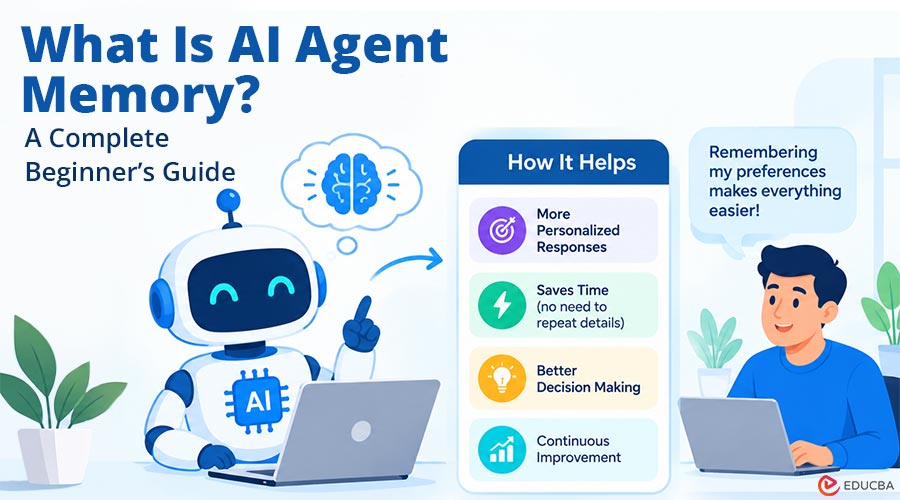
AI agent memory is the ability of an AI agent to store, retrieve, and use information from previous interactions, experiences, and tasks to improve future decisions.
Unlike traditional chatbots that primarily respond to the current prompt, AI agent memory can include information such as:
- Previous conversations
- User preferences
- Past actions and decisions
- Task-related information
- Important facts
- Feedback from users
- Environmental or application state
- Results from previous tool calls
For example, a travel-planning agent may remember that a user prefers budget-friendly hotels, avoids early-morning flights, and usually travels for business. When the user requests another trip later, the agent can use this information rather than asking the same questions again.
How AI Agent Memory Works?
An AI agent memory system typically follows a series of steps to transform interactions into useful information.
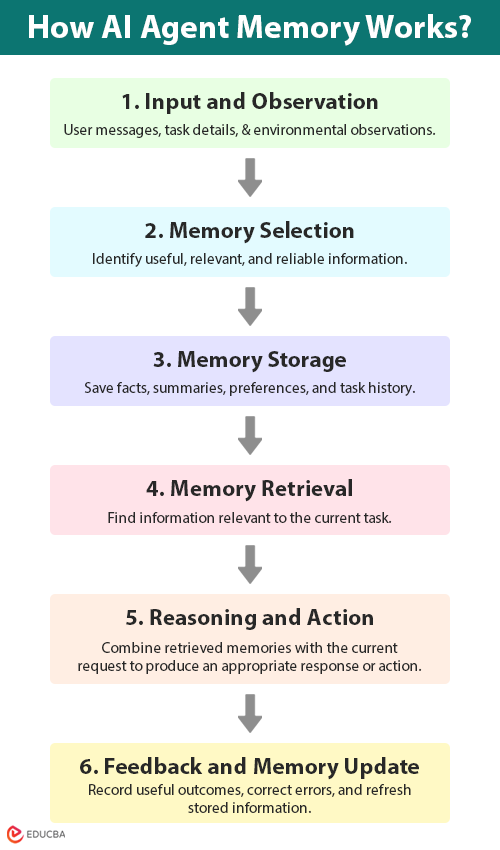
Step 1: Input and Observation
The agent receives information from user prompts, conversations, documents, tool results, and task outcomes. Not every detail should be stored. A memory system should identify information likely to be useful later.
Step 2: Memory Selection
Relevant information is organized into a suitable format. It may be stored as structured records, summaries, factual statements, event histories, or vector embeddings. For example, the system could summarize a long conversation into a concise record of the user’s project goals and preferences.
Step 3: Memory Storage
The system saves information in an appropriate storage layer. Temporary context may remain in the active session, while persistent information may be stored in a database or external memory service.
Step 4: Memory Retrieval
When a new task arrives, the agent searches for information relevant to the request. Retrieval may use keywords, metadata filters, semantic similarity, timestamps, or a combination of methods.
Step 5: Reasoning and Action
The agent combines retrieved information with the current request and results from available tools. It then uses this context to plan its next action.
Step 6: Memory Updating
After completing a task, the system may add new information, update an existing memory, remove outdated details, or record the outcome.
Types of AI Agent Memory
AI agent memory can be organized into several categories depending on how it retains and uses information.
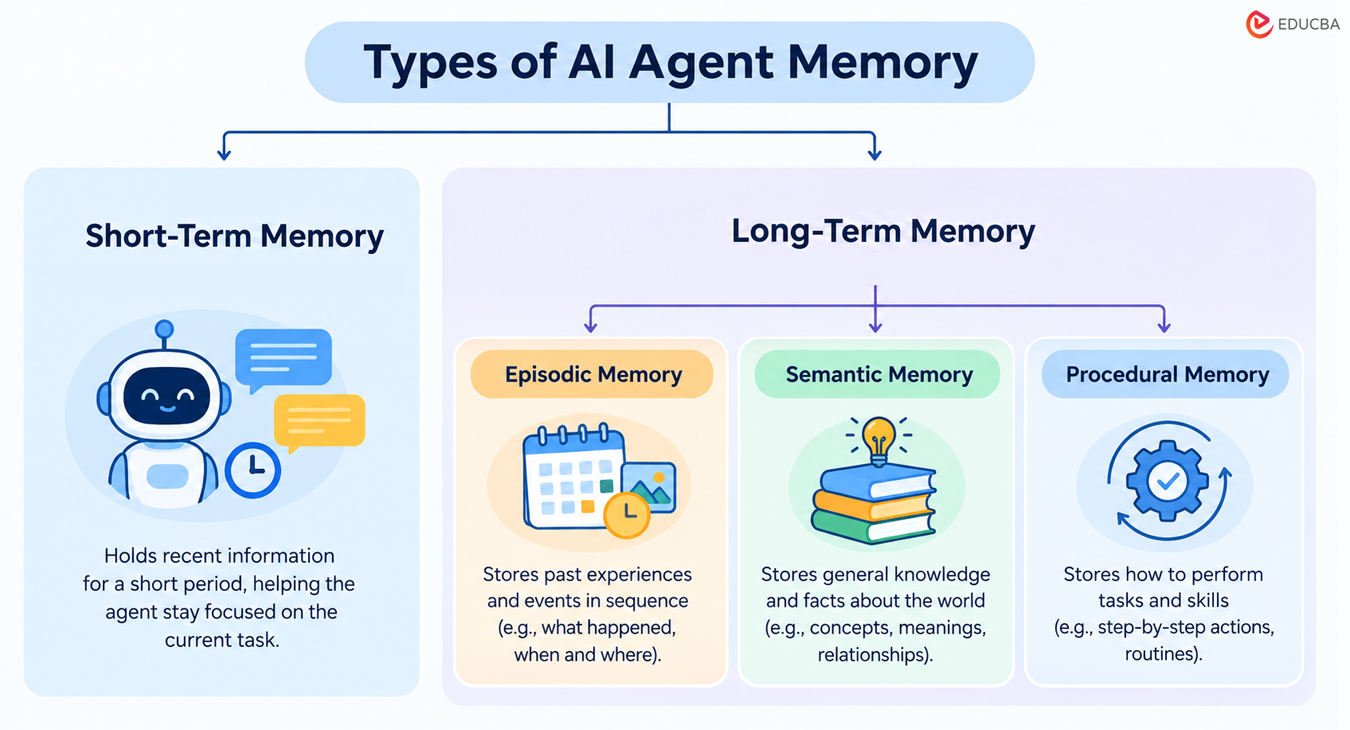
1. Short-Term Memory
Short-term memory contains information from the current interaction or immediate task.
For example, during a conversation about creating a presentation, the agent may remember the requested topic, number of slides, target audience, and preferred format. This type of memory is often closely related to the model’s context window.
Best suited for:
- Current conversations
- Immediate instructions
- Multi-step tasks
- Temporary context
The main limitation is that context windows have finite capacity.
2. Long-Term Memory
Long-term memory stores information that remains useful beyond the current conversation.
Examples include:
- User preferences
- Important historical facts
- Previous task outcomes
- Frequently used settings
- Long-term project information
Long-term memory is typically stored outside the model itself and retrieved when relevant.
a. Episodic Memory
Episodic memory records specific past events or interactions.
For example:
“The user previously rejected three hotel options because they were too far from the city center.”
An agent can use this event later to avoid repeating the same mistake.
b. Semantic Memory
Semantic memory stores general knowledge and facts, not specific events.
For example:
“The user prefers hotels close to public transportation.”
This information can be derived from multiple previous interactions and be used across different tasks.
c. Procedural Memory
Procedural memory retains knowledge of the steps and processes required to perform specific tasks.
For example:
“An AI coding agent might retain a project’s preferred testing process or deployment workflow.”
Procedural memory can help agents follow established processes consistently.
How AI Agents Store Memory?
The best storage approach depends on the information type and scale.
1. Vector Databases
Vector databases store numerical representations of information called embeddings. Agents can retrieve memories based on semantic similarity rather than exact keyword matches. For example, a query about “affordable flights” could retrieve a memory stating that the user generally prefers low-cost travel options, even if the words differ.
2. Traditional Databases
Relational or document databases are useful for structured information such as:
- Customer profiles
- Account settings
- Transaction records
- Task status
- Project metadata
3. Knowledge Graphs
Knowledge graphs represent relationships between entities. They help an agent understand connections between people, projects, organizations, products, or events.
AI Agent Memory vs. RAG
AI agent memory and Retrieval-Augmented Generation (RAG) both help AI systems access relevant information, but they serve different purposes. It retains information about previous interactions, experiences, preferences, and task progress, while RAG retrieves relevant information from external knowledge sources to generate accurate, context-aware responses.
| Feature | AI Agent Memory | Retrieval-Augmented Generation (RAG) |
| Primary Purpose | Maintains context across tasks and interactions | Provides relevant information from external knowledge sources |
| Information Stored | User preferences, past actions, experiences, and task history | Documents, knowledge bases, reports, and other reference materials |
| Data Sources | Conversations, agent actions, feedback, and observations | Internal documents, databases, websites, and indexed content |
| Retrieval Method | Uses memory lookup, metadata, semantic search, or structured queries | Commonly uses semantic search, keyword search, or hybrid retrieval |
| Typical Use Cases | Personal assistants, workflow automation, and multi-step AI agents | Document question answering, customer support, and enterprise knowledge search |
| Data Updates | Memories are added, modified, summarized, or deleted as needed | Knowledge indexes are refreshed when source documents change |
| Key Limitation | May retain outdated, incorrect, or irrelevant information | May retrieve irrelevant passages or miss important source information |
Example: An AI customer support agent may use memory to recall a customer’s previous complaint and troubleshooting attempts. It can use RAG to retrieve the latest product manual and warranty policy before recommending a solution.
Challenges of AI Agent Memory
Although memory makes AI agents more capable, implementing it introduces several challenges.
- Incorrect information: Agents may store inaccurate facts or retrieve outdated information, leading to unreliable responses.
- Memory overload: Saving too much information can increase storage costs and make retrieval less efficient.
- Context limitations: Even when information is stored externally, only a limited amount may fit into the model’s active context at a time.
- Privacy and security: Stored conversations and user details can expose sensitive information if access controls and retention policies are inadequate.
- Retrieval errors: A memory system may return irrelevant information or fail to find a useful record.
- Maintenance complexity: Memories need appropriate policies for updating, deduplication, expiration, and deletion.
Another important distinction is that memory does not automatically improve an AI model’s underlying parameters. An agent can retrieve stored information without retraining the model, and access to past experiences does not guarantee that it will learn from its mistakes.
Best Practices for Building AI Agent Memory
Organizations and developers can improve memory reliability by following these practices:
- Store relevant information selectively: Prioritize details likely to help with future tasks rather than retaining every interaction.
- Choose the right storage method: Use structured databases for exact facts, document stores for source material, and vector databases when semantic retrieval is useful.
- Retrieve information based on relevance: Consider the current task, timestamps, metadata, and source reliability when selecting memories.
- Update outdated records: Provide mechanisms to correct conflicting information, remove duplicates, and expire temporary details.
- Protect user information: Apply access controls, encryption where appropriate, data minimization, and clear retention and deletion policies.
- Evaluate memory quality: Test whether the agent retrieves accurate information, respects user preferences, and avoids using irrelevant or outdated context.
A well-designed memory system balances useful retention with accuracy, efficiency, privacy, and control.
Final Thoughts
AI agent memory lets intelligent agents maintain continuity, personalize interactions, learn from previous experiences, and manage tasks that extend beyond a single conversation. It can combine short-term context with long-term information stored in databases, vector stores, knowledge graphs, or other memory systems.
However, effective memory is not simply about storing more data. Reliable retrieval, memory accuracy, privacy, security, relevance, and lifecycle management matter just as much. As AI agents move toward more autonomous workflows, well-designed memory systems will play a central role in making those agents more useful, consistent, and context-aware.
Recommended Articles
We hope this comprehensive guide to AI agent memory helps you understand how intelligent agents store, retrieve, and use information. Check out these recommended articles for more insights into AI technologies, intelligent automation, and the future of AI-driven applications.


