


Updated January 13, 2026
Advantages and Disadvantages of Monarchy – Introduction
In a world where democratic systems dominate modern governance, several countries still operate under monarchies. From the United Kingdom and Japan to Thailand and Jordan, this ancient form of rule continues to shape political structures, national identities, and cultural traditions. Understanding the advantages and disadvantages of monarchy is essential to evaluating whether this system remains relevant in today’s society. While a monarchy can offer stability, unity, and continuity, it also raises concerns about equality, accountability, and public participation.
This article explores both sides of monarchy by examining its key benefits and limitations, supported by real-world examples, to help you gain a balanced and informed perspective on this enduring system of governance.
Historical Context of Monarchy
Monarchy is one of the oldest forms of governance in human history. Monarchy dates back thousands of years in ancient civilizations, where kings, queens, pharaohs, and emperors ruled with absolute authority over their lands. Early monarchs often claimed their authority as divinely ordained, linking political rule with religious legitimacy.
Over time, monarchy evolved in different parts of the world:
- Absolute Monarchies emerged, in which rulers held unchecked authority, such as Louis XIV of France.
- Constitutional monarchies emerged later, primarily in Europe, where constitutions or parliaments limited the monarch’s powers, as in the United Kingdom.
- Some monarchies, such as elective monarchies, allowed leaders to be chosen by a council or other body rather than through hereditary succession, as seen historically in the Holy Roman Empire.
Today, most monarchies are constitutional, serving primarily ceremonial and symbolic roles while democracy governs political decisions. However, the legacy of monarchy continues to influence culture, law, and national identity in many countries.
Current Monarchies Around the World
Despite the global shift toward democratic governance, monarchies persist in several countries. These monarchies differ in structure, authority, and political influence, and scholars broadly classify them as constitutional, absolute, or semi-constitutional monarchies.
1. Constitutional Monarchies
In constitutional monarchies, the monarch serves as a ceremonial head of state, while elected officials exercise executive power.
Examples:
- United Kingdom
- Japan
- Sweden
- Norway
- Netherlands
- Spain
- Thailand
These countries balance tradition with democracy by limiting royal powers through constitutions or parliamentary systems.
2. Absolute Monarchies
Absolute monarchies grant the monarch extensive political authority, with limited or no constitutional constraints.
Examples:
- Saudi Arabia
- Brunei
- Oman
- Qatar
- Eswatini
In these nations, the monarch plays a direct role in lawmaking, governance, and national policy.
3. Semi-Constitutional Monarchies
These monarchies share power between the monarch and an elected government, with the monarch retaining significant influence.
Examples:
- Morocco
- Jordan
- Kuwait
Here, monarchs actively participate in political decision-making alongside democratic institutions.
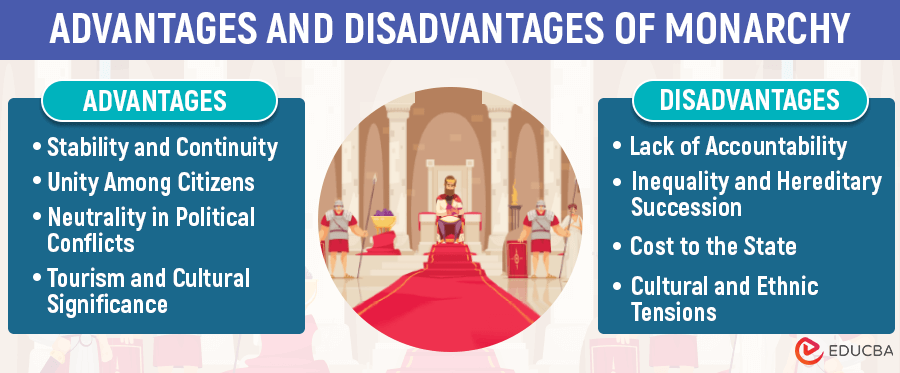
Advantages of Monarchy
1. Provides Stability and Continuity
Countries under monarchies are often more stable and have continuity in government. This is because the head of state remains unchanged over long periods.
2. Promotes Unity Among Citizens
Monarchs often serve as symbols of national unity, helping to bring people together across different regions and demographics.
3. Constitution Limits Negative Use of Power
Many modern monarchies are constitutional, meaning they have a constitution that limits the monarch’s powers, ensuring a system of checks and balances.
4. Improves Tourism and Preserves Culture
Monarchies are often known to preserve cultural heritage, thereby attracting tourists and contributing to the economy.
5. Provides Diplomatic Advantages
Monarchs can act as diplomatic figures and goodwill ambassadors, fostering international relations.
6. Expertise and Training Assist in Effective Governance
Monarchs often receive extensive training and education in the responsibilities of their office, enabling them to govern effectively.
7. Allows Long-term Planning
Monarchs can plan for the long-term benefit of their nation, as they do not face re-election pressures.
8. Maintains Neutrality in Political Conflicts
Monarchs often remain neutral in political disputes, thereby helping to mitigate conflict in their countries.
Disadvantages of Monarchy
Let’s look at some of the disadvantages of monarchy:
1. Lack of Accountability
Some monarchs may lack accountability, leading them to make decisions without public input and potentially to rule like dictators.
2. Inequality and Hereditary Succession
Monarchies often select the next ruler through hereditary succession, thereby perpetuating social and economic inequalities.
3. Potential for Tyranny
Monarchs can become oppressive rulers, undermining human rights and silencing opposing voices.
4. Limited Representation
Monarchies can limit citizens’ representation and participation in the political process.
5. Cost to the State
Maintaining a monarchy can be expensive, with taxpayers often funding the royal family’s lifestyle and official duties.
6. Dynastic Struggles
Hereditary monarchies can lead to power struggles within royal families, thereby destabilizing the nation.
7. Gender Inequality
Many traditional monarchies favor male heirs over female heirs, perpetuating gender inequality.
8. Cultural and Ethnic Tensions
Sometimes, monarchies can heighten tensions between cultural and ethnic groups when the ruling monarch represents only one segment of the population.
These were the top advantages and disadvantages of a monarchy.
Final Thoughts
Monarchy continues to shape governance in several countries, even as democratic systems dominate the modern world. As discussed, the system offers notable advantages, including political stability, national unity, cultural preservation, and long-term planning. At the same time, it presents serious challenges, including limited accountability, social inequality, high public costs, and the risk of authoritarian rule.
Understanding the advantages and disadvantages of monarchy allows citizens and policymakers to evaluate whether this form of governance aligns with contemporary values of fairness, representation, and transparency. Ultimately, a monarchy can function effectively when balanced by constitutional limits and public oversight; without these safeguards, it may impede democratic participation and social progress.
Recommended Articles
We hope you found this article on the advantages and disadvantages of monarchy helpful. Refer to the following recommendations to view similar articles.

