


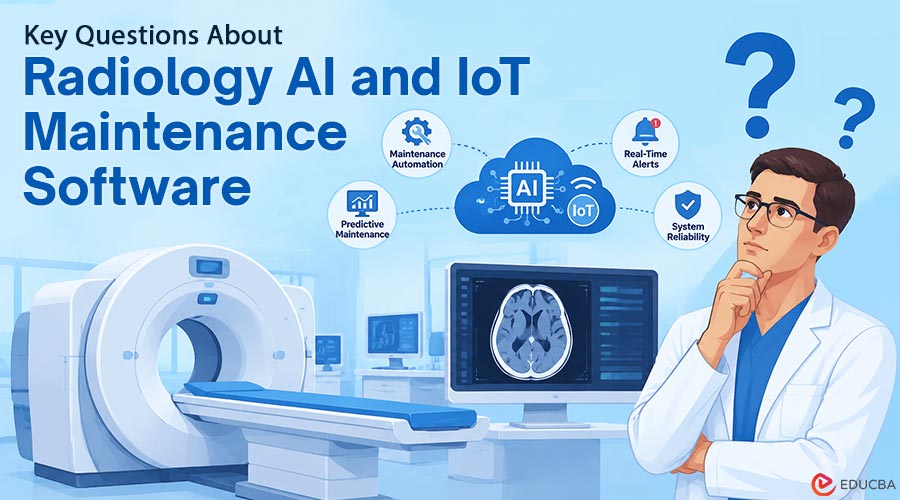
If you run a hospital, an imaging center, or a medical device business, you have probably thought about adding AI to your radiology workflow or using connected sensors to keep your equipment running. Many teams hold back because they are not sure the new software will work with what they already have, or they worry about patient data, cost, and time. These concerns are understandable. Implementing Radiology AI and IoT Maintenance software requires careful planning, particularly when existing healthcare infrastructure and critical medical equipment are involved.
This article covers the questions we hear most often about radiology reporting software, AI radiology software, and IoT predictive maintenance solutions, and gives plain answers so you can decide what makes sense for you.
Q1. Will the Software Work With Your Current PACS, RIS, and EHR?
Yes, if it is built properly. This is usually the first worry, because most hospitals already have a PACS, a RIS, and an EHR, and nobody wants a new tool that sits on its own. Well-built radiology reporting software connects to these systems using healthcare standards such as HL7 and FHIR. It pulls the patient and order details in, opens the right images, and sends the finished report back to the EHR without anyone retyping it.
Integration engines like Mirth Connect or Iguana often manage these links, and common EHRs such as Epic, Oracle Health (Cerner), and Meditech can all connect this way. The real question to ask any development partner is how many of these integrations they have actually delivered, and whether they can show you one that is live.
Q2. Can AI Radiology Software Replace Radiologists?
No. AI radiology software helps radiologists, and it works best when it stays in the background. When a new study comes in, the software runs a model on it and sends the result back as a structured report, an image overlay, or a worklist change that moves an urgent case to the top. The radiologist still reads the study and makes the final decision. AI just helps them see the most urgent cases first and spot things worth a second look.
You also do not have to build every model yourself. Many hospitals use a mix of models from AI marketplaces and their own models built on tools like MONAI, PyTorch, or TensorFlow. The key part is the layer that runs these models and displays the results within the radiologist’s normal workflow. If they have to open a separate app, they probably would not use it.
Q3. Is Patient Data Safe When Using Cloud-Based Radiology AI and IoT Maintenance Software?
It can be, as long as the system is set up correctly. Data security is a serious concern when images and reports move to the cloud. Still, the major cloud providers, including AWS, Azure, and Google Cloud, offer HIPAA-eligible setups for healthcare data. Your development partner should set up the system in these environments with a Business Associate Agreement (BAA) in place.
Other safeguards to ask about include de-identifying DICOM data used for AI training or research, keeping audit logs of who viewed what, and following the privacy rules in every country you work in, such as GDPR in Europe.
Q4. Does Radiology AI Software Need FDA Clearance?
Regulatory requirements depend on the software’s intended functionality. If it makes clinical claims, such as identifying or detecting diseases, it may require FDA clearance in the US or CE marking in Europe. That clearance belongs to the product owner, which means your company, not the software developer.
A good partner can help by preparing the technical and cybersecurity documents regulators expect, but you should plan for this step from the start if your product will need it. It is one of the most common reasons medical software projects get delayed, so it is better to raise it early.
Q5. Can Older Imaging Equipment Use IoT Predictive Maintenance?
Yes, in many cases. Many teams assume IoT predictive maintenance solutions only work with brand-new machines, but that is rarely the case. You can add sensors to track temperature, vibration, power use, or helium levels, and gateways can connect older machines that use industrial protocols like Modbus or OPC UA to the cloud. Edge devices can also process data on site, so the system keeps working even when the network is slow.
The software then watches for patterns that suggest a part is wearing out and sends an alert before the machine breaks down. That gives your team time to plan a repair overnight or on a weekend, instead of canceling a full day of scans. You will still need a clear plan for who receives the alerts and who acts on them.
Q6. How Do We Know If a Development Partner Is the Right Fit?
Look at how they start the project. Many good partners begin with a short discovery phase that maps out the architecture and gives you a clear cost estimate. Ask whether you get to keep that work even if you do not continue with them, because it shows how confident they are in their approach.
It also helps to know who you will actually work with. Ask whether senior engineers will lead the project and whether your first conversation is with someone who has built healthcare systems or with a salesperson. Check who owns the source code and IP once the work is done, especially if you plan to run the product in-house later. Also check security certifications such as ISO 27001, along with working hours. A team whose hours overlap with yours makes daily updates and quick fixes much easier.
Q7. Should We Buy Ready-Made Software or Build Our Own?
It depends on your budget, your timeline, and the systems the software has to connect with. Ready-made tools can be quicker to start with, but they do not always fit the way your team works or connect easily with your systems. Custom software takes more planning but can be built around your workflow, equipment, and data rules.
Many organizations end up with a mix, using existing tools where they fit and building custom parts for integration, AI orchestration, or device monitoring.
Final Thoughts
Implementing Radiology AI and IoT Maintenance software involves more than selecting new technology. Healthcare organizations must consider system compatibility, patient data security, regulatory requirements, equipment connectivity, and their development partner’s experience. Addressing these questions early helps organizations make better technology decisions, minimize implementation challenges, and build software solutions that support long-term operational needs.
Recommended Articles
We hope this guide to Radiology AI and IoT Maintenance Software helps you make informed healthcare technology decisions. Check out these recommended articles for more insights into medical software, AI integration, and equipment maintenance.