

What is Hurdle Rate?
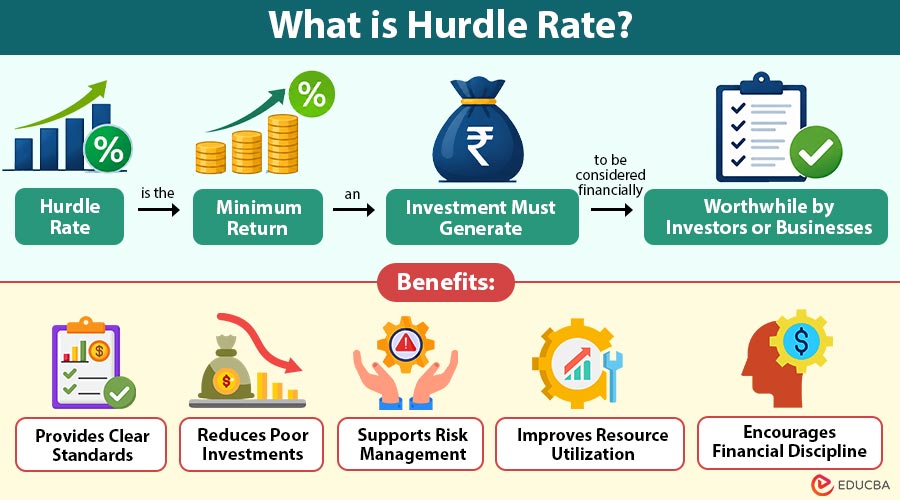
Hurdle rate is the minimum return an investment must generate to be considered financially worthwhile by investors or businesses.
Companies use this rate to evaluate investment opportunities and decide whether a project deserves financial support. It helps businesses compare expected returns with the minimum return they want to earn before committing their money.
For example, a company may set a hurdle rate of 12% for a new project. If the project is expected to generate a 15% return, it may be considered a suitable investment. However, if its expected return is only 9%, the company may reject it.
The rate generally depends on factors such as investment risk, financing costs, market conditions, and the company’s financial goals. A higher-risk investment usually requires a higher expected return to justify the additional uncertainty.
Table of Contents:
- Meaning
- Importance
- Working
- Formula
- How to Calculate Hurdle Rate?
- Types
- Examples
- Benefits
- Limitations
- Applications
- Difference
Key Takeaways:
- Hurdle rate establishes the minimum return required before businesses approve investment projects or opportunities.
- Companies consider financing costs, investment risks, and market conditions when determining suitable hurdle rates.
- Comparing expected returns with hurdle rates helps businesses allocate resources toward financially attractive investment opportunities.
- Regularly reviewing hurdle rates helps companies maintain realistic investment expectations as financial conditions change.
Importance of Hurdle Rate
A hurdle rate plays an important role in financial planning because it helps businesses evaluate investment opportunities before committing their resources.
The following points explain its importance:
1. Better Investment Decisions
It provides a clear financial benchmark, helping businesses compare investment opportunities and select projects that support their long-term financial objectives.
2. Risk Assessment
Companies can adjust the minimum expected return according to investment risk, ensuring that uncertain projects offer sufficient compensation for potential losses.
3. Efficient Capital Allocation
It helps businesses direct limited financial resources toward projects that offer better earning potential and support their overall growth plans.
4. Financial Planning
A predefined return requirement allows management teams to estimate investment performance and make more informed decisions about future spending.
5. Performance Evaluation
Businesses can compare actual investment returns with their original expectations to understand whether projects are delivering satisfactory financial results.
6. Cost Management
It encourages companies to consider borrowing expenses and other funding costs before approving projects that require significant financial investment.
How Does Hurdle Rate Work?
The hurdle rate works as a benchmark that helps investors and businesses assess whether an investment can deliver sufficient financial returns.
The process generally involves the following steps:
1. Set a Minimum Return
A company establishes the minimum return it expects from an investment based on its financial objectives, funding costs, and acceptable risk level.
2. Evaluate Investment Opportunities
The business estimates the expected return from each proposed project by examining its projected income, expenses, cash flows, and investment requirements.
3. Compare Expected Returns
The estimated return is compared with the established hurdle rate to determine whether investment meets the company’s financial expectations.
4. Make Investment Decisions
Projects that meet or exceed the required return may receive approval, while investments offering lower returns may be rejected or reconsidered.
5. Monitor Investment Performance
After approving a project, the company reviews its actual financial performance to check whether it continues meeting the expected return requirements.
Hurdle Rate Formula
Businesses use different financial methods to establish a hurdle rate depending on their investment requirements and risk considerations.
A common approach is to add a risk premium to the company’s cost of capital.
The formula is:
Where:
- Cost of Capital: The overall cost a company pays to obtain funds through debt and equity financing.
- Risk Premium: The additional return expected for accepting investment risks beyond the basic financing cost.
For example, suppose a company has a cost of capital of 8% and adds a risk premium of 4%.
= 8% + 4%
= 12%
Therefore, the company’s hurdle rate is 12%. Any proposed investment should generate at least this return to meet its minimum financial expectations.
How to Calculate Hurdle Rate?
Calculating the hurdle rate involves identifying the company’s financing costs and adding an appropriate premium for investment risk.
The following steps explain the calculation:
1. Identify the Cost of Capital
Determine how much the company spends on obtaining funds through different financing sources, including borrowed money and shareholder investments.
2. Assess Investment Risk
Examine the possible financial risks associated with the project, including market changes, competition, operational problems, and uncertainty in future cash flows.
3. Determine the Risk Premium
Assign an additional percentage based on the investment’s risk level and the extra return required to compensate for potential financial losses.
4. Apply the Formula
Add risk premium to cost of capital to establish the minimum return expected from the proposed investment.
5. Compare Investment Returns
Compare the calculated rate with the project’s expected return to determine whether the opportunity meets the company’s financial requirements.
Types of Hurdle Rate
Businesses may use different hurdle rates depending on their investment strategies, financial structures, and project requirements. The common types include:
1. Fixed Hurdle Rate
A fixed hurdle rate remains unchanged for a specific period, allowing companies to evaluate different investments using the same minimum return requirement.
2. Variable Hurdle Rate
A variable hurdle rate changes according to market conditions, financing costs, investment risks, or other factors affecting the expected financial return.
3. Risk-Adjusted Hurdle Rate
This rate considers the level of risk associated with an investment, requiring higher returns from projects involving greater uncertainty.
4. Project-Specific Hurdle Rate
Companies establish separate minimum return requirements for individual projects based on their expected cash flows, business objectives, and financial risks.
5. Weighted Average Cost of Capital-Based Hurdle Rate
This approach uses the company’s weighted average cost of capital (WACC) as a starting point and adds a suitable risk premium.
Examples of Hurdle Rate
The following examples explain how businesses and investors use hurdle rates when evaluating different financial opportunities.
1. Manufacturing Project
A manufacturing company sets a hurdle rate of 10% for a new production facility. Since the expected return is 14%, management considers approving the project.
2. Real Estate Investment
A real estate investor requires a minimum annual return of 12% before purchasing a commercial property. An expected return of 15% makes the opportunity attractive.
3. Technology Investment
A technology company evaluates a software development project with an expected return of 18%. Since its hurdle rate is 15%, the project meets expectations.
4. Business Expansion
A retail company plans to open another store and establishes a minimum return requirement of 11%. Its estimated return of 9% falls below expectations.
5. Equipment Purchase
A logistics company considers purchasing automated equipment that could improve operational efficiency. It approves the purchase because the projected return exceeds its 13% hurdle rate.
Benefits of Hurdle Rate
Using a hurdle rate offers several benefits when businesses evaluate projects and manage their investment decisions.
1. Provides Clear Standards
It establishes a minimum financial target, making it easier for management teams to evaluate opportunities using consistent investment performance expectations.
2. Reduces Poor Investments
It discourages businesses from accepting projects with insufficient expected returns, helping them avoid investments that may not justify their financial commitments.
3. Supports Risk Management
Adjusting the required return according to project risk helps businesses account for uncertainty before allocating substantial financial resources.
4. Improves Resource Utilization
Companies can prioritize projects with stronger return potential, allowing them to use available funds more effectively across different business activities.
5. Encourages Financial Discipline
A predefined return requirement encourages managers to examine project costs, expected earnings, and financial risks before requesting investment approval.
Limitations of Hurdle Rate
Although hurdle rates support investment decisions, they also have certain limitations that businesses should consider.
1. Difficult to Estimate Risk Premium
Determining an appropriate risk premium can be challenging because market uncertainty and project-specific risks are not always easy to measure accurately.
2. May Ignore Strategic Benefits
Some projects offer long-term advantages, such as customer loyalty or market expansion, which may not appear clearly in immediate financial return calculations.
3. Changes in Market Conditions
A hurdle rate established earlier may become unsuitable when interest rates, economic conditions, or financing costs change significantly over time.
4. Possibility of Rejecting Valuable Projects
Using an excessively high hurdle rate may cause companies to reject projects that could provide meaningful financial and strategic benefits.
5. Depends on Estimated Returns
The calculation relies on expected financial performance, which may differ from actual results because of unexpected expenses or changing market conditions.
Applications of Hurdle Rate
Hurdle rates are used across different financial activities to evaluate investment opportunities and support business planning.
1. Capital Budgeting
Companies use hurdle rates to evaluate long-term projects, such as purchasing machinery, building facilities, and expanding production capacity.
2. Private Equity
Private equity firms use minimum return expectations when assessing potential investments and evaluating whether businesses offer sufficient financial growth opportunities.
3. Real Estate Investment
Property investors compare expected rental income, property appreciation, and investment costs against their required return before purchasing properties.
4. Corporate Finance
Financial managers use hurdle rates when comparing investment proposals and deciding how to distribute available funds across different business projects.
5. Portfolio Management
Investment managers use required return benchmarks to assess investment opportunities and determine whether particular assets justify their associated financial risks.
6. Project Evaluation
Businesses compare projected project returns with established minimum requirements before approving new products, services, or operational improvements.
Difference Between Hurdle Rate and Required Rate of Return
The table below highlights the differences between the two:
| Basis | Hurdle Rate | Required Rate of Return |
| Meaning | Minimum return required to approve an investment. | Minimum return an investor expects from investment. |
| Main Purpose | Evaluates business projects and investment opportunities. | Determines whether an investment offers sufficient compensation. |
| Usage | Commonly used in capital budgeting and project evaluation. | Commonly used in investment analysis and valuation. |
| Risk Consideration | Includes project-specific risk and financing costs. | Reflects the investor’s expected return and associated risk. |
| Decision | Helps approve or reject proposed projects. | Helps investors decide whether to invest or hold an asset. |
Final Thoughts
A hurdle rate helps businesses evaluate investment opportunities by setting a minimum acceptable return. It supports better financial planning, risk assessment, and capital allocation. By comparing expected returns with this benchmark, companies can identify suitable projects and avoid investments that may not meet their financial objectives. However, businesses should also consider market conditions, strategic benefits, and long-term growth before making final investment decisions.
Frequently Asked Questions (FAQs)
Q1. What is a good hurdle rate?
Answer: A good hurdle rate depends on the company’s cost of capital, investment risk, industry conditions, and financial objectives. There is no single rate suitable for every business.
Q2. Who decides the hurdle rate?
Answer: A company’s finance team and senior management generally establish the hurdle rate based on financing costs, investment risks, market conditions, and business expectations.
Q3. Is a higher hurdle rate better?
Answer: A higher hurdle rate can provide greater protection against investment risk, but it may also cause businesses to reject projects with worthwhile financial and strategic benefits.
Q4. What happens when an investment fails to meet the hurdle rate?
Answer: An investment that falls below the hurdle rate may be rejected, reconsidered, or modified to improve its expected financial performance.
Recommended Articles
We hope that this EDUCBA information on “Hurdle Rate” was beneficial to you. You can view EDUCBA’s recommended articles for more information –